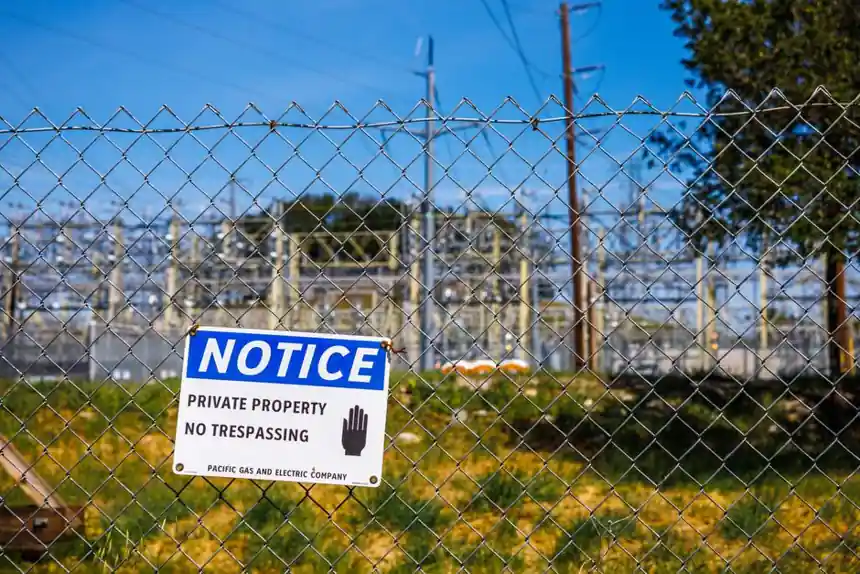
Open-path (line-of-sight) gas detectors along a perimeter fence are most commonly specified at 30-60 m beam lengths for IR and UV toxic detectors, with point toxic or combustible sensors behind them as gap-fillers, and with the beam axis set 0.3-1.0 m inside the fence line so the optical path does not see beyond the site boundary [S1][S5].
Fence-line gas monitoring is the perimeter layer of a fixed gas detection scheme: open-path devices (acoustic, IR, UV) cover the long runs of the boundary, while point detectors handle congested corners, gate houses and vent stacks. Selecting the right mix is driven by gas type, path length, ambient visibility and the response time the hazard analysis requires [S1][S2].
Why open-path, not just point detectors, on a fence line
Open-path detectors measure gas concentration across a single infrared, ultraviolet or acoustic beam, so one device covers a continuous strip of fence instead of a single point, which is why they dominate long, straight perimeter runs where point detectors would need to be installed every 9-12 m [S1][S5].
For personnel safety around a probable leak source, point detectors are typically placed no more than 5 m from that source because they only sense what immediately surrounds the head, but on a fence line the leak source is everywhere along the boundary, which is precisely the case where line-of-sight (LOS) devices pay for themselves [S2]. A typical open-path IR or UV detector such as the SafEye Quasar series is offered in path lengths up to 60 m for H2S and NH3 service, with heated optics to defeat condensation, snow and icing, and a SIL2 rating for the safety loop [S1]. For pressurised gas releases (compressed natural gas, methane, hydrogen at process pressure), acoustic detectors such as the Gassonic Observer-i give an omni-directional detection range up to 28 m, independent of ventilation, using an Artificial Neural Network to reject false alarms from compressors, flares and rain [S1].
Spacing rules and beam geometry on the fence
For open, flat terrain, the empirical rule of thumb for fixed gas sensor spacing is 9-12 m (30-40 ft) between point heads, but for an open-path beam on a perimeter fence the spacing is set by the optics: most IR/UV LOS detectors are sold with maximum path lengths of 30, 60 or 120 m, and the beam-to-beam pitch on the fence is set at roughly 0.8-1.0 times that rated path so adjacent beams overlap by 10-20% and a single plume cannot slip between two dead zones [S1][S5].
Mounting height is not arbitrary and is set by gas density, not by the fence height: for methane and hydrogen (lighter than air) the beam should sit on or near the upper fence rail, typically 2.0-2.4 m above grade; for H2S and NH3 in ppm ranges, the path is normally placed in the 1.5-1.8 m breathing-zone band so the measurement matches personnel exposure assumptions; for refrigerants and heavier hydrocarbons the beam drops to within 0.3-0.6 m of grade [S1][S5]. The same logic governs combustible gas detector selection: the sensing volume, not the fence height, defines where the optical axis must sit. Practical mounting notes from real perimeter projects include keeping posts independent of the fence fabric so wind-induced fence vibration does not modulate the beam, and using a visible aiming laser to align the transmitter and receiver at dusk when the dot is easy to see [S3].
Selection criteria: ultrasonic vs IR-DOAS vs UV open-path
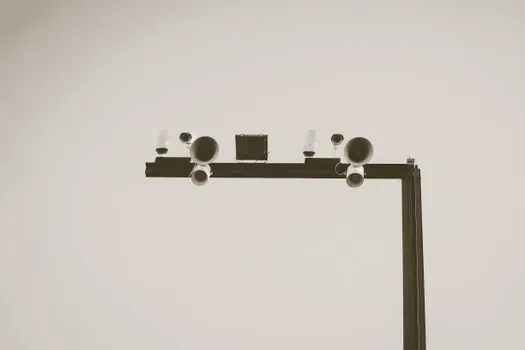
The three viable line-of-sight technologies for fence-line service diverge sharply on a few engineering axes, and the right pick depends on which axis is binding for the project [S1].
Acoustic (ultrasonic) detectors such as the Observer-i listen for the 25-80 kHz noise of a pressurised gas leak and do not require an optical path, so they are the only technology that works when fog, rain, sand or steam will kill an IR/UV beam, with a 28 m acoustic range per device and 360° coverage per head; they do not measure concentration in LEL or ppm, only that a release is happening [S1]. IR open-path detectors use Differential Optical Absorption Spectroscopy (DOAS) on a Xenon-flash beam, are sold for hydrocarbon gas service at typical 5-60 m paths, and provide a real ppm·m or LEL·m reading, but fail in heavy rain and direct sunlight unless the optics are filtered and heated [S1]. UV open-path detectors (SafEye Quasar 960 class) are restricted to gases that absorb in the ultraviolet, primarily NH3 and H2S, and quote 60 m paths with heated windows, sunlight immunity and 0-20 mA / HART / Modbus RS485 outputs, which makes them the workhorse for sour-gas and ammonia perimeters [S1]. A useful side-by-side table for a hazard analysis meeting is:
Acoustic: up to 28 m range per head, no ppm reading, weather-independent, ideal for compressor stations and well heads.
IR-DOAS: 5-60 m paths, ppm·m output, sunlight-tolerant, not for use in heavy precipitation without heated optics, ideal for LNG, NGL and hydrocarbon storage perimeters.
UV: 5-60 m paths, ppm·m output, sunlight- and flare-immune by design, gases limited to NH3 and H2S families, ideal for refinery and fertiliser fence lines.
For a wider design context, the same density-driven siting logic used for indoor point detectors (heavier-than-air propane near floor, lighter-than-air methane near ceiling, ppm toxins in the 4-6 ft breathing zone) should be re-applied to the beam height on the fence, or the device will read clean air even during a real release [S5].
Beam path planning: line of sight, weather and false alarms
A LOS beam is only as good as the air inside it, and three failure modes dominate fence-line service: beam blockage by vegetation or snow, beam deflection by thermal gradients just above black asphalt, and false alarms from solar radio-frequency interference, welding flashes and flare radiation [S1].
Heated optical windows, fitted as standard on the Quasar 900/950/960 series, defeat condensation, icing and snow accretion on the lens, and the same series is specified as totally immune to sunlight, arc welding and direct lightning exposure, which removes the most common nuisance-trip causes on outdoor fence lines [S1]. For long infrared perimeters, vendors also recommend using a pulsed Xenon-flash source rather than a continuous filament lamp so the receiver can lock onto the flash signature and reject steady ambient IR; this is the core trick behind the spectral-fingerprint DOAS technique used in the Quasar 900 hydrocarbon detector [S1]. As a separate (and complementary) perimeter measure, fence-mounted photo-electric beam detectors for intrusion are typically rated for 90 ft (27 m) or 660 ft (200 m) runs and rely on a clear optical path between two posts that are not physically tied to the fence, so fence vibration does not false the beam, a placement rule that transfers directly to open-path gas beams [S3].
Integration with the safety system and the wider perimeter
Open-path detectors are not a standalone perimeter; they hand a 4-20 mA, HART or Modbus RS485 signal into the same safety PLC or fire-and-gas controller that reads the indoor point detectors, and their alarm setpoints should be set in LEL·m or ppm·m, not in raw LEL or ppm, because the measurement is path-integrated [S1].
Most modern Quasar-class open-path detectors are SIL2 certified for the safety loop, which is the level typically required by IEC 61511 for a perimeter gas risk-reduction function, and they support HART for predictive maintenance data (window contamination, beam strength, alignment drift) so the same network that runs the fence can also predict a wash-window service before the beam starts to fail [S1]. For compliance-grade documentation the installer should keep the manufacturer's path-length certificate and the beam-alignment record on file, since coverage claims (60 m, 120 m) only hold when the optical path is unobstructed, vibration-isolated and within the device's alignment tolerance. A useful reference for the wider fixed-gas layout decision is the fixed gas detector and the gas detector entries on the encyclopaedia, which cover the point-sensor side of the same design problem.
Limits, failure modes and what line-of-sight cannot do
LOS detectors cannot grade concentration at a specific point, they return a path-integrated reading, so a small, very concentrated release on a 60 m beam can look the same as a moderately diffuse release and the alarm setpoint must be set so the worst case still trips within the required response time [S1][S5].
Physical-layer constraints also matter: outdoor posts must be stiff enough that a 30-60 km/h wind does not deflect the beam out of the receiver's field of view, and the alignment laser should be re-checked seasonally because even rigid posts settle, and the Quasar-class heated-window models are designed specifically to keep the optics serviceable across that same annual cycle [S1][S3].
Trackable signals for the next design cycle: vendor datasheet revisions for the Quasar 900/950/960 path-length certificates, updates to IEC 60079-29-4 for open-path performance under partial obscuration, and the migration of perimeter gas controllers from HART-only to native Ethernet-APL for the safety network, which would let beam-strength and window-contamination data sit on the same plant network as the perimeter alarm and safety fence layers.
For a related engineering perspective on perimeter device placement, this site's piece on industrial coating selection for corrosive plant equipment covers the same outdoor-fabric durability logic that applies to perimeter posts and brackets, and the enclosure-rating discussion in cable-laying vessel work offshore is a useful proxy for the IP rating decisions on a coastal fence line.