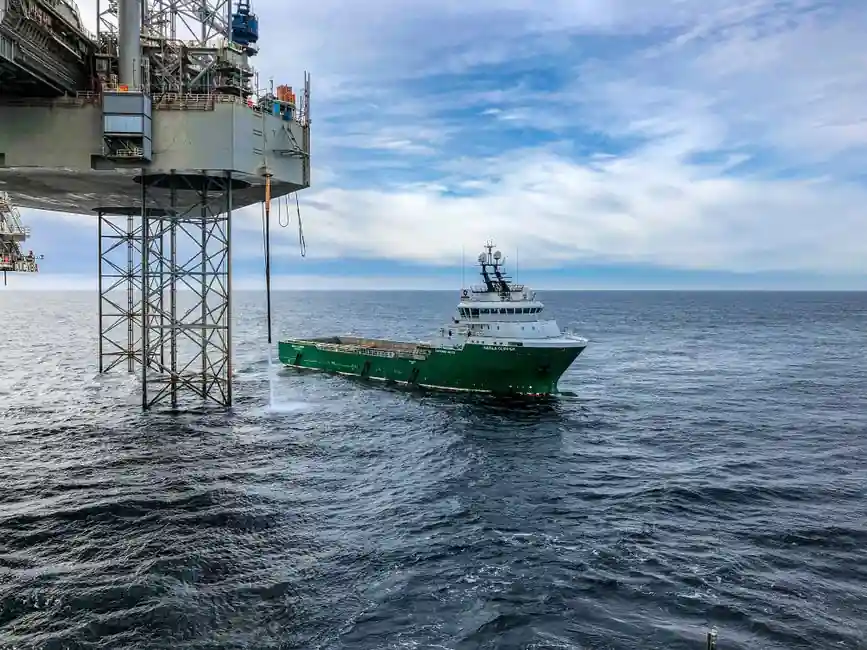
Only a little over 60 cable-laying, repair, and maintenance vessels operate worldwide, the majority of them aging, against a forecast offshore cable demand ramp from 1,932 km in 2020 to 18,173 km in 2028, a 9.5-fold increase driven mainly by offshore wind [S1][S2].
Specialised cable-laying day rates have moved from a USD 320,000–380,000 band in 2023 to USD 480,000–620,000 by May 2026, a price signal consistent with sustained capacity scarcity rather than a soft market [S6]. The dedicated cable-laying vessel segment is expected to account for 39.0% of the global market by share in 2026, with offshore wind farms taking a further 34.0% [S3].
Fleet capacity and the bottleneck behind rising day rates
Global cable laying vessel revenue is projected to grow from USD 2.15 Bn in 2026 to USD 3.80 Bn by 2033, a 4.3% CAGR, a modest top-line figure that masks a much tighter picture at the specialist-ship level [S3]. HVDC cable production at the three European leaders (NKT, Prysmian, Nexans, who together hold roughly 75% of the HVDC market) is fully booked into the late 2020s, pushing project developers to compete for a finite installation window on top of already constrained cable supply [S2]. The Jan De Nul Fleeming Jenkin, launched on 21 October 2025 with a 28,000-tonne loading capacity, is the world’s largest of its kind, a useful reference point for new-build scale but not a near-term capacity fix [S3]. For context on what these subsea conductors carry, see the power cable and shielded cable reference entries.
Where the demand is coming from: offshore wind, interconnectors, fibre
Annual offshore wind installation capacity has grown roughly 30% per year since 2019, and interconnector cable demand is on a similar upward slope as European projects extend to longer crossings [S1]. The 8,100 km Intra-Asia Marine Cable linking Japan, South Korea, Taiwan, the Philippines, Singapore, and Malaysia, formalised on 13 January 2026, illustrates how telecoms work is also competing for the same hull-days [S3]. Subsea power conductors for these grids are typically routed and protected as described in the cable gland and cable tray reference pages, which document the topside interfaces that vessel schedules must align with.
Selection pressure on vessels: capacity, water depth, control systems
Specifiers typically weigh five decision criteria when choosing a hull: carousel tonnage band (below 1,000 t up to above 7,000 t), water-depth rating split between shallow and deep, dynamic-positioning class, integrated burial tool, and on-board current-profile instrumentation [S4][S5]. DEME’s Viking Neptun, fitted with a Nortek VM Operations vessel-mounted ADCP, uses real-time current data through the water column to keep cable routing within tolerance, a configuration that directly extends cable service life by reducing lay-induced stress [S4]. The Nexus-class vessels, with 5,000-tonne carousels, sit in the mid-to-upper tonnage band most often quoted for European export-cable work [S7]. Operating limits and termination practices for the cables themselves are catalogued in the control cable and cable wire references.
What the constraint costs in schedule and risk
Vessel scarcity translates directly into project risk: lay windows slip, insurance premiums rise on HVDC work, and some developers are routing procurement to non-traditional factories to protect schedules, for example ZTT Submarine Cable in China supplying export cable for the Baltica 2 project offshore Poland, and two of three Seagreen 1 export cables sourced from the USA [S1]. The sum of cable scarcity, tight hull capacity, and the move to longer, higher-voltage HVDC links is the binding constraint flagged across both the supply-side and the financial analyst commentary [S1][S2][S6].
Who the shortage hits, and who it does not
European and North American offshore wind developers building 2027–2030 commissioning windows are the most exposed, because they depend on a small, mostly European owner pool and a cable-manufacturing base that is sold out [S2]. Asian-Pacific telecoms projects benefit from regional yards and a 31.0% 2026 share of vessel demand, the largest of any region, giving APAC operators shorter logistic loops for hull-days [S3]. Operators with existing charter optionality, long-term framework agreements, or equity in new-build hulls (Jan De Nul, DEME, Prysmian-linked operators) are best positioned to lock 2026–2028 lay windows; spot-market buyers should expect to clear at the upper end of the USD 480,000–620,000 band or wait.
Trackable signals to watch into 2027
Three verifiable signals will indicate whether the bottleneck is easing: (1) the in-service date of XLCC’s Hunterston export-cable plant, originally targeted to begin cable production in 2026, which would add UK HVDC output at a time the European order book is otherwise closed [S1]; (2) further newbuild deliveries in the 7,000 t+ carousel class, building on the Fleeming Jenkin’s 28,000 t reference, which would directly add installation throughput [S3]; (3) any softening of the USD 480,000–620,000 day-rate band through 2026, the cleanest read on whether fleet additions are catching up with the 9.5× cable demand ramp [S1][S6]. Track each against published quarterly operator reports rather than press releases.
For related coverage, see Fan Beam vs Cone Beam CT for Dense Parts: Spec-by-Spec Selection.