
Five core sensing families cover ~95% of 2026 industrial moisture analyzer quotations: loss-on-drying (LOD) with halogen or infrared heaters, near-infrared (NIR), radio-frequency (RF/capacitance), microwave resonant and process-in-line microwave or NIR probes — each defined by its sample form, contact distance and required accuracy window [S6].
Buying decisions in 2026 are increasingly driven by three trade-offs: lab vs inline, contact vs non-contact, and the cost gap between US$310 entry-level halogen units and 400 W quartz-heater bench models [S2][S3]. The same instrument class spans 0.001% laboratory resolution and 0.1% online repeatability on a moving powder bed — they are not interchangeable.
Define the moisture analyzer class by sample state and contact distance
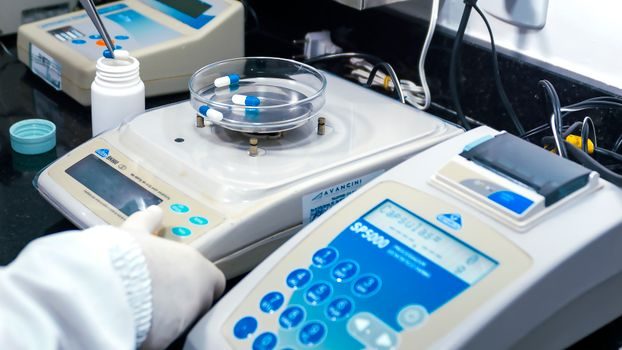
Halogen- and infrared-heated LOD bench units — including 400 W quartz-glass models with internal sequence memory [S2] — are the default for discrete 0.001 g–160 g samples in QC labs, with drying temperatures usually programmable from 40 °C to 200 °C and a backlit LCD readout [S2][S5]. These instruments measure mass loss under controlled heat, so they assume thermally stable, non-volatile samples; they are not a fit for products that oxidize, decompose or release plasticizer below 200 °C [S4].
For continuous in-process use, online moisture analyzers split into contacting probes (RF/capacitance, resistive) and non-contact probes (NIR, microwave resonant). Particle-handling designs such as the MicroPolar LB 56 series are built for solids, powders and bulk material on conveyors or in chutes, where contact geometry is the dominant error source [S1]. For gas streams, dedicated gas analyzers with moisture channels are usually a separate instrument class — the dew-point range, response time and hazardous-area certification differ from solids analyzers.
Match technique to the four typical industrial sample forms
Powders and granules (cement, flour, plastic pellets, detergent, fertilizer, food powders) are the dominant online target and are usually measured with NIR reflectance on a belt chute or with RF/capacitance probes inserted into the bulk — both approaches compensate bulk density by referencing mass flow from a linear guide-mounted carriage in some skid designs [S1][S6]. Pastes, slurries and creams favor NIR or microwave resonant, both of which read through a window and tolerate surface moisture films [S6].
Liquid process streams and solvents (paint, oil, glycol, biodiesel) are best handled by inline NIR or RF probes in a flow cell, not by LOD bench units — the LOD approach loses solvent long before the test finishes [S4][S6]. Bulk solids in bins and silos are a different problem: low-frequency capacitance and microwave transmission across the bin diameter are the two real options, with bin geometry and dielectric constant driving probe selection [S6]. Cosmetic and personal-care powders, where texture is part of the spec, are commonly shipped through makeup-process conveyor skids that include inline moisture measurement as a release parameter.
Selection criteria: a four-axis check before signing the PO

Axis 1 — accuracy window. Lab LOD instruments with 0.001 g readability and 0.01%–0.1% moisture repeatability dominate pharmaceutical, food and chemical QC [S2][S5]. Online NIR and microwave resonant instruments are typically specified at 0.1%–0.5% absolute moisture for process control; they trade laboratory precision for time resolution, which is the value the plant actually pays for [S6].
Axis 2 — sample mass and throughput. A 160 g capacity, halogen quartz heater, internal sequence memory and 17 mm backlit digit display is the typical 2026 mid-range bench spec [S2]. Low-throughput R&D or cosmetic labs that need fewer features but more portability often default to compact Ohaus-class MB27 units shipped from Guangdong, in the US$1,200 range ex-works [S5].
Axis 3 — output and integration. Modern bench analyzers expose USB, RS-232 and LIMS-friendly file output; inline analyzers expose 4–20 mA, Modbus TCP, EtherNet/IP or OPC UA, and require a documented MIB or AOI to integrate with a vibration analyzer-style asset-health dashboard [S1]. For OEMs, "for integration" is now an explicit catalog attribute on DirectIndustry listings, not a footnote [S1].
Axis 4 — calibration and service. Halogen and IR LOD units drift mainly through heater aging and balance contamination; the OEM service window for routine testing is generally quoted on a 6- to 12-month cycle with sodium tartrate dihydrate or similar certified reference materials. Inline NIR and RF probes drift from window fouling, material buildup and LED aging; the field service plan is a separate line item and usually includes at least one in-situ verification per year.
Halogen vs IR LOD vs NIR vs RF vs microwave: a criteria comparison
The five main options on a 2026 RFQ line up against four decision criteria as follows. Halogen LOD: high accuracy (0.01% range), slow (3–25 min/cycle), 40–200 °C programmable, best for QC labs [S2][S4].
RF/capacitance: contacting, dense-specific, robust on powders and slurries, calibration sensitive to bulk density, low cost per probe [S1][S6]. Microwave resonant: non-contact through a window or across a bin, excellent on high-moisture and coating-weight applications, more expensive electronics, less product-specific calibration work than NIR [S6]. For utilities and spectrum analyzer-adjacent test stands, microwave moisture heads can share a rack with general-purpose RF instrumentation; for routine lab work they are over-spec [S6].
Who a moisture analyzer is FOR — and who should buy something else

It is FOR: QC chemists running 10–200 samples/day on powders, granules, pastes and slurries where 0.01%–0.1% moisture is a release parameter; process engineers controlling a dryer, mixer, fluid bed or granulator in real time; and bulk-solids handlers with a crossed-roller guide-driven traversing carriage measuring moisture as a function of bin position [S1][S2]. It is NOT for: trace water below 1 ppm (use Karl Fischer coulometric titration), organic-solvent streams with low boiling points (LOD cannot complete the drying curve), and inline gas-pipeline moisture where a dedicated moisture analyzer dew-point meter or laser hygrometer is the right instrument family [S6].
A second pattern shows up in 2026 quotations: brand-name repackaging. Several Ohaus-class MB27 halogen units are now relabeled by Guangdong trading companies and shipped with near-identical firmware to OEM units; the on-paper 0.01% resolution is the same, but the heater warranty, the service network and the calibration-certificate chain are not [S5]. For regulated industries, the OEM service contract is part of the instrument, not a separate line item.
Failure modes, constraints and the 2026 service reality
Halogen and IR LOD instruments fail in three predictable ways: halogen lamp aging (output drops ~10% per 1,000 h, raising the measured moisture reading), balance drift from sample splash, and temperature uniformity loss from a dirty glass cover [S4]. Inline NIR fails first at the window (fouling, scratches, condensation), second at the lamp (typical service interval 12,000–20,000 h), and third at the calibration transfer between the bench unit and the probe [S6].
RF/capacitance probes fail on bulk-density change — a 5% density shift on the same product can shift the moisture reading by 0.3%–0.5% absolute unless the controller has a density compensation input from a load cell or a Coriolis reference [S6]. Microwave resonant probes tolerate density shifts much better but are sensitive to metal near the gap and to product temperature above ~80 °C; the spec sheet will list both limits explicitly [S6].
For 2026 procurement: budget a 4%–8% annual line item of the instrument purchase price for calibration consumables, reference materials and at least one preventive service visit, and require the vendor to provide a written measurement uncertainty budget for the actual product matrix, not for a generic water-in-methanol check. Food-industry users also need the analyzer's clean-in-place or wipe-down procedure documented against the actual line — a 160 g bench unit with a 400 W halogen heater is not a hygienic-design instrument, and any claim of "food-grade" must trace back to a specific surface-finish spec, not to marketing copy [S2].
2026 sourcing signals and what to track next
Two signals are worth watching through Q3 2026. First, the consolidation of NIR and RF product lines at the major weighing OEMs continues to push mid-range bench instruments into the US$2,000–US$4,000 band, with halogen-only units falling toward the US$1,000 mark at the entry level [S3][S5]. Second, the IndustryARC market analysis keeps NIR and RF as the fastest-growing online technique segments through 2026, while classical LOD remains the volume leader in unit count but flat in revenue [S6].
For an engineer writing a 2026 specification, the practical checklist is: pick the technique first (LOD for QC, NIR/RF for process), pin the accuracy window to the product spec (not the brochure), require a documented calibration transfer between lab and line, and treat the service contract as part of the instrument price. Inline particle-handling models like the MicroPolar LB 56 series are the bench mark for solids and powder integration in 2026, while compact halogen units in the US$1,200 range cover the small-lab use case [S1][S5].
For related coverage, see Thermal mass flowmeter buying guide 2026: inline vs insertion vs low-flow liquid.