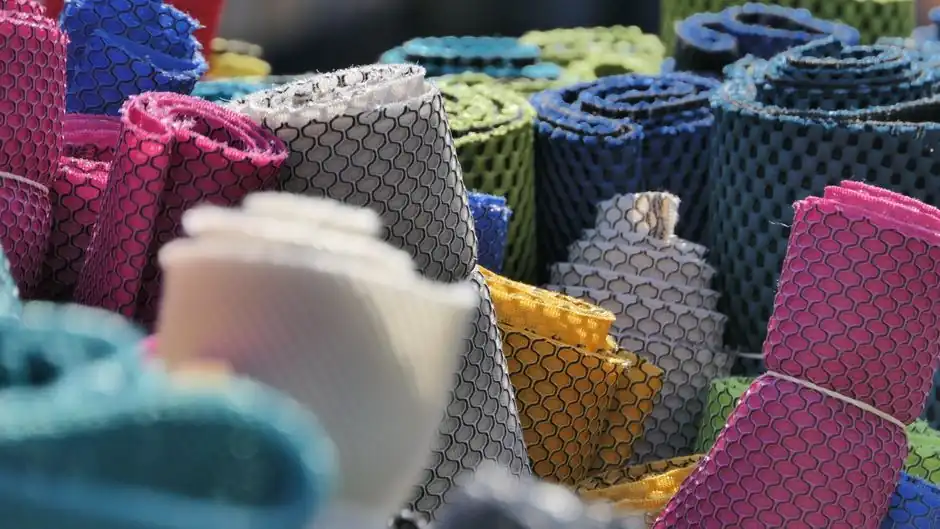
For general fabrication work, NBR is the workhorse elastomer whenever petroleum oil, diesel, gasoline, or grease contact is the dominant service factor, and the engineering decision reduces to one variable: acrylonitrile (ACN) content, expressed as a percentage of the polymer backbone [S3][S4].
The practical ACN range for stock NBR compounds runs 28–40%, with intermediate grades at 33–34% covering general automotive sealing [S3]. A 28–33% ACN grade keeps the seal flexible down to −40°C for cold-start duty, while 36–40% ACN holds volume swell under 15% in IRM 903 at 100°C for continuous hot-oil service [S3]. Outside petroleum media, NBR loses its advantage, and EPDM or silicone rubber takes over.
ACN Content as the Primary Selection Lever
Raising ACN tightens volume swell in ASTM Oil No. 3, synthetic ATF, and aromatic-rich fuels; reducing ACN drops the glass transition temperature and preserves low-temperature pliability [S3]. The polarity of the nitrile group resists non-polar hydrocarbon swelling, which is the chemistry that makes NBR the default oil-side elastomer and a poor fit for polar solvents, ketones, and brake fluid [S2][S3]. For a fabricator deciding between grades, the ACN number is set before any other additive is weighed, not after the fact [S3].
ACN selection rules of thumb documented for general fabrication: 28–33% ACN for fuel-filler gaskets and northern-climate transmission seals; 34% ACN for hydraulic O-rings balancing swell and cold-bend down to −30°C; 36–40% ACN for crankshaft and camshaft seals running 100–120°C continuous in mineral oil [S3]. This ACN-first workflow is the same one applied in adjacent NBR spec work, including the ACN/hardness/service-band map used in defense sealing NBR selection for defense.
Property Envelope for Stock NBR Sheet and Extrusion
Standard NBR sheet and extruded stock land in a 50–80 Shore A hardness band (±5), with the automotive comfort zone at 60–70 Shore A [S3]. Tensile strength on a general-purpose NBR compound is specified at ≥20 kN/m, elongation at break ≥300%, and tear strength ≥20 kN/m, values that hold across molded and extruded product forms [S3].
Hot-air aging at 100°C for 70 hours is the standard control test, requiring hardness change within ±8 Shore A and tensile retention ≥80% on the aged specimen [S3]. Low-temperature brittleness for the cold-side 28–33% ACN grades is rated at ≤−40°C per ASTM D746 [S3]. The combined envelope, −40°C to +120°C continuous service with the ACN split above, is what separates a fabricator's working grade from a catalog pick [S3][S4].
Material Comparison Against Common Alternatives

Against the four elastomers a fabricator is most likely to keep on the shelf, NBR scores well on oil/fuel and abrasion, average on weather and acid, and poorly on flame and steam, with a temperature window of −40°C to +120°C and a relative cost of $$ [S4].
For comparison, natural rubber runs −50°C to 70°C with excellent tear and compression set but poor oil/fuel resistance; EPDM runs −50°C to 150°C with excellent weather and steam but poor oil; neoprene (CR) runs −40°C to 120°C with balanced oil and weather performance; silicone (VMQ) runs −60°C to 230°C with excellent weather but only fair oil resistance [S4]. On cost alone, NBR sits in the same tier as EPDM and neoprene, below silicone, making it the value pick whenever the media is petroleum-based.
Where NBR Fits, and Where It Fails
NBR is the right call for engine oil seals, transmission seals, hydraulic O-rings, power-steering hose seals, fuel-filler gaskets, lubricated gearbox seals, pump diaphragms, and pneumatic actuator lip seals, in short, anywhere the contact medium is mineral oil, ATF, petroleum-based hydraulic fluid (HM, HV), or hydrocarbon fuel [S3]. It is also the standard pick for rubber trim exposed to oil mist in machinery enclosures, where its abrasion and tear resistance are equally relevant [S5].
NBR is the wrong call for outdoor weathering, ozone-rich environments, steam lines, hot water above ~100°C, aromatic solvents, ketones (acetone, MEK), strong acids, and brake fluid (DOT 3/4/5.1 glycol-ether based) [S2][S3][S4]. For steam, potable hot water, or weather-exposed seals, EPDM is the correct substitute; for high-temperature dry-heat sealing above 150°C, silicone or FKM (Viton) is the correct substitute [S4]. Specifying NBR where any of these media dominate is the most common premature-failure mode in general gasket work [S4].
Hardness, Pressure, and Mechanical Trim
For fabricated gaskets, O-rings, and seals in hydraulic circuits, operating pressure sets the durometer target. Pressures up to ~10 bar generally accept 50–70 Shore A; 10–25 bar typically needs 70–80 Shore A; above 25 bar the spec usually shifts to 80–90 Shore A or fabric-reinforced NBR to resist extrusion into the bore [S3][S4].
When chemical exposure is combined with elevated temperature, the effective continuous limit drops further, and the standard fabricator practice is to derate by 15–20°C below the published maximum before selecting the compound [S4]. A 100°C oil-service NBR rated to 120°C in clean air is a different working envelope from a 100°C NBR running in oil with a 5% water phase; treat the published number as a ceiling, not a steady state.
Standards, Compliance, and Test Methods
For general fabrication, the controlling test methods are ASTM D746 for low-temperature brittleness (the −40°C rating cited above), ASTM Oil No. 3 / IRM 903 immersion for volume-swell control, and the 100°C × 70 h hot-air aging check for aged-property retention [S3]. These are the same references a fabricator or compound supplier should cite on a certificate of conformance for any lot going into automotive, hydraulic, or industrial sealing duty.
For applications tied to food-contact or potable-water service, NBR is not the default, and an EPDM or silicone grade with explicit FDA or WRAS approval is the correct substitute, since NBR's polar backbone does not provide the inertness those approvals require [S4]. For general industrial fabrication where the medium is petroleum and the temperature stays between −40°C and +120°C, NBR remains the lowest-risk, lowest-cost, and most readily stocked elastomer on the shelf.
Trackable signals to watch on the next sourcing cycle: lot-level certificates confirming ACN percentage and ASTM D746 brittleness rating, especially for any 28–33% ACN stock destined for cold-climate fuel-system service, and confirmation that the published 120°C ceiling is being derated for any application combining heat with water or aggressive additive packages.
For component-level specifications, see nitrile rubber.