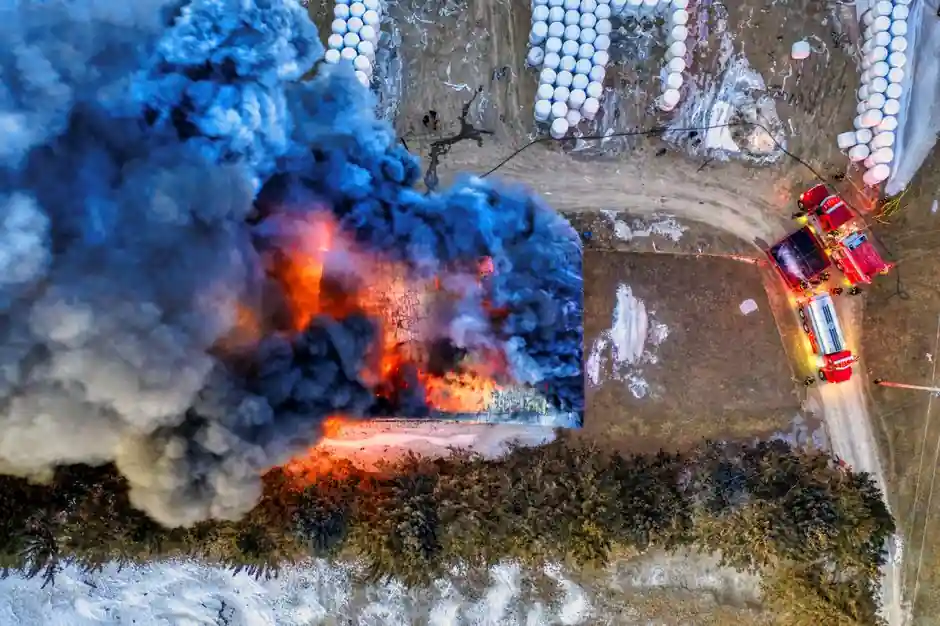
NFPA 652 mandates that every Dust Hazard Analysis (DHA) be reviewed and updated at least once every five years, with the initial September 2020 deadline producing the first revalidation cycle in 2025 [S1][S2][S3].
That five-year window is the floor, not the ceiling: a DHA must also be redone whenever new processes, equipment, or raw materials are introduced, even well before the next scheduled cycle [S1][S4][S5]. Facilities that treat the five-year tick as a passive calendar item rather than an event-driven obligation are the ones that show up in CSB incident reports.
Why the 5-Year Clock Exists Under NFPA 652
NFPA 652, Standard on the Fundamentals of Combustible Dust, sets the minimum general requirements for managing fire, flash fire, and explosion hazards across all facilities that manufacture, process, blend, convey, repackage, generate, or handle combustible dusts or particulate solids [S1]. The standard's purpose is threefold: protect people from flash fires and explosions, limit consequential damage so the facility stays operable, and shield adjacent buildings, enclosures, and emergency life-safety systems [S1].
The DHA itself is the tool that operationalises those objectives, a systematic, facility-wide assessment used to identify and evaluate potential fire, flash fire, and explosion hazards associated with combustible dusts across processing equipment, material handling systems, and building spaces [S5]. A five-year revalidation is built into the standard because combustible-dust incidents have a long statistical tail: the U.S. Chemical Safety Board's 2006 Combustible Dust Hazard Study recorded 281 incidents, 119 fatalities, and 718 injuries across 44 states over the 1980 to 2005 period [S5].
Triggers That Force an Off-Cycle DHA Update
The five-year cycle is the minimum revalidation interval, and NFPA 652 also requires a DHA whenever the process or facility changes in ways that can shift dust accumulation, ignition sensitivity, or confinement. Common event-driven triggers include: new raw materials or new suppliers, new equipment or process installations, expansions or upgrades to existing installations, and changes in material suppliers that alter particle-size distribution or moisture content [S3][S4][S5].
NFPA 652 explicitly requires a DHA for "all new installations or expansions/upgrades to existing installations", and a separate DHA update is called for whenever a new process or facility compartment is added, not just at the five-year mark [S3][S4]. This dual-trigger structure is why compliance teams schedule DHAs against both a calendar and a change-control register.
What the DHA Itself Must Cover
A compliant DHA evaluates each process compartment for credible fire, flash fire, and explosion hazards, then produces an actionable mitigation plan covering equipment layout, ignition-source control, housekeeping, and protective measures such as explosion protection or suppression [S1][S2]. The standard recommends (but does not strictly require) that the DHA be carried out by a multi-disciplinary team, with plant engineers, EHS personnel, and plant management most frequently involved, and led by a qualified person [S3].
Importantly, the DHA does not test your materials for combustibility. Combustibility screening, including Go/No-Go explosibility tests and the explosion-severity parameters (Kst, Pmax) and ignition-sensitivity parameters (MEC, MIE, MIT cloud/layer) that feed the DHA, must be obtained from an accredited laboratory beforehand [S1][S5]. Around 70 percent of dusts can create an explosion given the right ignition source and environmental conditions, so a "we don't handle combustible dust" assumption is itself a hazard [S2].
NFPA 652 vs NFPA 660: Where the Rule Now Lives
NFPA 652 is the umbrella "fundamentals" standard, but it sits alongside commodity-specific standards, NFPA 61 (agricultural and food products), NFPA 484 (combustible metals), NFPA 654 (manufacturing), and others, that govern the same DHA obligation for specific dust classes [S3]. NFPA 660 consolidates the combustible-dust safety standards and now carries the same DHA revalidation language, with the same five-year revalidation requirement and the same event-driven triggers [S5].
For compliance planning, that means a single DHA cannot satisfy the standard for two different commodity classes: a food-grain facility references NFPA 61 in addition to 652, while a metal powder operation references NFPA 484, and both must be revalidated on the same five-year clock unless an off-cycle trigger fires sooner [S3].
Selection Criteria: How to Schedule the Next DHA
Decision criterion 1: Time elapsed since last DHA. If the last DHA is older than 5 years, the revalidation is overdue and a new one is due now; the first revalidation cycle for the original 2020 cohort closed in 2025 [S2]. Decision criterion 2: Change-control events since the last DHA. If any new raw material, supplier, equipment, or process compartment has been introduced, a new DHA is required even inside the five-year window [S3][S4][S5]. Decision criterion 3: Hazard severity class. Facilities handling high-Kst dusts (e.g. aluminium, magnesium, some organic pigments) or dusts with low MIE benefit from shorter revalidation intervals (e.g. 2 to 3 years) as a matter of engineering judgement, not because the standard compels it. Decision criterion 4: Lab data currency. The DHA draws on Kst, Pmax, MEC, MIE, and MIT cloud/layer values from a competent laboratory; if those values are older than five years, or if the powder source has changed, re-testing is required before the DHA can be revalidated [S1][S5].
Limits, Failure Modes, and Common Compliance Gaps
The most common failure mode is treating the five-year revalidation as a paperwork exercise rather than a re-examination of the process. A second, more dangerous failure mode is running the DHA without current laboratory data, so the Kst and MIE values used in the hazard assessment no longer match what is actually being handled. A third gap is scope: NFPA 652 requires the DHA to cover all facility compartments, not just the obvious high-dust units, and a partial DHA (e.g. dust collectors only, ignoring sifters, dryers, hoppers, and packaging) does not satisfy the standard [S1][S2].
Housekeeping is the other recurring gap. The standard does not ban brooms outright, but compressed-air blowdown and ordinary shop vacuums are widely flagged as incompatible with combustible-dust housekeeping because they create dust clouds, which is one of the five conditions in the dust explosion pentagon [S2]. Combustible-dust-certified industrial vacuums are the usual specification for routine cleaning, with the DHA determining the frequency and zoning [S2][S3].
Compliance Documentation the AHJ Will Ask For
Authorities Having Jurisdiction (AHJ), which include OSHA, insurance providers, facility safety personnel, and fire marshals, expect the facility to hold: a current DHA report with the date of the most recent revalidation, laboratory test data supporting the Kst, Pmax, MEC, MIE, and MIT values used, a written mitigation plan with assigned actions, and a change-control log showing which process events triggered interim updates [S3][S5].
NFPA 652 also cross-references the International Building Code (IBC), which incorporates sections of NFPA 652 and the commodity-specific standards for area classification, equipment selection, and building separation requirements [S4]. For dust-handling equipment selection, the dust collector and adjacent detection or monitoring gear should be specified against the DHA's hazard zoning, not against a generic catalogue page.
Trackable Signals for the Next Compliance Window
Two signals to monitor through the rest of 2026: first, the next five-year revalidation cohort lands in 2030, but any facility that introduced a new raw material, supplier, or process compartment since 2025 is already inside the off-cycle trigger window and should revalidate now [S2][S5]. Second, NFPA 660 is the consolidation document going forward, so any new citations from an AHJ are likely to reference NFPA 660 rather than NFPA 652, but the five-year revalidation rule and the event-driven update triggers carry over unchanged [S5].
Spec-level background on the components involved: dust detector, and dust particle meter.
Related analysis: DIN 22102 W vs X vs Y vs Z cover grades: spec decision map.