O-rings in 2026 industrial catalogs span bore diameters of 3 mm to 230 mm (OD up to 250 mm) and survive -150 °C to 250 °C (-238 °F to 482 °F) depending on elastomer selection [S1][S3]. The geometry is fixed — a torus in a rectangular or circular cross-section — but the elastomer compound, the addition of guide or back-up rings, and the static-vs-dynamic mounting decide where each O-ring actually runs.
Across 135 manufacturers and roughly 390 catalog listings on DirectIndustry, the product is classed under the O-ring family as Type O-ring, with sub-variants covering piston seals, rod seals, EMI-shielded seals, and rectangular-cross-section rotary face seals [S5]. Two reference points anchor this map: the KASTAS K16 compact piston seal (NBR/steel, 17–230 mm bore, 400 bar max) [S1] and the Dichtomatik K70 piston seal (bronze/NBR/PTFE composite, -150 °C to 250 °C, 160–400 bar) [S3].
Static vs Dynamic O-Ring Service
Static O-rings run in axial or radial compression between two non-moving faces and see no friction energy input; their failure mode is compression set, chemical attack, or extrusion into clearance gaps, and the catalog mark is "static, hydraulic" [S1]. Dynamic O-rings see reciprocating or rotary motion — the CinchSeal 7520 is a rectangular-cross-section rotary face seal that runs in air at 5–7 PSI purge above vessel pressure to keep a positive seal on shaft diameters of 3–8 mm (0.118–0.315 in), with a 400 °F (204 °C) FDA-silicone element [S2].
Selection rule of thumb: at sliding speeds above 0.5 m/s, a back-up ring or composite design (NBR energiser + PTFE/bronze face) is mandatory, because pure elastomer loses seal integrity from frictional heat. The Dichtomatik K70 covers 0.5 m/s to 15 m/s (1.6 ft/s to 49.2 ft/s) only because the KPOR-series combines a PTFE-bronze sealing element with an NBR O-ring that serves as the pre-tensioning element [S3].
Material Selection Matrix and Operating Windows
Five elastomer families dominate the catalogs: NBR (nitrile), FKM (fluorocarbon), EPDM, silicone, and PTFE composites. NBR is the default hydraulic fluid seal — K16 NBR holds -30 °C to 105 °C (-22 °F to 221 °F) up to 400 bar [S1]. Silicone extends the high-temperature end; the CinchSeal 7520 FDA-grade silicone runs continuously at 204 °C (400 °F) and is specified for direct food-contact rotary shafts [S2].
For cryogenic and high-temperature process lines, the K70 NBR/PTFE/bronze compound reaches -150 °C (-238 °F) on the low end and 250 °C (482 °F) at the high end — the broadest published band in the surveyed catalogs [S3]. EMI-shielded and conductive O-rings, such as the GETELEC GT3100 with graphite-filled silicone, cover -55 °C to 150 °C (-67 °F to 302 °F) and are specified for EMC conduit gaskets in electronic and railway equipment [S6].
Cross-Section and Geometry Variants
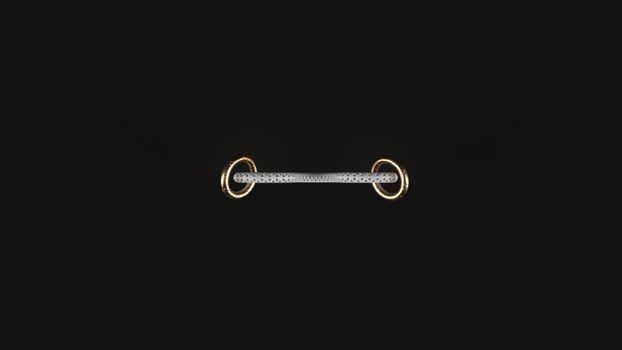
The classical O-ring is a circular cross-section torus. Catalog listings also show rectangular cross-section (CinchSeal 7520, 3–8 mm ID, OD 4.7–11.4 mm), which converts the O-ring into a face seal that rides on a rotor [S2]. Compound names like X-ring, D-ring, T-shaped, U-shaped, and tadpole describe the same elastomer family in non-circular profiles and are used to reduce friction in reciprocating motion or to act as flange gaskets [S6].
For reciprocating pistons and rods, the O-ring is almost never used bare at high pressure; the K16 stacks a fabric-reinforced elastomeric sealing element with two thermoplastic back-up rings to prevent extrusion into the cylinder clearance, while the K70 uses a PTFE-bronze sliding element pre-loaded by an NBR O-ring [S1][S3]. These "compact seals" carry an O-ring sub-component but are sold as piston- or rod-seal assemblies — a distinction buyers must keep straight when sourcing spare parts.
Pressure, Speed, and Clearance Limits
Pressure capability in the surveyed catalogs spans 0 bar to 400 bar (0 to 5,801.5 psi) for compact O-ring piston seals [S1][S3]. Pure elastomer O-rings without back-ups are typically derated to about 10–20 bar in dynamic service and 50–100 bar in static gland service, though specific values are not listed in the supplied data. The K70 explicitly publishes 160 bar minimum (2,320.6 psi), indicating the lower bound for the composite design in mobile hydraulics [S3].
Speed and pressure interact: at 15 m/s (49.2 ft/s) the K70 is only rated at its lower pressure band, while the K16 is rated 0.5 m/s at 400 bar [S1][S3]. For rotating shaft sealing, the CinchSeal design avoids high sliding speed by replacing sliding contact with a rotor/stator face seal, then air-purging the housing at 5–7 PSI above vessel pressure to maintain a positive barrier against slurry leakage [S2].
Application Map: Where Each Type Runs
Mobile hydraulics, agricultural machinery, construction machinery, injection-molding machines, and presses all use piston-seal assemblies with an O-ring sub-component, with the K70 explicitly listed across all five [S3]. Mining, marine hydraulics, iron-and-steel plants, and heavy presses use the K16 with its fabric-reinforced element for high wear resistance and stick-slip-free standby [S1].
Rotary applications split into two camps. Slurries, abrasives, and food-grade powders run the CinchSeal 7520 rectangular-face O-ring on shaft diameters 3–8 mm, purged with 5–7 PSI air [S2]. Lubricating-oil and transmission shafts run conventional round O-ring kits such as the Timken line, sold in inch and metric sizes for vehicle and mechanical-component duty [S4]. EMI and RFI shielding in electronic enclosures, automotive electronics, railway, and medical equipment is the GT3100 territory, with graphite-filled silicone profiled into U, T, X, D, and tadpole cross-sections [S6].
Compatibility and Sourcing Constraints
For static hydraulic and pneumatic glands, a standard NBR O-ring with a Shore A hardness around 70 is the default and the cheapest stocked part. For dynamic reciprocating duty above 0.5 m/s, or for temperatures outside the NBR window, the buyer must move to composite (NBR + PTFE/bronze), silicone, or FKM — and the price moves with the material, not the geometry. Hardness is published for the GT3100 (Shore A scale, filled silicone) but not for the K16 or K70 in the supplied data [S1][S3][S6].
One sourcing caveat from the Dichtomatik catalog: their K-series piston seals are "suitable for many applications excluding safety-critical ones like Automotive," and the catalog refers buyers to Freudenberg premium products for safety-critical duty [S3]. Buyers specifying O-rings for aerospace, automotive brake systems, or medical implants should therefore confirm the material batch certification, hardness, compression set, and traceability — not just the temperature and pressure band on the catalog card. The Apple Rubber Products site (seal-design.com) lists MicrOrings, MacrOrings, EMI-shielded seals, and composite seals as separate product lines, indicating the breadth of micro- and macro-scale custom work the O-ring geometry supports in 2026 [S7].
Selection Checklist and Failure Modes

For a working spec, the buyer needs to lock five numbers before selecting an O-ring or O-ring-based compact seal: (1) media and chemical compatibility, (2) temperature min and max, (3) pressure min and max, (4) sliding or rotating speed, and (5) gland clearance plus surface finish. The KASTAS K16, Dichtomatik K70, CinchSeal 7520, GETELEC GT3100, and Timken kit each publish at least four of these five [S1][S2][S3][S4][S6].
Common failure modes — extrusion into clearance, compression set at high temperature, chemical swell in aggressive media, spiral failure in reciprocating motion, and explosive decompression in high-pressure gas — are all mitigated by the catalog design choices above: back-up rings, PTFE/bronze composites, silicone for high-temp food service, and graphite-filled compounds for conductivity [S1][S2][S3][S6]. The MISUMI catalog re-frames the same set as "O-Rings for Dynamic Applications, P Series" in EPDM, FKM, NBR, and silicone — confirming that compound choice, not cross-section, is the primary spec lever for dynamic O-ring service [S9].
Track the next catalog refresh on DirectIndustry for K-series piston seals (Dichtomatik/S1) and the Timken O-Ring Kit coverage tables (S4); the MISUMI P-series listing (S9) is the cleanest public reference for the four standard dynamic-seal elastomers in 2026.
Component reference pages worth checking: retaining ring, and slewing ring bearing.
See also our earlier report, Aluminum Sheet Suppliers 2026: China Capacity, Alloy Bands, and Sourcing Map.