Spec the seal from four anchors before the part number: shaft diameter, bore diameter, width, and a material rated for the media and temperature. Standard metric rotary oil seals follow ISO 6194 / DIN 3760 with a Shaft ID x Bore OD x Width callout, e.g. 20 x 47 x 7, so the drawing line and the bin label read the same way [S1][S5].
Skip the cross-reference until the four anchors are locked. The wrong size leaks inside a week, the wrong material delaminates in three months, and the wrong lip design lets dust past a single sealing edge in any drivetrain exposed to splash, grit, or road debris [S1][S3][S5]. Engineers who start at the cross-reference table are the ones who call back for warranty.
Step 1: Lock the Three Dimensions and the Designation Format
Inside Diameter (ID) is the shaft size, Outside Diameter (OD) is the housing bore, and Width (W) is the seal thickness, and the metric designation reads ID x OD x W in millimetres. Imperial seals invert the convention: the leading number is the OD, the middle is the ID, the last is the width, so 300 212 37 decodes to 3 in OD, 2 1/8 in ID, 3/8 in W [S5].
Common ISO 6194 / DIN 3760 sizes in the American Rubber Corp reference table start at 10 x 22 x 7 mm and step up through 12 x 24 x 7, 15 x 30 x 7, 17 x 30 x 7, 20 x 35 x 7, 22 x 40 x 7, 25 x 40 x 7, 28 x 47 x 7, 30 x 47 x 7, 32 x 52 x 8 mm [S1]. These stock profiles cover the majority of pumps, gearboxes, and small electric motors; anything outside that envelope usually means a custom tool.
Step 2: Match the Lip Design to the Contamination Profile
Single-lip seals (code SC / R21) carry one sealing edge to retain oil and are the default for moderate-speed, clean-side applications such as pumps, gearboxes, and standard motors. Double-lip seals (code TC / R23) add a secondary dust lip and are the default for automotive drivetrains, wheel bearings, hydraulic cylinders, and any equipment exposed to splash or airborne grit [S5].
Cross-reference a TC (double-lip) into a housing originally machined for an SC (single-lip) only after confirming the extra width fits the bore depth; a 7 mm groove that takes a 9 mm TC will not bottom out and the secondary lip will preload against the shaft. Conversely, an SC slipped into a wheel-bearing bore fails fast, because the dust side has no defence at all [S5].
Step 3: Pick the Elastomer for Media and Temperature

NBR (nitrile) is the workhorse for petroleum oils at roughly -40 to 120 °C. FKM / Viton covers higher temperatures, typically up to about 200 °C, and resists aggressive synthetics. EPDM is reserved for brake fluid, steam, and water-based fluids where NBR and FKM both fail. Silicone, HNBR, FFKM / Kalrez, neoprene, SBR, TPV / Santoprene, AFLAS, and PTFE each fill a narrow window for specialty media [S1][S3].
A frequent buyer mistake is specifying FKM for a glycol-based coolant or for phosphate-ester hydraulic fluid; both attack FKM. For those fluids, EPDM (coolant) or a PTFE seal with a stainless garter (phosphate ester) is the correct call, not an upgrade in durometer [S3][S5]. Viton and silicone are not interchangeable: silicone wins on cold flexibility and food/dairy compliance, but has poor abrasion resistance and is usually wrong for a rotating shaft seal [S3].
Step 4: Verify the Shaft Itself Before Pressing the New Seal In
Recommended shaft surface finish is 0.2 to 0.8 µm Ra: smoother than that and the lubrication film starves, rougher than that and the lip wears in. Insufficient hardness below the recommended case depth scores a wear groove in the shaft within a few hundred hours, and no elastomer upgrade will compensate once the groove is cut [S5].
Oscillating shafts, such as a saildrive shift selector, can wear a localised groove even at low stroke counts; the symptom is a leak that reappears weeks after the seal is replaced. The fix is to inspect the shaft under a light, measure the groove with a dial indicator, and either sleeve the journal or replace the shaft before fitting a new seal, otherwise the replacement fails on the same duty cycle [S4]. A seal pick or a small self-tapping screw is the right tool to extract the old seal from a blind housing; prying against an aluminium casting damages the bore and forces a housing replacement [S4].
Oil Seal vs O-Ring: When the Wrong Part Sneaks Onto the Drawing
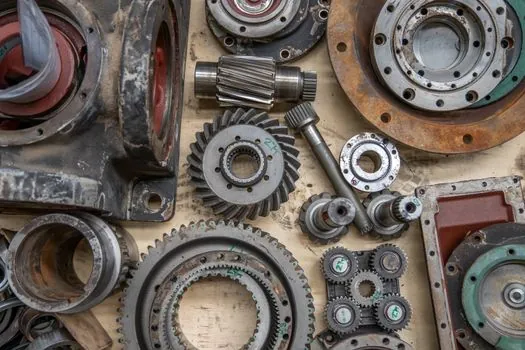
Oil seals (also called shaft seals or rotary shaft seals) are built for a rotating shaft, with a metal case and an elastomeric sealing lip that rides the journal. O-rings are static or slow-motion gaskets, usually seated in a gland, used on pipe connections, flanges, and hydraulic cylinders [S3].
Use an oil seal where a shaft passes through a housing and lubricant must stay inside or contaminants must stay outside. Use an O-ring where two mating faces clamp a groove under bolt load. A common error is substituting an O-ring on a rotating shaft; the O-ring has no hydrodynamic lip geometry, no garter spring, and no dust side, so it leaks within hours at any meaningful shaft speed [S3]. Conversely, forcing a TC double-lip oil seal into a static face seal wastes space and traps a lubrication film that the static joint does not need.
Selection Criteria Compared: NBR vs FKM vs PTFE
Three materials cover the majority of industrial seal specs. NBR (nitrile) is the lowest-cost option, rated to about 120 °C in petroleum oils, with good abrasion resistance but poor ozone and weather resistance. FKM (Viton-class) extends to roughly 200 °C and resists a wider chemical set, at 3 to 6 times the unit cost of NBR. PTFE seals handle the highest temperatures (often above 200 °C with the right filler) and the most aggressive media, run dry without a garter spring, and tolerate surface speeds well beyond elastomer limits, but require a tighter housing tolerance and careful installation to avoid lip set [S1][S2][S3].
Use the comparison as a rule of thumb: spec NBR for general-purpose gearboxes and pumps under 120 °C; spec FKM for under-bonnet, hot oil sumps, and most synthetic lubricants; spec PTFE for chemical duty, dry-running applications, or peripheral speeds beyond 15 m/s where elastomer heat build-up becomes the failure mode [S2][S5]. PTFE is also the correct fallback when an engine has been re-engineered for higher specific output and the original NBR seal no longer survives the oil-temperature envelope.
Cross-Reference Without Buying the Wrong Part
The correct sequence for an interchange is: identify the original brand code or style if it is on the old seal; use the interchange table to find likely equivalents; then verify the shaft, bore, and width on the actual housing before ordering [S6]. A 20 x 47 x 7 metric from one supplier and a 20 x 47 x 7 from another are dimensionally the same but can differ in elastomer, lip geometry, and the presence or absence of a dust lip, so the part-number match is a starting point, not a final answer [S1][S6].
For engine overhauls, the most frequently replaced Elring shaft seals in the Wilmink catalogue cover crankshaft front and rear positions across Mercedes-Benz, BMW, VAG, PSA, Renault, Ford, GM, and Volvo applications, with nine part numbers covering the majority of passenger car and light commercial jobs [S2]. Sourcing those by vehicle application, not by generic size, is the only way to land the correct OD and the correct rotation sense (some seals are handed) on the first order [S2].
When an Oil Seal Is the Wrong Component
Do not pick a standard oil seal when the duty is high pressure above roughly 0.5 bar differential, when shaft speed exceeds the material's peripheral limit, or when the media attacks every common elastomer. In those cases, the correct parts are a mechanical seal for pump shafts, a bellows seal for thermal-expansion duty, or a cartridge seal assembly for severe chemical service. If the application is static and the gland is already machined, an O-ring or an oil seal bonded variant is usually cheaper and more reliable than forcing a rotary seal into a non-rotating joint [S3].
Track these signals over the next two purchasing cycles: tighter stock-holder stocking of FKM and PTFE profiles for hot-oil and chemical service, and more cataloguing of double-lip TC variants as the default wheel-bearing and gearbox choice. Buyers who standardise on NBR for everything they touch will keep paying the leak rate, and buyers who spec PTFE universally will keep paying the unit cost; the win is matching the elastomer and lip code to the four anchors before the part number leaves the desk. For adjacent sealing decisions, the same spec-first logic used in gland packing selection applies to rotary seals: anchor on duty, then material, then part number.