
For clean single-phase flow in steam, gas, and water lines, the two workhorse technologies are the orifice plate flowmeter and the vortex flowmeter; the former is a differential-pressure (DP) primary element, while the latter is a shedding-body frequency device, and that single distinction drives nearly every other spec difference.
Selection falls along three axes: the governing standard (ISO 5167 for orifice plates vs no equivalent custody standard for vortex), the output signal type (analog DP vs linear pulse/frequency), and the operating turndown (roughly 4:1 for an orifice vs 10:1 to 20:1 for a vortex body). When the process is wet steam, superheated steam, or a clean gas with Reynolds number above roughly 10,000, the decision matrix below separates the two cleanly.
Operating Principle and Governing Standard
An orifice plate flowmeter is a concentric thin-edged plate clamped between flanges; flow contracts through the bore and the resulting pressure drop is measured across the upstream and downstream taps, with discharge coefficient, expansibility, and density all factored into the mass flow equation per ISO 5167-2 (2022) for the plate geometry and ISO 5167-1 (2022) for the general calculation. [S2]
Because the output is frequency, the meter is inherently digital at the sensor and only the transmitter stage converts it to 4-20 mA or HART.
The standard split matters in custody work: ISO 5167-2 (2022) defines beta ratio limits, tap locations (corner, D and D/2, flange), plate thickness, and the empirical Reader-Harris/Gallagher (2008) discharge coefficient equation, so an orifice plate reading on a steam header can be traceable to a national standard, while a vortex meter in the same line is generally a process measurement, not a custody one.
Rangeability, Accuracy, and Repeatability
[S1]
Vortex flowmeters in industrial steam and gas service are specified at ±0.75% to ±1.5% of rate with repeatability around ±0.2% of reading, and a turndown of 10:1 (some vendors rate 15:1 to 20:1 with low-flow cut-off enabled) because the Strouhal relationship is linear across a much wider Reynolds range; the lower limit sits around Re 10,000 for liquid and roughly 4,000 for gas, below which the signal-to-noise ratio collapses.
Where repeatability and rangeability both matter, such as a steam distribution header that swings between 30% and 110% of nameplate, the vortex body holds ±1% across the band while an orifice needs either dual-beta plates or a stacked DP transmitter to stay inside ±2%.
Pressure Loss and Pumping Cost
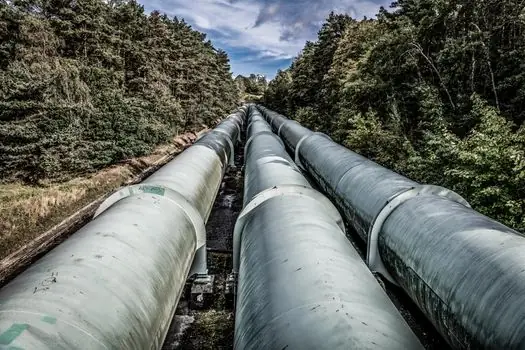
An orifice plate permanently bleeds energy; the permanent pressure loss is roughly 50% to 65% of the measured differential for a single concentric plate at beta 0.5, and that loss is paid every minute the line is in service. For a 4-inch steam line at 10 barg with 8 m/s velocity, the wasted pumping or boiler back-pressure cost is in the order of 5 kW to 15 kW per plate, scaled with mass flow. [S1]
Vortex bodies shed the same vortices but the bluff geometry is shaped to keep permanent pressure loss to about 10% to 25% of the DP that an equivalent orifice would create, depending on body width and beta; vendors commonly quote 1.5 to 2.0 times lower pumping cost than ISO 5167-2 (2022) orifice plates in the same line size. On long steam mains, this difference is what tilts the spec toward vortex, not the accuracy number.
For a benchmark: a DN150 line at 1.5 m/s water with a beta-0.6 orifice at 25 kPa DP shows roughly 0.6 kW of hydraulic loss, while a comparable vortex in the same bore runs about 0.1 kW to 0.15 kW; the per-meter delta is small, but across 50 measurement points in a refinery the cumulative blower or pump penalty is what shows up on the next energy audit.
Fluid Compatibility and Failure Modes
Both technologies demand a single-phase, reasonably clean process. Orifice plates tolerate moderate amounts of entrained liquid in gas, can be re-bored or replaced in-line for new beta, and the upstream straight-pipe run is specified in ISO 5167-1 (2022) as a function of the upstream fitting (for example, 28D after a single elbow for beta 0.7), which the pipe designer has to leave room for. [S4]
Vortex meters are more sensitive to vibration, low-frequency pipe noise, and multi-phase flow. A vortex body that works perfectly on clean superheated steam will fail in wet steam with more than roughly 5% entrained moisture, because the slugs damp the shedding and the piezo signal drops into the noise floor; similarly, two-phase flow or flashing service kills the frequency stability.
Maintenance differs: an orifice plate can be inspected, re-certified, and re-installed in under an hour on a flanged joint, while a vortex shedder is usually replaced as a cartridge. On a 24-month turnaround cycle, this is roughly comparable, but the orifice offers a path to custody-grade recalibration that the vortex does not.
Sizing, Installation, and Inline Footprint
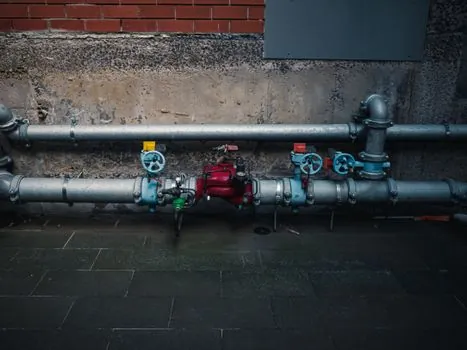
Sizing an orifice follows ISO 5167-2 (2022): pick a beta ratio (commonly 0.4 to 0.7) that keeps the differential pressure between 10 kPa and 100 kPa at design flow, calculate the discharge coefficient at the operating Reynolds, and check that the expansion factor at minimum flow stays above 0.95 for gases. The plate itself adds 5 mm to 20 mm to the face-to-face length between flanges. [S1]
Vortex sizing is shorter: the body length is typically 1.5D to 2.5D depending on manufacturer, and there is no flange-tap drilling to align. Inline diameters run DN15 to DN300 as standard catalog items, with larger sizes (up to DN500) available as engineered assemblies; orifice plates, by contrast, scale cleanly to DN1000 because the plate itself is just a flat disc.
For a related spec-first decision on inline vs insertion form factors in a different sensing family, see this ultrasonic flowmeter vs general flow meter selection map.
Cost, Lead Time, and Calibration
An orifice plate assembly, including a 316L stainless concentric plate, companion flanges, and tap blocks, lands in the 800 to 3,000 USD range for DN50 to DN300, with a lead time of 2 to 4 weeks from a regional fabrication shop; a matching differential-pressure transmitter adds 1,200 to 2,500 USD, so a complete orifice point typically costs 2,000 to 5,500 USD installed. [S2]
A vortex body in the same DN50 to DN300 range is a more integrated assembly, with the sensor, shedder, and transmitter in a single housing; prices cluster at 3,000 to 8,000 USD, with a slightly longer 4 to 6 week lead time because the manufacturer calibrates the body against a reference flow rig. The vortex is more expensive per point, but the installed labor is lower because there is no separate DP transmitter to plumb and wire.
Orifice calibration can be re-verified by dimensional inspection of the bore (eccentricity, edge sharpness, plate flatness) per ISO 5167-2 (2022), which is a workshop job; vortex calibration is by comparison against a master meter, which means the body has to come off the line and ship to a flow lab. For a remote plant, this trade-off alone often decides the issue.
Decision Matrix: When to Pick Which
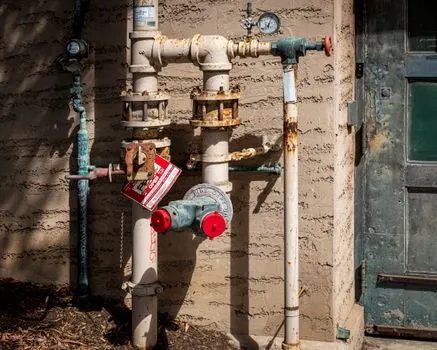
For custody-transfer steam on a utility header, pick the orifice plate flowmeter with ISO 5167-2 (2022) corner taps and a calibrated 4-20 mA + HART DP transmitter, accepting the permanent pressure loss in exchange for traceability. [S2]
For process steam between 0.5 barg and 40 barg, with turndown beyond 4:1, the vortex flowmeter wins on rangeability, lower pumping cost, and a frequency output that drives a flow computer or totalizer directly. For a worked spec walk-through on the vortex side, see this vortex flowmeter 2026 buying guide.
For clean water and air in HVAC, building services, and plant utilities below DN80, both work; the deciding factor is usually whether the BMS expects a linear pulse (vortex) or a 4-20 mA scaled to flow (orifice + DP transmitter). For non-condensing, non-fouling liquid service with no custody requirement and steady flow, a Coriolis flowmeter is the next step up, but it costs roughly 5x to 8x a vortex body and is overkill for a 4:1 turndown.
Signals worth tracking: any revision to ISO 5167-2 (2022) Reader-Harris/Gallagher discharge coefficient constants, and any shift in the IEC 61511 (2016) SIL rating envelope for vortex transmitters, which currently sit at SIL 1 to SIL 2 depending on vendor, against SIL 2 to SIL 3 for the DP transmitter pair on an orifice.