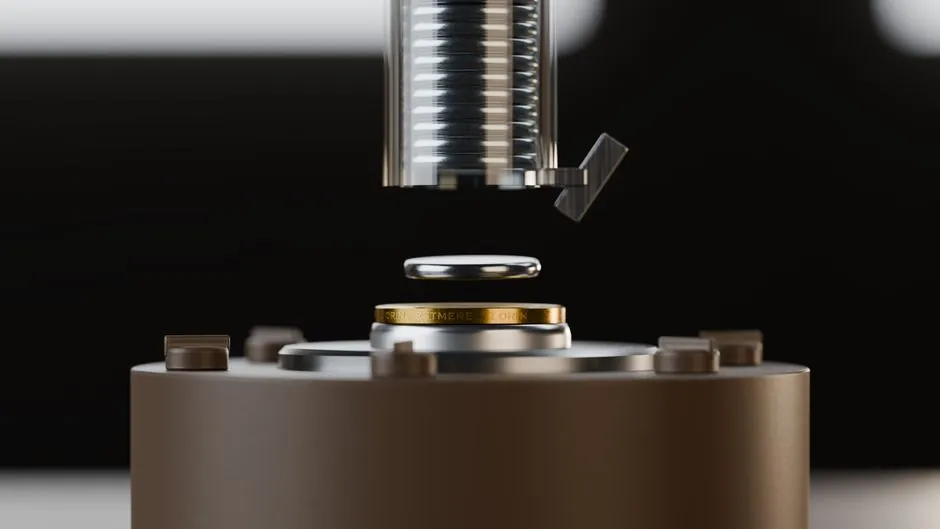
Low-profile pancake load cells are donut-style force transducers built around a central threaded through-hole, with rated capacities spanning 50 lb to 500,000 lb across the major US OEM catalogs [S2][S3][S7].
Compression is the default calibration mode; tension is supplied as an optional NIST-traceable calibration on most lines, with Transducer Techniques charging $125 to add tension calibration on units up to 20,000 lb and $250 for the 30,000 to 50,000 lb range [S3].
Mechanical Construction and Capacity Range
Transducer Techniques LPU series bodies are machined from 17-4 PH heat-treated stainless steel with bonded foil strain gauges sealed for industrial environments, offered in 14 capacities from 100 lb through 50,000 lb with 150% safe overload and 350 ohm nominal bridge resistance [S3].
Cooper Instruments' LGP-310 family extends the upper limit to 500,000 lb for both tension and compression, targeting materials testing stands and structural load frames where the donut shape fits inside limited axial real estate [S7].
Capacity drives the body OD and the central thread: the LPU 100 to 500 lb units share a 3.0 in OD with a 3/8-24 UNF center thread, while the 20,000 to 50,000 lb units step up to 6.0 in OD with a 1-1/2-12 UNF center thread, and height holds at 1.0 in for small capacities and 1.8 in for 7,500 lb and up [S3].
Accuracy, Thermal Performance, and Bridge Specs
The LPU series is rated at 0.1% of rated output nonlinearity, 0.1% hysteresis, 0.05% nonrepeatability, and 1.0% zero balance, with 3 mV/V nominal output, 10 VDC excitation, and a compensated range of 60 to 160 °F against a safe range of -65 to 200 °F [S3].
Temperature coefficients are 0.005% of load per °F on output and 0.001% of R.O. per °F on zero, figures that are competitive with column-type and S-beam units of similar capacity but achieved in a much shorter axial package [S3].
ATO's 500 kg sealed unit quotes 0.05% accuracy with IP67 protection, suitable for washdown or outdoor service where a potted-only IP65 body, such as the 800LoadCel SWCM, would be marginal [S4][S6].
Tension vs Compression: How the Same Body Handles Both

FUTEK's shear-web design uses multiple shear struts at higher capacities and bending beams at low capacities, with a central female thread plus outer through-holes so the outside can be fixed and force pulled through the center for tension [S2].
Adding a tension base plate converts the cell to in-line tension and compression service, which is the typical accessory for tank weighing, tablet press compression force, and injection-mold clamping force, where the donut shape bolts directly into a structural member [S2].
Loadstar Sensors' RSB6 takes a different route: the through-hole is the load path, not the central thread, so a rod or clevis pin passes through the donut and the cell measures whatever the rod pulls or pushes; the design tolerates high off-axis load better than S-beam or diaphragm cells of the same capacity [S8].
Selection Criteria: Capacity, Deflection, Mounting, and Environment
Four criteria drive a pancake selection: rated capacity (with 150% safe overload margin and an application factor of 1.5 to 2 for peak or shock loading), deflection budget (lower-capacity units use bending beams and deflect more than multi-strut high-capacity units), mounting geometry (central thread vs through-hole vs load button), and sealing (IP65 potted, IP67 sealed, or hermetic for submersion) [S2][S3][S4][S5].
For inline press force, fatigue-rated LCF-series shear web cells from FUTEK are the right pick because their multi-strut geometry tolerates high cycle counts; for structural load testing at very high force, the Cooper LGP-310 up to 500,000 lb covers what most donut lines stop at 50,000 lb [S2][S7].
A comparison of representative OEM lines: Transducer Techniques LPU (100 to 50,000 lb, 0.1% NL, 17-4 PH, foil gauge, 350 ohm, IP rating on request), Cooper LGP-310 (5 to 500,000 lb, tension and compression, materials testing focus), ATO 500 kg (0.05% accuracy, IP67 sealed), and 800LoadCel SWCM (IP65 potted, low cost, compression only) [S3][S4][S6][S7].
This decision table maps directly to a load cell spec sheet review: capacity first, accuracy class second, mounting third, environment fourth.
Calibration, Indicators, and Signal Conditioning
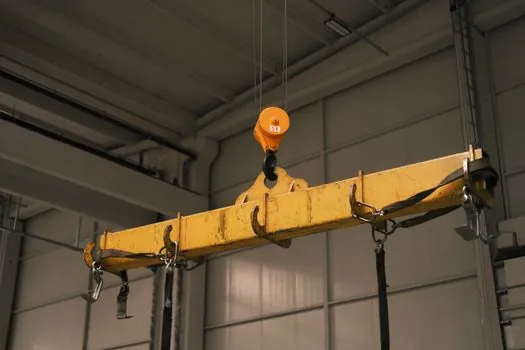
Pancake cells ship with a compression calibration certificate by default; tension calibration is a line item, and a TEDS plug-and-play option on the LPU adds another $115 plus the $83 mating cable assembly, useful when the indicator or checking and testing apparatus can read IEEE 1451.4 TEDS data [S3].
The 3 mV/V full-scale bridge output at 10 VDC excitation gives 30 mV at full load, which is the same signal level as a column-type or S-beam cell, so a standard strain-gauge indicator or summing box will accept a pancake without modification [S3].
For applications that need force versus displacement, such as a force gauge stand retrofit or a tensile test rig, the donut body bolts between the crosshead and a load fixture, with the central thread taking the pulling rod and the outer through-holes reacting against the fixture.
Where Pancakes Are NOT the Right Pick
Do not specify a pancake where high side loads or large bending moments dominate, because the multi-strut shear web is less sensitive to extraneous loads than S-beam or diaphragm cells but is not immune; the off-axis spec must be checked against the application [S2].
For weighbridge or tank weighing with multiple support points and long creep stabilization requirements, a double-ended shear beam or rocker column typically gives better long-term zero stability; the pancake is generally reserved for in-line or short-baseline force measurement, not multi-point platform weighing [S2].
Submersible or severe-washdown service needs a true hermetic seal rather than an IP65 potted body, and at 500,000 lb the Cooper LGP-310 is one of very few donut lines still offering that capacity, so most high-capacity builds funnel to a canister or column [S5][S7].
Trackable Signals for the Next Cycle
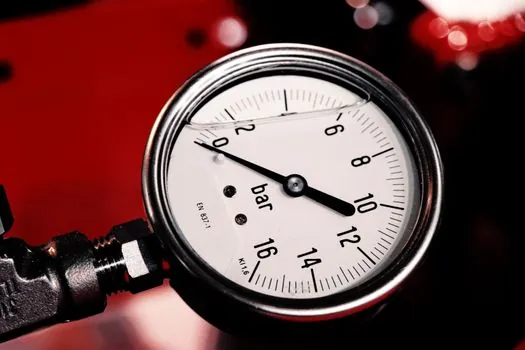
Watch for new fatigue-rated shear-web releases in the 50,000 to 250,000 lb window to close the gap between the LCF Shear Web line and the LGP-310 ceiling, and for IP68 or hermetic pancake options priced below the current submersible tier. [S3]
For deeper reading on how a pancake's potted sealing compares to a hermetically sealed alternative in a washdown plant, see the Hermetic vs Epoxy-Potted Load Cells for Washdown Service breakdown.
