The Paper Pulp Helmet, a 2013 Royal College of Art prototype, is a recycled-newspaper shell with a chemical water-resistant additive rated for roughly six hours of rain and a target retail near USD 1.50 per unit [S3].
Its designers, Tom Gottelier, Bobby Petersen, and Edward Thomas, built it for short-term bike-share riders in London, not for paper mills, chemical pulping lines, or woodyards where impact, chemical splash, and heat exposure are routine [S1][S3].
What the Paper-Pulp Helmet actually is
The shell is moulded from old newspapers pulped with water and pigment, then treated with a water-resistance additive that holds for about six hours of rain, an explicit concession to London's weather [S3].
There is no vent cut into the shell, which the inventors accept as a minor trade-off for a temperate market, and the chin strap is itself paper, not woven nylon or aramid [S1][S3].
End-of-life is part of the design: the helmet is meant to be re-pulped and reformed, so its usable service life is closer to a few rides than a working shift [S2][S3].
Why pulp and paper mills are a different hazard class
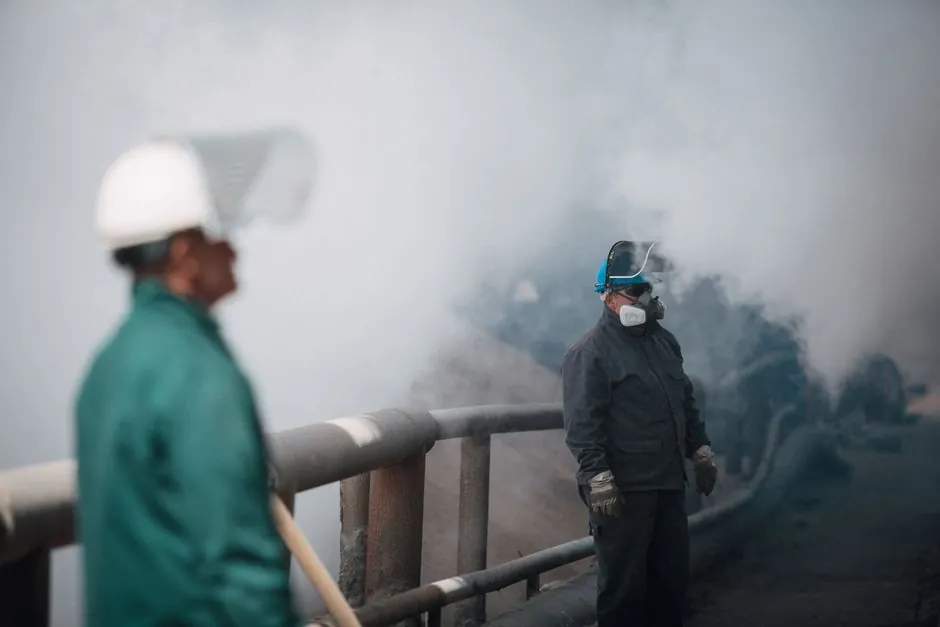
Paper mills combine moving rolls, dryer cans, slitter knives, overhead cranes, and forklift traffic, plus exposure to hot surfaces near the dryer section and to chemicals such as sodium hydroxide, sodium sulfide, and hydrogen peroxide in the pulping area. [S2]
Personal protective equipment in these zones is governed by industrial head-protection standards, typically EN 397 in Europe or ANSI/ISEA Z89.1 in North America, which set minimum impact attenuation, penetration resistance, and (optionally) electrical insulation, plus high-temperature and chemical-splash variants such as EN 397 with -30 °C / +150 °C marking [S1].
For the broader category of protective headgear used in heavy industry, see the reference entry on the safety helmet and the related machine-safety framework at machine safety.
Paper-pulp helmet vs industrial hard hat: side-by-side
On impact attenuation, a paper-pulp shell absorbs one low-energy bike fall at best, while an EN 397 or ANSI Z89.1 Type I Class E hard hat must pass a 5 kg striker dropped from 1 m onto the crown, with transmitted force below 4.8 kN for Class E electrical isolation up to 20 kV [S1][S3].
On service life, a pulp helmet is designed for one short trip and a six-hour rain window, whereas a suspension-equipped industrial hard hat typically carries a 5-year in-service life from the date of manufacture, with the shell replaced sooner if it takes a direct blow [S2][S3].
On materials, the pulp version is recycled newsprint plus additive and a paper strap, while industrial shells are usually HDPE, ABS, or fiberglass-reinforced polyester with a textile webbing suspension [S1][S3].
On chemical and heat exposure, the pulp shell has no published rating against NaOH, H2SO4, or 150 °C surfaces, all of which are routine near digesters, bleach plants, and dryer sections [S1][S3].
Selection criteria a mill safety officer should anchor on
For a kraft or mechanical pulp mill, the first gate is the certification mark: EN 397 with the relevant temperature option, or ANSI/ISEA Z89.1-2014 Type I Class E or G, matched to the electrical hazard class of the zone. [S2]
The second gate is compatibility with other PPE: a slotted shell for hearing-muff clips, a 6-point or 8-point textile suspension, and a chinstrap option rated to keep the helmet on during a fall from height.
For guidance on building a spec-anchored shortlist across vendors, the spec-anchored selection map for safety helmets lays out the same impact, electrical, and chemical-splash decision tree in detail.
Where a paper-pulp helmet might fit, and where it must not

It fits a very narrow use case: disposable head protection for short urban bike-share trips in a temperate climate, a use case BHSI itself describes as needing a safety-standard upgrade before any wider rollout [S1].
It does not fit any industrial task in a pulp mill, paper machine hall, converting line, or woodyard, and it is not a substitute for arc-rated or chemical-splash headgear near bleach plant operations.
The fire-safety framing around PPE selection is covered separately in the fire safety reference entry, which addresses why standard issue industrial helmets are the baseline for hot-work permits and confined-space entries.
Limitations of the public record
The BHSI page is the most recent public summary, dated 2026-08-01, and it states plainly that the inventors' own website is no longer reachable, so no third-party lab test data has been published [S1].
Coverage in Grist and Trend Hunter dates to 2013, so any claim of "European safety standard" compliance for the original design rests on the designers' own statement rather than a published EN 1078 or EN 397 certificate [S2][S3].
Signals worth tracking

Signal one: a new commercial re-launch of the paper-pulp concept, identifiable by a reachable project site and an independent lab report against EN 1078 for cycle helmets, the only head-protection standard whose scope matches a single-use urban shell. [S1]
Signal two: any mill-side pilot in Scandinavia or the US Southeast pairing a paper-pulp visitor cap with an industrial safety helmet baseline, which would be the first documented crossover between the two product families.