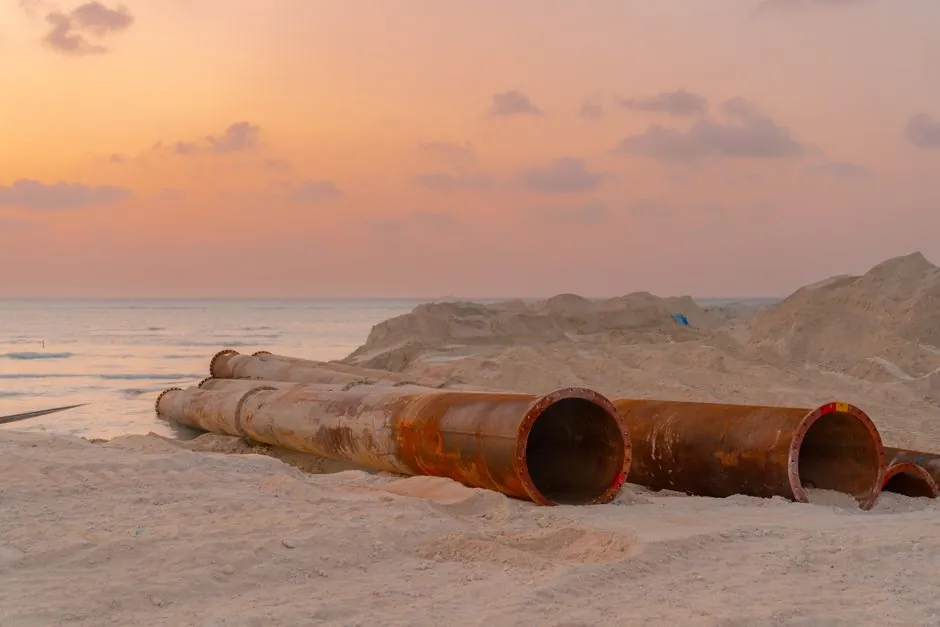
Solid-wall high-density polyethylene pipe is extrusion-manufactured up to 2,500 mm (98.43 in) outside diameter today, the practical upper limit for water transmission mains using PE4710 (North America) or PE100/PE100-RC (ISO) resin [S5][S9].
At that diameter, a 2,500 mm OD solid-wall HDPE main is roughly 2.5x larger than the 1,600 mm OD concrete cylinder or ductile iron mains it often replaces, and is the largest size that current continuous-extrusion production lines can deliver in standard laying lengths of 40 to 50 ft (12 to 15 m) [S2][S9].
Resin Classification: PE4710 vs PE100 and PE100-RC
PE4710 is an ASTM D3350 cell-class designation where "4" sets the density class, "7" sets the slow crack growth resistance, and "10" sets the hydrostatic design stress (HDS) at 1,000 psi for water at 73 °F (23 °C); it is the highest-performance pressure-pipe classification in common North American use [S1][S4].
PE100 is the ISO equivalent, and PE100-RC (RC = Resistance to Crack) is a sub-class with enhanced slow crack growth performance that allows the pipe to be installed in challenging native-soil conditions without a sandy bedding envelope [S1]. Lab testing cited by the Water Research Foundation reports PE100-RC pipe lasting in excess of 100 years under most water-quality conditions, including exposure to the strong oxidizers used for drinking-water disinfection [S1]. For an overview of how these resins fit into the broader PE pipe family, the classification system spans MRS (Minimum Required Strength) ratings from PE63 up through PE100-RC.
Dimensional Standards: ASTM F714 and AWWA C906
ASTM F714 governs polyethylene pipe in sizes 4 in and larger and is the primary dimensional standard for large-diameter water, sewer, and force-main applications in North America [S4]. AWWA C906 is the water-utility counterpart, covering HDPE pressure pipe and fittings up to 65 in (1,650 mm) for water transmission and distribution [S2].
For utilities specifying potable mains, the relevant consensus standards stack is: AWWA C906 (polyethylene pressure pipe and fittings for water), ANSI/NSF 14/61 (plastics piping system components and drinking-water safety), ASTM F714 (dimensions), ASTM D3035 (smaller IPS sizes), and ASTM D3350 (cell classification of the base resin) [S2]. Large-diameter metric sizes beyond 1,600 mm typically follow ISO 4427 (PE pipes for water supply) rather than AWWA C906, since AWWA C906 tops out at 65 in OD [S2][S5].
Diameter Sizing Systems: IPS, DIPS, and Metric OD
HDPE pipe uses four distinct OD or ID sizing systems that must be matched to the existing main or fitting standard: IPS (Iron Pipe Size), DIPS (Ductile Iron Pipe Size), CTS (Copper Tube Size), and SIDR (Standard Inside Dimension Ratio) [S4].
The diameter difference between IPS and DIPS at the same nominal size is a frequent specification trap: a 6 in DIPS HDPE pipe has an OD of about 6.90 in, versus 6.625 in for a 6 in IPS pipe, and the two will not fusion-weld together [S4]. Large-diameter metric PE pipe (e.g. 1,200 mm, 1,600 mm, 2,000 mm, 2,500 mm OD) is its own sizing track and is not interchangeable with IPS or DIPS fittings, so transitions require dedicated flange adapters or custom butt-fusion stub ends [S5]. Engineers working across both metric and imperial systems often reference the plastic pipe compatibility tables to confirm fusion compatibility before field welding.
SDR and Pressure Rating at 2,500 mm OD
Standard Dimension Ratio (SDR) is the ratio of outside diameter to minimum wall thickness and directly controls pressure capacity: a higher SDR number means a thinner wall and a lower pressure rating at a given OD [S4][S5].
For PE4710 IPS pressure pipe in the published ISCO table, the working pressure ratings at 73 °F are 333 psi (DR 7), 317 psi (DR 7.3), 250 psi (DR 9), 200 psi (DR 11), 160 psi (DR 13.5), and 138 psi (DR 15.5) [S5]. The same DR-to-pressure relationship scales to 2,500 mm metric pipe: a DR 11 solid-wall HDPE main at 2,500 mm OD has a minimum wall of about 227 mm and a PE100 pressure rating in the 10 to 16 bar (145 to 232 psi) range depending on the design factor applied [S5]. The trade-off is linear: doubling the wall to DR 7 roughly doubles the surge and pressure capacity but also adds substantial material cost and pipe weight per meter.
Joints, Surge, and 2 Million Cycle Test
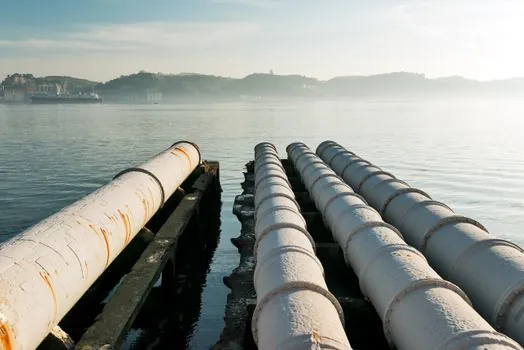
Butt-fusion and electrofusion joints produce a leak-proof, gasket-free joint that is the primary reason HDPE is specified over gasketed PVC or bell-and-spigot ductile iron for large transmission mains [S1][S2].
Surge (water hammer) is the most-cited concern with large-diameter HDPE, because the viscoelastic pipe wall absorbs and dissipates surge pressure more slowly than a rigid pipe [S1]. The 2015 WRF Report #4485 addressed this with a dedicated recurring-surge test on a large-diameter HDPE pipe, which survived 2 million surge pressure cycles without failure, validating the material for cyclic surge conditions typical of pumped transmission mains [S1][S3]. A standard 40 or 50 ft laying length translates to fewer joints per kilometer, which is the structural reason HDPE large-diameter mains show the lowest reported leakage rates of any common pressure-pipe material [S2]. Where large-diameter HDPE connects to ductile iron or PVC, flanged pipe fittings with PE-backed stub ends and backup rings are the standard transition detail.
Application Limits and Where 2,500 mm Makes Sense
The 2,500 mm upper size is reached today in marine outfalls, intake pipelines, and very large municipal transmission mains where the alternative is a precast concrete cylinder pipe (PCCP) or a steel pipe with internal lining [S9]. Out-of-roundness in the as-extruded pipe becomes the controlling variable at diameters above about 1,600 mm, because higher ovality raises the kinking risk when the pipe is cold-bent to match a route alignment [S9].
For most municipal distribution work, AWWA C906 sizes up to 65 in (1,650 mm) cover the practical range; 2,500 mm PE pipe is specified for specialty applications such as seawater intake/outfall, large irrigation tailwater, and industrial cooling-water circuits where long, fused, leak-free runs are critical [S2][S8][S9]. The American Water Works Service Company standard spec 33 11 00.13 covers HDPE up to 16 in for water and wastewater service, which is a useful contrast: anything above 16 in typically requires project-specific dimensional and fusion procedures beyond the standard utility spec [S7]. Specifiers working on chemical or oxidizing service should also review pipe clamp material compatibility, since HDPE support saddles must be sized to the larger OD to avoid point loading.
Related analysis: NESHAP Subpart EEEEE Cupola Emission Limits for Iron Foundries.