
Photoelectric sensors for industrial automation are commodity in form factor but not in specification: a 2025-08-01 market study sizes the global category at USD 2.18 billion in 2024 with a 4.02 billion USD 2032 projection across through-beam, retroreflective, diffuse reflective, fiber-optic and multi-beam structures. A 2026 buy should be driven by sensing physics and interface, not by catalog brand, because the visible-red polarized retroreflective CXP-AN-1A from AutomationDirect, the diffuse-mode OGx3xx family from ifm, the QS18 fiber-optic amplifier from Banner, the color BFS0002 from Balluff and the miniature background-suppression E3T-BGS from Intellisense all satisfy the same generic "photo eye" label but address different detection tasks [S1][S2][S3][S4][S5].
For a 2026-07-05 spec-driven selection, define first: target object color/finish, sensing distance band, background behavior, housing shape, IP rating, supply voltage, output type (PNP/NPN/push-pull/IO-Link), and the connector or pigtail form. Lock those gates, then run vendor and stock shortlists. Background on sensing principles and form factors is condensed in the photoelectric sensor reference.
Spec Gate 1: Sensing Mode and Optical Principle
Through-beam (separate emitter and receiver) gives the longest range and highest excess gain for dirty environments, but requires wiring on both sides and precise alignment; retroreflective collapses that to one head plus a reflector, with the CXP-AN-1A delivering 2 m on visible red with dark-on logic, NPN output and a 3-wire pigtail for general purpose cells [S5]. Diffuse reflective uses a single housing and reads light off the target, but its range collapses on dark, matte, or angled surfaces — a problem that background-suppression (BGS) variants solve by triangulating the cut-off distance, as on the OGx3xx family which spans 2 mm to 20,000 mm in one series and adds retroreflective, through-beam and diffuse modes in a cylindrical IP69K body [S4].
For color or mark discrimination a fixed-focus diffuse color sensor is the right tool: the BFS0002 from Balluff reads 15-30 mm with three PNP NO outputs and a teach color switchpoint input, packaged in a 17 x 50 x 50 mm Series26K rectangular housing [S1]. For tight installs where the housing is the limiting factor, miniature BGS heads like the E3T-BGS cover 3-20 mm in an infrared compact rectangular body aimed at PCB and small-parts detection [S2]. Fiber-optic heads such as the QS18 amplifier from Banner add IP67 sealing in a rectangular World-Beam housing and let glass or plastic fibers reach into hot, small, or confined spaces the electronics cannot enter [S3].
Spec Gate 2: Range, Beam, and Light Source
Range is the single most quoted and most abused spec. The ifm OGx3xx series illustrates the full envelope: a minimum 2 mm near-point on diffuse BGS and a 20,000 mm maximum in through-beam configuration from a single sensor family [S4]. Visible red is the default for general purpose polarized retroreflective (2 m on CXP-AN-1A) and is preferred where the operator needs to see the spot during commissioning [S5]. Infrared is the default for through-beam and BGS miniature heads where eye-safety, ambient-light rejection and longer range matter; the E3T-BGS uses infrared in a 3-20 mm window for small-part detection [S2], and the QS18 fiber-optic amplifier also runs infrared to exploit low-loss glass fiber bundles [S3].
Laser class is a separate gate: Class 1 or Class 2 laser emitters are common on long-range through-beam and small-spot diffuse sensors, and the chosen class affects machine-safety distance calculations under ISO 13849-1 and the laser-product IEC 60825-1 family. Excess gain curves, not headline range, decide dirty-environment viability — a 2 m diffuse sensor with 5x excess gain at 2 m will fail in a steel-mill cell where a 1 m through-beam with 50x excess gain will run. If the spec sheet does not list excess gain at the working distance, ask for it.
Spec Gate 3: Housing, IP Rating and Mechanical Mounting
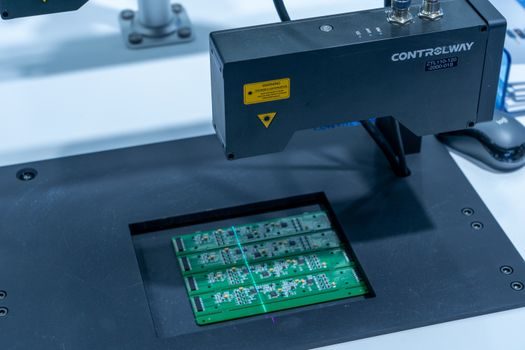
Rectangular and cylindrical are the two mechanical worlds. Rectangular QS18 (Banner), Series26K (Balluff) and AutomationDirect CXP housings are designed for flat surfaces, dovetail brackets, and standard through-holes, and they tend to integrate M8 or M12 connectors or fixed pigtails [S1][S3][S5]. Cylindrical M18 or M30 bodies suit threaded-nut mounting on conveyor side rails, with the OGx3xx family carrying IP69K for food-industry washdown, a rating that covers high-temperature, high-pressure jet cleaning [S4].
IP67 is the practical minimum for any sensor near coolants, oils, or outdoor enclosures and is explicitly listed for the Banner QS18 fiber-optic amplifier [S3]. For hygienic or food zones, IP69K plus stainless or food-grade plastic is the constraint set, and that gate alone disqualifies most commodity sub-IP67 heads regardless of price. Mounting geometry also fixes the connector choice: pigtail leads (as on the CXP-AN-1A) ease routing in retrofit cells, while M8/M12 quick-disconnects dominate new machinery lines where rapid swap-out matters.
Spec Gate 4: Output, Wiring and IO-Link
Output protocol is the gate most often got wrong in 2026 retrofit work. PNP (sourcing) and NPN (sinking) are the legacy 3-wire DC norms, with the Balluff BFS0002 specified as 3x PNP NO [S1] and the AutomationDirect CXP-AN-1A specified as NPN dark-on with a 3-wire pigtail [S5]. Push-pull outputs drive both PNP and NNP loads from the same sensor, simplifying spares. For 2026 greenfield lines, IO-Link is the decisive gate: it delivers bidirectional digital data, remote teach, condition monitoring and standardized M12 ports, and the same sensor can replace a discrete PNP on day one and join an IO-Link master on day two without rewiring.
Power supply is the second output-side gate: most DC photoelectric heads run 10-30 V DC, while AC-only units still exist for legacy 100-240 V cells. The supply range, ripple tolerance, and short-circuit protection class should be on the data sheet, not on a separate accessories page. For multi-vendor plants, lock the output type and connector at the panel-builder level and let purchasing follow — otherwise you end up stocking both PNP and NNP variants of the same model.
Spec Gate 5: Vendor, Stock and Cost Bands

Photoelectric-sensor pricing is wide and tier-driven. On the Chinese wholesale side, audited Diamond Member listings on 2026-04-15 show photoelectric sensor switches starting at US$ 4.45-4.65 per piece MOQ 1 from Yueqing Lifang Electric and US$ 10.50-13.00 per piece MOQ 10 from Tianjin G-tek Sensor Technology. These landed prices are roughly one-third of Western premium-brand list prices for the same sensing mode, but lead time, documentation depth, and CE/UL/CCC certification depth vary — see the 2026-04-04 wholesale-infrared sourcing page on Made-in-China for the wider SKU list. [S1]
Western premium brands (Banner, ifm, Balluff, SICK, OMRON — OMRON's E3S general-purpose built-in-amplifier line is the textbook example of an established industrial photoelectric series) carry stronger datasheets, longer warranty, and stable revisions [S6]. For buyers running a 2026 sourcing program, the typical split is premium brand on safety-relevant, regulated, or washdown cells (food, pharma, ATEX 2014/34/EU zones) and Chinese OEM on non-safety general-purpose cells where unit cost and replacement ease dominate — see the photoelectric sensor selection guide on six spec gates for the same trade-off framed against end-point detection. Lead time in 2026 remains a separate variable: confirm factory-stock status on each SKU before locking the BOM.
Limits, Failure Modes and Standards Anchors
Diffuse reflective sensors fail on dark, glossy, angled, or transparent targets unless BGS or foreground suppression is added; retroreflective fails when the reflector is dirty, occluded, or the target is a highly reflective surface that returns light to the sensor from the wrong path. Through-beam fails on alignment drift and on opaque build-up on either optic, and a 5-10x excess-gain margin is the rule of thumb for conveyor cells. IO-Link sensors behave like discrete PNP/NPN on the wire, so a plant mixing IO-Link and 4-20 mA analog loops must keep the topology clean: HART is FSK-modulated on a 4-20 mA loop, while Foundation Fieldbus and PROFIBUS PA are fully digital — those are different protocol families and are not interchangeable with photoelectric outputs. [S2]
Relevant standards to anchor a 2026 spec sheet: IEC 60947-5-2 for proximity and photoelectric sensor switching elements, IEC 60825-1 for laser-emitting sensors, ISO 13849-1 for safety-rated photoelectric guards (with Type 1/2/3/4 categories), and ATEX 2014/34/EU plus IEC 60079-0 for explosive-atmosphere cells. The Chinese wholesale listings are best treated as a price and SKU reference, not as a certification certificate; require CE, UL or CCC marks on the data sheet itself. In 2026 retrofit audits, verify the photoelectric sensor selection logic at every line before swapping a brand.
Decision Matrix and Final Selection Logic

Decision matrix for a 2026 cell, four rows against four criteria: (1) Through-beam: best excess gain, longest range, two-side wiring, worst on alignment. (2) Retroreflective polarized: one head plus reflector, 2 m typical on visible red like the CXP-AN-1A, weak on highly reflective targets [S5]. (3) Diffuse BGS: one head, ignores background, best for part-on-conveyor detection at 2-20 m bands as on the OGx3xx family [S4], weak on dark transparent films. (4) Fiber-optic: remote optics, IP67 head, fits hot or tight spaces, the QS18 amplifier is a typical host [S3]. A color sensor (BFS0002) is its own row with teach switchpoint, 15-30 mm window, three PNP NO outputs [S1].
Final selection logic: choose the sensing mode from target physics, choose the housing/IP from environment, choose output from PLC/IO-Link, then shortlist on stock and lead time. Track two signals through 2026: IO-Link penetration in new Chinese OEM catalogs (visible on the Made-in-China sourcing pages), and EU/EU-style washdown demand pulling IP69K cylindrical bodies like the OGx3xx into the food and packaging cell default [S4]. The same six-gate sequence is what 2026 purchasing should be audited against — and it is also how the spec-driven end-point detection comparison frames sensor choices on the wider factory floor.
For component-level specifications, see linear guide, and crossed roller guide.