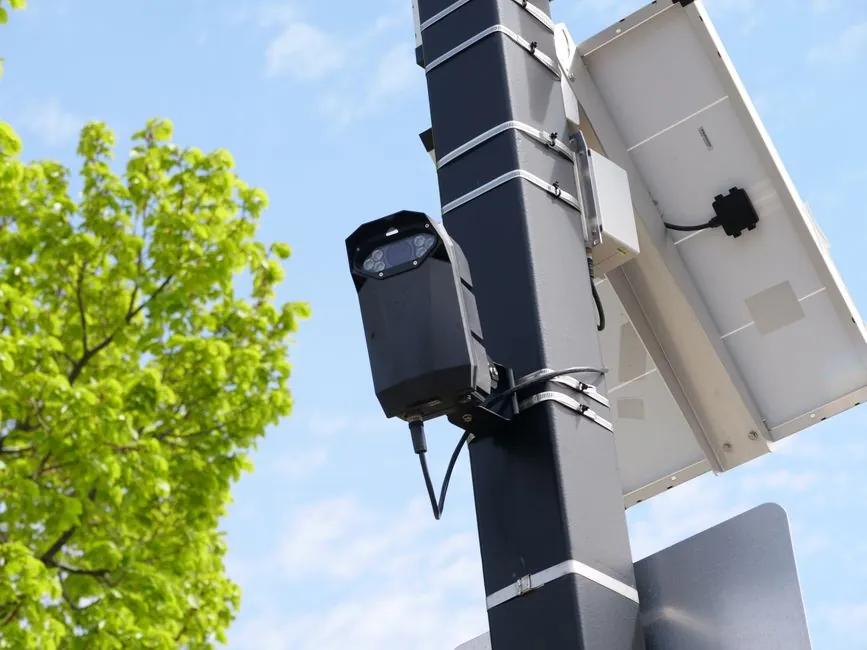
Diffuse-reflective, retroreflective, and through-beam photoelectric sensors cover roughly 90% of discrete part-detection duties on packaging, conveyor, and assembly lines, with effective ranges clustered in the 0.1-50 m band depending on optical geometry [S3].
On a 2026 buying shortlist, the dominant Chinese-sourced M18 tubular photoelectric switch sits between US$ 4.45 and US$ 4.65 per piece at 1-piece MOQ, while a heavier-duty through-beam infrared beam set runs US$ 160-400 per set at 1-set MOQ, a roughly 35:1 spread that tracks housing, optics, and output stage more than emitter wavelength [S1][S2].
Mode selection: four optical geometries, four typical ranges
Through-beam pairs emitter and receiver in separate housings, delivers the longest range (commonly 5-50 m with infrared LED) and the highest excess gain, and is the right call when target reflectance is low or variable [S3].
Retroreflective units fold the path back on a passive reflector, typically reach 0.1-5 m, and need a polarising filter when the target is shiny packaging film to defeat false triggers from specular reflection [S3].
Diffuse-reflective sensors co-locate emitter and receiver, detect light scattered off the target itself, and usually top out near 0.05-1.0 m; a fixed-field (background-suppression) variant uses a defined cutoff to ignore surfaces beyond the set distance, which is the cleanest pick for detecting dark or irregular parts on a conveyor [S3].
Laser class 1 (IEC 60825-1) diffuse or through-beam heads are the workhorse where the target is small (sub-mm) or the beam must be aimed through a narrow aperture; a visible red spot also helps mechanical commissioning. A plain infrared diffuse head fails both jobs, so do not substitute on price alone [S3].
Output, wiring, and the IO-Link decision
Three-wire DC photoelectric switches in the M18 tubular format dominate the 2026 catalogue, with NPN (sinking) and PNP (sourcing) transistors as the two standard load-side options; many offer both polarities in the same SKU plus a complementary NO+NC pair for ladder logic fallback [S1].
IO-Link is the point-to-point digital protocol (IEC 61131-9) increasingly built into new M18 and block-style photoelectric heads; it gives the PLC access to excess gain, temperature, and run hours, which converts a binary photoeye into a diagnosable node on a 3-wire cable [S3].
For North American build-and-test lines, the relay-output AC/DC photoelectric switch in 110-240 V form is still specified, but European and Japanese OEMs have moved to 24 V DC PNP + IO-Link as the default on new machinery; the through-beam infrared beam set cited above (US$ 160-400 per set) is typical of that industrial tier with NPN/PNP selectable outputs and 3-wire connection [S1][S2].
Body, optics, and environmental survival
IP67 is the baseline for a washdown-rated M18 photoelectric sensor; IP69K is the higher tier specified for food, beverage, and pharmaceutical lines that see high-pressure hot-water cleaning at 80-100 bar and 80 °C, and it costs roughly 1.5-2.5× the IP67 equivalent in the same optical class. [S1]
Housing material is usually nickel-plated brass or 304 stainless for the M18 barrel, with PPS (polyphenylene sulfide) or PC (polycarbonate) for the optical window; an O-ring seated on the front face is what actually delivers the IP rating, so a damaged seal voids the spec even if the body is intact [S4].
Ambient light immunity, sunlight up to 10,000 lux for indoor diffuse units and 100,000 lux for outdoor-rated through-beam heads, is a real differentiator: a cheap diffuse sensor aimed at a backlit window will chatter, and no amount of gain trim will fix it. If the application involves outdoor conveyors or welding-cell perimeter guarding, a through-beam pair with modulated infrared at 10-50 kHz and a daylight-reject filter is the safer pick [S3].
Who should NOT pick the cheapest diffuse unit
A diffuse-reflective sensor should not be specified for transparent PET bottle counting, mirror-finish metal detection at distance, or any target smaller than 0.5× the beam spot, because the return signal collapses below the switching threshold and the head reads "no part" continuously [S3].
Through-beam is also the wrong pick for in-line conveyor applications where the two heads must survive side impact, because a 5 mm misalignment from a forklift nudge can turn a 50 m-rated pair into a constant-fault sensor; in those cells, a retroreflective head with the reflector on a sprung bracket is more robust per dollar [S1][S3].
Capacitive and ultrasonic sensors are the correct alternatives, not photoelectric ones, when the target is liquid level, bulk powder in a hopper, or a non-metallic part whose colour or transparency defeats optical contrast; see capacitive sensor and displacement sensor entries for those duty profiles.
Comparison: four modes against four decision criteria

Use the table logic below to shortlist a photoelectric sensor for a given duty: range, target type, cost tier, and commissioning complexity. [S1]
Through-beam scores best on range (5-50 m) and excess gain on dark or low-reflectance targets, and worst on cost (top tier, US$ 160-400 per set) and commissioning (two heads to align) [S1][S3].
Retroreflective sits in the middle on every axis: 0.1-5 m range, single-head wiring, polarised variants handle shiny film, and the cost is roughly 20-40% below a through-beam pair at equivalent range [S3].
Diffuse-reflective is the cheapest and fastest to install, ≤1 m range, but it loses to any change in target colour or surface finish, so it is a stable pick only on a known, repeatable part on a single-product line; on a mixed-SKU conveyor, a fixed-field diffuse head with background suppression is the safer upgrade [S2][S3].
Laser class 1 heads add sub-mm spot size for small-part registration, at a 2-4× price premium over LED diffuse, and they are the right call for electronics pick-and-place, syringe tip detection, and lead-frame sensing where the LED diffuse spot is too coarse [S3].
Standards, sourcing signals, and 2026 supply map
Buyers comparing 2026 OEM catalogues should treat IEC 60825-1 (laser safety), IEC 60947-5-2 (low-voltage switchgear proximity sensors), and IEC 61131-9 (IO-Link) as the three governing references for the sensor head itself; housing ingress falls under IEC 60529 (IP code) [S3].
The 2026 supply side on the Made-in-China.com index for "photoelectric sensor" shows a heavy cluster of M18 tubular three-wire NPN/PNP switches in the US$ 4-14 bracket from Jiangxi, Zhejiang, and Tianjin suppliers, with the higher-spec infrared beam sets (US$ 160-400 per set) concentrated in Tianjin and Wuxi industrial zones, useful when matching an OEM panel builder's bill of materials [S1][S2].
See photoelectric sensor for the mode-by-mode reference, and flow sensor for adjacent process-instrument selection.
Background reading: Safety shoe selection for oil and gas: hazard map, sole chemistry, and certification gates.