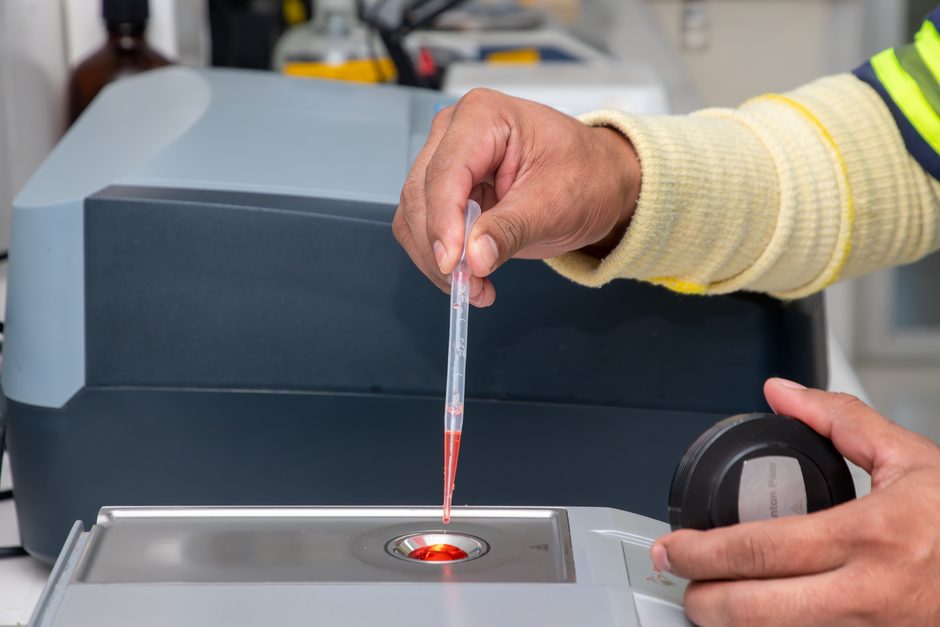
A photoionization detector (PID) ionizes target molecules with a UV lamp and measures the resulting current; the SRI Instruments 10.6 eV PID reaches detection limits down to 10 ppb on aromatics, with the lamp window — not the lamp body — heated to extend service life into the multi-year range [S1].
The technology is mandated in EPA Methods 8021 (aromatics by GC/PID) and TO-14 (volatile organics in ambient air by GC/PID/ELCD), and is favored for handheld volatile organic compound (VOC) monitors because readings are instantaneous and continuous, suiting worker-exposure alerting [S1][S2]. The 2025-08 published ethanol method in <em>Fresenius J Anal Chem</em> shows 0.005% 3δ detection on aqueous ethanol with a 20 s time constant, confirming PIDs remain a reference technique for low-molecular-weight VOC matrices [S3].
What a PID Actually Detects — and What It Misses
PIDs respond to molecules whose ionization potential (IP) lies below the lamp photon energy; the industry-standard 10.6 eV lamp covers most aromatics and many chlorinated or oxygenated VOCs, but misses methane (IP ≈ 12.1 eV) and other low-IP aliphatic gases that need an FID or a higher-energy lamp [S1]. Detection limits for benzene, toluene and xylenes reach the low-ppb to low-picogram range, which is why PIDs dominate the detector side of EPA 8021/TO-14 workflows and most modern handheld VOC meters [S1][S2].
For breath ethanol, the 1995 Reimann et al. method on a purge-and-PID train produced 0.005% 3δ detection with 4.8–6.0% RSD, validated against GC and non-dispersive IR — a useful baseline for medical and process-gas specifiers cross-checking PID linearity [S3]. A PID is non-destructive: effluent ions recombine, so the same sample stream can feed a downstream FID/DELCD combination detector for confirmatory or orthogonal chromatograms from a single injection [S1].
Selection Criteria: Lamp, Response Factor, Humidity, Safety
Four decision points determine whether a PID fits an application: lamp energy (commonly 9.8, 10.0, 10.6, 11.7 eV), compound-specific response factor, humidity compensation, and area classification (intrinsically safe vs explosion-proof). The 10.6 eV lamp is the default because it ionizes benzene (IP 9.24 eV), toluene (8.82 eV) and most EPA 8021 analytes; 11.7 eV lamps extend coverage to some lower-IP compounds at the cost of shorter lamp life and higher humidity sensitivity [S1].
Spring-loaded, tool-free lamp cartridges — as in the SRI design — cut service time during the periodic window cleaning that column-bleed build-up forces on the operator, and only the window is heated so the lamp body stays cool and lasts years [S1]. For site safety, buyers should match the instrument's certification to the zone: a catalytic-bead or NDIR gas detector on the same rack may carry ATEX/IECEx markings the PID must also hold for refinery or tank-farm use. A comparison grid for spec sheets:
• Lamp energy vs target IP — 10.6 eV covers aromatics; 11.7 eV for harder-to-ionize species.<br>• Response factor library — vendor-supplied RFs let the meter read isobutylene-equivalent ppm directly [S2].<br>• Humidity quenching — specified as % loss at 90% RH, typically single-digit for compensated units.<br>• Run mode — bench GC/PID with column vs handheld stream monitor; the PID can run on air carrier, useful when no cylinder gas is available [S1].
Who Should Specify a PID — and Who Should Not
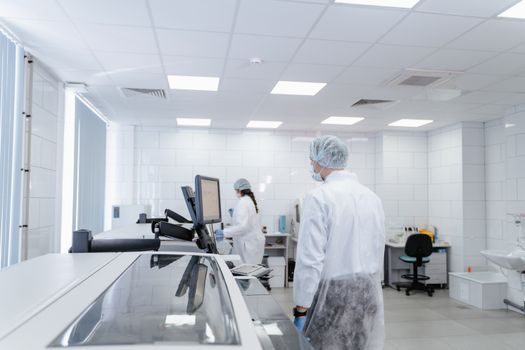
Specifiers of indoor air quality, hazardous-materials response, refinery turnaround monitoring, soil-vapor surveys and breath/food ethanol will see a PID pay back in minutes-long response and ppb-level sensitivity — the same reasons Fisher Scientific's catalog places PIDs under Industrial Hygiene and lists leak detection, perimeter monitoring, spill delineation and PPE determination as standard applications [S2].
Engineers chasing methane, ethane or natural-gas leaks should walk away: PIDs do not ionize C1–C2 aliphatics reliably, and an FID, NDIR or heat-detector type catalytic sensor belongs in that bill of materials instead. Likewise, continuous fixed-point monitoring in oxygen-deficient orifices demands an oxygen detector head alongside the PID, since a UV lamp does not warn of asphyxiation on its own. If the analyte set is dominated by particulates or aerosols, a dust detector is the right primary instrument and a PID is a secondary channel at best.
Method Compliance and Standards Mapping
U.S. EPA Method 8021 (aromatics) and Method TO-14/TO-15 (ambient VOCs) explicitly list PID as an accepted detector, which is the cleanest procurement justification a spec writer can cite [S1]. For international tenders, the cross-reference to ISO 16000 and similar indoor-air methods lets the same PID data set satisfy both compliance and worker-exposure reporting, provided the instrument's response-factor library has been cross-validated against the target compound list.
Area-safety compliance for hazardous-location PIDs falls under the IEC 60079 family (electrical apparatus for explosive atmospheres) and ATEX 2014/34/EU in the EU; buyers should request the certificate number and the specific zone/group marking rather than the marketing line "explosion-proof". The same precaution applies to pairing a PID with a crossed-roller guide driven auto-sampler on a refinery lab bench — the detector certificate does not extend to motion peripherals and those must carry their own markings.
Operation, Calibration and Known Failure Modes
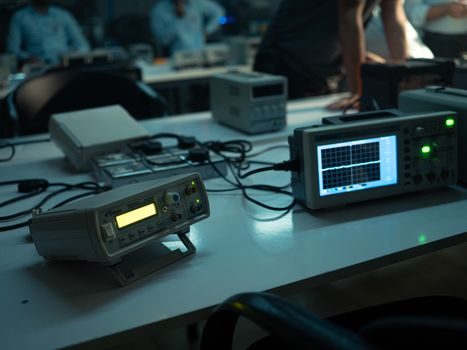
Two failure modes dominate PID field service: lamp-window fouling from column bleed or particulates, and humidity quenching that suppresses reading at high RH. The SRI spring-loaded design targets the first by letting operators remove, wipe and re-install the lamp in seconds without tools; only the window is heated, so contamination pyrolyzes off while lamp-body heat (a common failure driver) is avoided [S1]. Humidity quenching is mitigated by compensation algorithms, but the data sheet should still quote the loss percentage at 90% RH so QA can write the uncertainty into the SOP.
Calibration cycle length is governed by lamp output drift and electrode contamination; annual bump-testing with isobutylene span gas and a zero-air challenge is typical for handheld units, while bench GC/PIDs follow the GC's own calibration schedule. For multi-technique carts, the linear-guide rail that drives an auto-injector or filter wheel should be specced separately — a PID spec sheet tells you nothing about motion-system life.
Procurement Signals Worth Tracking in 2026
Two trackable signals for the second half of 2026: vendor release notes on 11.7 eV lamp-life improvements (historically a six-to-twelve-month service item), and any update to the EPA TO-series method list that would re-shape the certified-compound matrix a PID must cover. Handheld multi-gas kits on Fisher's catalog are now offered in three sensor bundles — LEL/O2/CO, LEL/O2/CO/H2S, and CH4/O2/CO/H2S — and the PID sensor cost vs catalytic gas detector lifecycle trade-off is the first spec-side comparison a buyer should run, because the lamp replacement interval drives total cost more than the sticker price. Side-by-side with broader gas-detection catalogs, PIDs are also frequently paired with an oxygen detector cell in confined-space kits, so any 2026 update to the oxygen-cell warranty terms will move the total cost of ownership alongside the PID lamp number. [S1]