
A pneumatic cylinder and a push-in fitting serve two different jobs on the same air line: the cylinder converts compressed-air energy into linear force, while the push-in fitting terminates the supply tube into the cylinder port, valve manifold or treatment block [S1][S7]. Conflating them leads to over-specified fittings or under-rated cylinders, so engineering buyers should treat the pair as a coupled decision.
Spec ranges in 2026 listings cluster as follows: miniature aluminium cylinders in the 20–25 mm bore / 50–100 mm stroke band [S9]; standard industrial cylinders at 32–100 mm bore with strokes up to 200 mm (SC 63 × 200 example, 2-1/2 in bore, 8 in stroke) [S9]. Push-in fittings across the same period cover tube OD 3–14 mm at 0.5–16 bar working pressure, with body materials split between nickel-plated brass, technopolymer (polyamide) and stainless steel [S2][S3][S4].
Function Boundary: Force Element vs Tube Terminator
A pneumatic cylinder is a power device — bore, stroke, piston area, cushioning and rod-end mounting define its output force at a given supply pressure, with bore sizes from 20 mm (TAILONZ TN20-100) up to 63 mm-plus commercial units (SC 63 × 200) catalogued in 2026 best-seller data [S9]. Selection is governed by mechanical load, stroke length, mounting style (clevis, tie-rod, foot, flange) and cycle rate.
A push-in fitting is a fluid-handling connector — its job is to grip a polymer or polyurethane tube by an internal O-ring and a collet/release ring, sealing at line pressure without tools [S2][S3]. Configurations include straight, elbow, T and Y, with attachment modes threaded (BSP/BSPT/metric), push-in, push-to-lock and snap-in [S2][S4]. On a cylinder port, the fitting is sized to the cylinder port thread (commonly M5, G1/8, G1/4, G3/8, G1/2) and the tube OD on the upstream side.
For system-level context on how these components fit into a broader pneumatic actuator assembly, see the pneumatic-actuator cost band guide for typical 2026 sourcing floors on actuators, valves and the fittings around them.
Pressure and Temperature Envelopes: What Each Part Must Withstand
Cylinder body ratings are typically 10 bar standard shop-air duty (ISO 15552 / ISO 21287 typical bands for tie-rod and compact cylinders), with seals in NBR or polyurethane for –20 °C to +80 °C service. Push-in fittings in 2026 listings show working pressure from 0.5 bar minimum up to 16 bar (232 psi) for brass-body screw-in / push-in T-fittings [S3], and 12 bar (174 psi) for the reduced-dimension RR series [S2]. Vacuum service (down to –1 bar) is also common on push-in fittings with internal O-rings, since the collet grip is pressure-direction insensitive.
Tube OD is the most common spec on the fitting side: 4, 6, 8, 10 and 12 mm are the dominant metric sizes across C.Matic MV12 and similar elbow/compact lines [S4], with imperial equivalents in 1/8, 3/16, 1/4 and 3/8 in. Fitting material drives both pressure ceiling and media compatibility: nickel-plated brass for general shop air; technopolymer (polyamide) bodies for lightweight, low-cost assemblies; stainless steel where washdown, chemicals or elevated temperature rule out brass or plastic [S2][S3][S4].
For the connector side of the same air circuit, the pneumatic-fitting selection reference catalogues thread, tube and configuration matrices used across the industry.
Material Comparison: Brass vs Technopolymer vs Stainless
Nickel-plated brass is the default for push-in fitting bodies: it threads cleanly, handles 10–16 bar working pressure, and survives typical industrial fluids [S2][S3]. Cost is moderate, and the range covers nearly every standard thread spec (BSP, BSPT, metric parallel, metric taper) [S2].
Technopolymer (polyamide) bodies appear in compact, lightweight or cost-sensitive assemblies. The C.Matic MV12 line uses technopolymer with nickel-plated brass threaded inserts and NBR seals, targeting compact machine builds where weight and panel density matter more than peak pressure [S4]. Maximum tube OD on those elbow/compact lines is 12 mm (0.472 in) [S4].
Stainless steel (typically 316L or 304) is specified for food-grade, pharmaceutical, marine or chemically aggressive service. Waircom's RO series lists stainless among its body options alongside brass, polyamide and polyurethane internal components [S3]. Stainless fittings typically cost 3–5× equivalent brass units and carry longer lead times, so they are reserved for the duty that genuinely demands them.
A wider primer on tube-side materials and tolerances is in the pneumatic tubing reference, which covers polyurethane, polyethylene and nylon tube behaviour in push-in systems.
Configuration and Geometry: Straight, Elbow, T, Y and Swivel
Push-in fittings come in five common geometries — straight, 90° elbow, T, Y and swivel — plus bulkhead and manifold variants. The SAF RR series covers T, 90° angle and Y configurations in nickel-plated brass with BSP/BSPT threads at 3–14 mm tube OD [S2]. Waircom's RO series adds T-shaped and elbow forms with male/female thread options and metric parallel or taper threads [S3]. C.Matic's MV12 focuses on compact elbow geometry with integrated shut-off or flow regulation [S4].
The cylinder side runs a different configuration matrix: tie-rod (ISO 15552), compact (ISO 21287), round-body, magnetic-piston and rodless (band or magnetically coupled) variants. The 2026 best-seller mix shows round-body double-acting aluminium cylinders (TAILONZ MAL25×50, 25 mm bore × 50 mm stroke) dominating small-format machine work, with tie-rod aluminium units in 3.25 in bore (Buyers Products TGC32508V) covering heavier mobile hydraulics-replacement applications [S9].
Selection Criteria: Cylinder and Fitting as a Coupled Decision
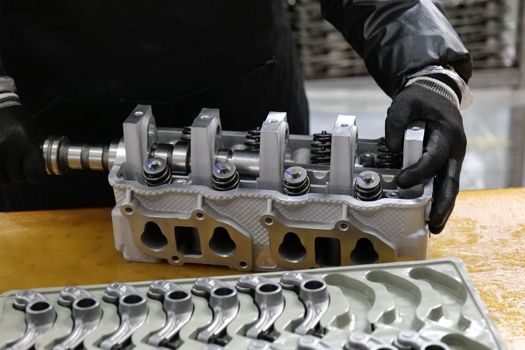
Step one is the cylinder: pick bore, stroke, mounting and cushioning to match load, speed and cycle rate. The 2026 catalogue shows 20–25 mm bore micro-cylinders for small automation and tooling, and 63 mm (2-1/2 in) bore tie-rod units for heavier pushing applications [S9].
Step two is the fitting: match the cylinder port thread (commonly G1/8, G1/4, G3/8 for the 25–63 mm bore range), then choose tube OD to balance flow capacity against flexibility — 6 mm and 8 mm OD dominate 25–63 mm bore circuits. Step three is material: brass for general industrial, technopolymer for compact or low-cost, stainless for washdown or chemical exposure [S2][S3][S4]. Step four is configuration — straight runs use straight fittings, cylinder-mounted valve banks use elbow or swivel fittings to relieve tube stress.
For a broader framework on selecting pneumatic actuators (the cylinder's parent category) and matching them to valve and fitting subsystems, see the pneumatic actuator vs vacuum generator engineering logic reference.
Failure Modes and Field Pitfalls
Cylinder-side failures typically trace to seal wear (NBR or PU rod seals degrading past 80 °C or under unlubricated air), rod bending from side-load, and cushioning seal fatigue at high cycle rates. Push-in fitting failures more often come from tube-side issues: under-inserted tube (less than full OD engagement), tube OD out-of-tolerance (oversized OD cracks the collet; undersized OD leaks past the O-ring), or chemical attack on the O-ring or polymer body. NBR seals handle standard mineral-oil-lubricated air; for synthetic oils or aggressive fluids, specify FKM or EPDM [S3][S4].
Pressure spikes above the fitting's rated 12–16 bar band are a common root cause — installing a flow regulator or a quick-exhaust valve upstream protects both the fitting and the cylinder. A fitting rated 16 bar (232 psi) is not the same as a fitting rated for 16 bar continuous with 25 bar spike, and that distinction shows up in cycle-life testing rather than in the data sheet [S3].
Sourcing Landscape: 2026 Catalog and Supply Snapshot

Directindustry's 2026 push-in fitting category lists 106 manufacturers offering 516 products, with European names (AIGNEP, A&T Fluid Solutions, BEULCO, BAK Technology) and Asian suppliers (Beswick, Baoji Yinggao, Ningbo Senya) competing across brass, technopolymer and stainless lines [S1]. Made-in-China's pneumatic-connector category lists 2,000+ manufacturers with 6,000+ products, with MOQs as low as 50 pieces at $1.84–1.99/piece for general-purpose brass fittings and unit pricing down to $0.10–1.50 for plastic push-in fittings on bulk orders [S6][S7][S8]. Amazon's 2026 industrial best-sellers for pneumatic air cylinders are dominated by TAILONZ PNEUMATIC micro-cylinders (MAL25×50, TN20-100, SC 63 × 200) with pricing in the same low-tens-of-dollars band [S9].
Lead times in mid-2026 remain short for stock brass and technopolymer fittings (1–3 weeks ex-Asia, 3–7 days ex-EU for catalogue sizes), while stainless and special-thread variants typically run 4–8 weeks. Cylinder lead times track similarly — 2–4 weeks for catalogue bore/stroke combinations, longer for non-standard strokes or stainless tie-rods. Track the next two nodes: ISO 15552 bore/stroke standardisation continuing to consolidate tie-rod cylinder SKUs, and Asia-sourced technopolymer fittings pushing deeper into low-pressure (≤10 bar) European OEM builds.
For component-level specifications, see pneumatic cylinder.