
Mill-grade pneumatic tubing selections in 2026 cluster around four polymers (PU, nylon 12, PE, PTFE) and three metals (316/316L stainless, copper, aluminium), with the polymer/metal choice driven by the chemistry, temperature, and pressure of the specific circuit [S1][S2].
Pulp and paper plants run a wider chemistry envelope than most process industries: chlorine dioxide, hydrogen peroxide, sodium chlorate, starch-based adhesives, solvent-based inks, and caustic cleaning fluids all flow through the same compressed-air and fluid-handling skids [S3][S5]. That envelope is what separates a general-purpose pneumatic tubing pick from a mill-spec pick.
Mill Chemistry Envelope and What It Does to Tubing
Bleach-plant circuits around Eka ClO2, sodium chlorate, and hydrogen peroxide expose tubing to strong oxidisers at 60–90°C in the injection ring; paper-machine sections add steam, condensate, and size-press starch at 50–80°C; converting areas carry solvent- and water-based inks plus PVA-based adhesives for box and tissue assembly [S5]. ARO's pulp-and-paper pump portfolio lists ink transfer, solvent flushing, lacquer coating, starch/dextrin re-circulation, and corrugate glue as the dominant fluid duties [S3].
Polyurethane (PU) and nylon 12 cover roughly 90% of actuator and signal-air service below 10 bar and 80°C. Where oxidiser splash or wash-down chemistry is routine, 316/316L stainless with FKM seals, rated to 150°C, is the conservative default [S2]. Pneuflex's 316/316L push-in fittings with FKM seals are published for food, beverage, and aggressive-environment service up to 150°C (302°F) [S2].
Selection Criteria by Circuit Type
Four circuits define nearly every tubing decision in a mill: (1) valve-actuator pilot air, (2) sensor and transmitter impulse lines, (3) chemical-dosing injection quills, and (4) ink/adhesive transfer at the converting end. Each maps to a different pressure/temperature/chemistry band. [S3]
For pilot-air and pneumatic actuator circuits at 6–8 bar and ambient, PU (Shore 98A) and nylon 12 (PA12) in 4 mm, 6 mm, 8 mm, 10 mm, 12 mm OD are the industry baseline, with working pressure typically 10–15 bar at 23°C and derated with temperature [S1]. For sensor impulse and pneumatic-conveying bias lines, antistatic PU or conductive nylon is specified to avoid spark risk near powder dust clouds, a common failure mode flagged in pneumatic-conveying bend-loss studies [S7].
Material Comparison: PU vs Nylon 12 vs 316L vs PTFE

On four decision criteria, the four dominant materials line up as follows. Cost per metre: PU and nylon 12 are lowest, 316L stainless is roughly 8–12× higher per metre, PTFE sits between but with higher fitting cost. Maximum continuous temperature: PU 60–80°C, nylon 12 80–100°C, 316L 150°C with FKM seals, PTFE 200°C+. Chemical resistance to ClO2 and H2O2: PU and nylon 12 are marginal, 316L is excellent, PTFE is excellent. Flexibility/bend radius: PU is best (tightest bend), nylon 12 good, 316L and PTFE poor (need tube benders and long radii). [S2]
For new mills, the conservative approach is nylon 12 for general pneumatic service, 316L/FKM in bleach-plant and chemical-skid splash zones, and PTFE only where temperature exceeds 150°C or where solvent-based inks contact the tube [S2]. Pneuflex's ISO 9001:2000-certified composite and stainless push-in range is one of the stocked families that hits these duty points [S2].
Pressure, Temperature, and Bend-Loss Reality
Pneumatic-conveying lines for cellulose fluff, fly-ash-style fillers, and broke-reclaim dust are not the same duty as instrument air. Sharma and Mallick's bend-loss study on fine powders through 90° bends showed that bend radius ratio (R/D) and particle loading dominate pressure drop more than tube material does, with R/D of 6–10 giving the lowest specific loss coefficient for fine powders [S7]. That result carries directly into tubing layout: oversized bend radii save compressor energy and reduce tube-wall erosion in conveying service.
For actuator and FRL drop legs, SMC's standard airline equipment (filters, regulators, FRL combos, soft-start valves) is the upstream reference, and tubing downstream of an FRL should be sized so velocity stays under roughly 15 m/s to keep pressure recovery predictable at the pneumatic cylinder [S1].
Who 316L Is, and Is Not, For
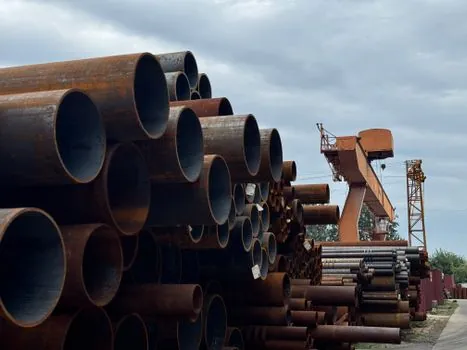
316L with FKM seals is the right call when the tube sees bleach-plant splash zones, hot caustic CIP, or solvent-based ink and lacquer transfer near the coater; it is also the right call in any hygienic or sanitary tissue-converting line where routine wash-down is the norm [S2][S3]. It is the wrong call for general instrument-air drops across a paper machine, where the cost premium is not justified and the tube will spend its life in dry, ambient, oil-free air.
PU is not the right call for outdoor bleach-area runs in winter: below roughly -20°C it stiffens, and microcrack fatigue under vibration becomes a real leak path. For cold-mill outdoor drops, nylon 12 or PE is the conventional substitute [S1][S2].
Sourcing, Standards, and Trackable Signals
Three trackable items to confirm on a 2026 tubing PO: (a) raw-material traceability to ASTM A269 for stainless or to ISO 7628 for polymer pneumatic tubing, (b) seal compound designation (NBR, FKM, EPDM) matched to the chemistry on the MSDS, and (c) pressure rating at the actual operating temperature, not the 23°C catalogue number. SMC's FRL and airline equipment catalogue remains a useful cross-reference for upstream pressure class and temperature derating [S1]. Pneuflex's 316/316L push-in family is one of the widely stocked lines for aggressive-environment service [S2].
Two market signals worth watching into late 2026: Hygienic NAMUR valves and 3/2 pilot valves in the SMC range continue to displace direct-actuated valves in paper-machine headbox and size-press skids, which shifts the tubing spec toward 4 mm and 6 mm PU on shorter runs [S1]; and ARO's pulp-and-paper pump guidance, covering ink, solvent, lacquer, starch, and glue duties, is now the most explicit OEM duty-list for converting-area tubing selection [S3]. For elastomer-side context on chemical and CIP exposure, the related industrial rubber selection gate map lines up seal choices to chemistry.