Specifying rubber for a mold or die in 2026 comes down to four gates, and the order matters: elastomer family, molding process, ISO 3302-1 tolerance class, then ASTM D2000 line call-out [S3][S5].
Compression molding remains the lowest-cost route for sub-25,000-piece annual volumes of FKM, EPDM, and silicone parts, while injection molding pulls ahead on cycle time (1–4 min versus 3–15 min) and flash control above that band [S4][S5].
Elastomer family selection: what each polymer actually does in a mold
Natural rubber (NR) leads on elasticity, tear strength, and dynamic performance, which is why it stays the default for vibration dampers, springs, and moving industrial components, but it breaks down in heat, oil, ozone, and several chemicals [S3]. EPDM takes over for weather, ozone, and steam exposure; nitrile (NBR) is the workhorse for oil, fuel, and O-ring duty; silicone covers extreme temperature and biocompatibility; neoprene balances oil, weather, and abrasion; and FKM (Viton) handles the most aggressive chemical and high-temperature envelopes [S3][S5].
For industrial rubber selection in tooling contexts, the rule of thumb in 2026 guides is: match the fluid/thermal envelope first, then dynamic duty, then cost. Silicone and FKM win above ~150°C continuous service; NBR wins for petroleum exposure below ~120°C; EPDM wins for steam, brake fluid, and outdoor UV; NR and SBR win for purely mechanical, dry, dynamic applications such as isolator mounts and buffers [S3].
A useful concrete anchor: compression-molded FKM fuel-line grommets for Tier 1 automotive programs typically run around 8,000 pieces per year per part number, exactly the band where compression tooling amortizes faster than injection [S5].
Process route: compression, transfer, or injection
Compression molding loads a preform into an open heated cavity and closes the press; transfer molding forces rubber through runners from a chamber into the cavity; injection molding plasticizes and shoots rubber at high pressure into a closed mold, giving the fastest cycle and tightest flash control [S3][S4].
The 2026 break-even window is geometry- and compound-dependent, but a defensible default sits at 5,000–25,000 pieces per year per cavity, with a 16-cavity compression mold often paying for itself inside the first 1,500 pieces for FKM fuel-system parts [S5]. Tooling envelope for compression runs roughly $2,000–$15,000 per mold, against materially higher injection mold amortization [S5].
Process windows that drive defect rates: mold temperature 150–200°C (302–392°F), clamp pressure 14–28 MPa (2,000–4,000 psi), cure cycle 3–15 min for compression versus 1–4 min for injection [S5]. Preform mass tolerance within ±2% is the practical floor; outside that, flash, voids, and under-fill appear [S5].
Mold materials and design gates
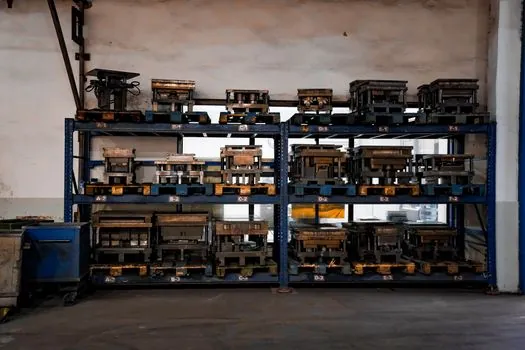
Production compression molds are two-plate tools machined from hot-rolled steel; aluminum is reserved for prototype and short runs because it cuts faster but wears faster [S5]. For higher-cavitation and longer-life injection and transfer tools, hardened steel is the default, with beryllium-hardened copper used in inserts where heat extraction is the bottleneck [S4].
Design gates that consistently come back in 2026 references: parting line placement with minimum draft, gate location and runner layout balanced for flow, venting sized to compound viscosity, and shrinkage compensation built into the cavity (rubber is not a plastic; post-cure swell is real) [S4]. For casting mold and die casting tooling programs that also need rubber-overmolded inserts, the same parting-line and draft rules apply to the rubber half of the tool.
Part size envelope for compression-molded rubber is wide: roughly 0.6 mm to 762 mm (0.024–30 in) per cavity in commercial practice [S5].
Tolerance, standards, and the ASTM D2000 / ISO 3302-1 pairing
Best practical tolerance class for compression-molded rubber is ISO 3302-1 Class M2–M3, which works out to ±0.15 mm to ±0.80 mm depending on the nominal dimension, with the tighter end reserved for small, geometrically stable cross-sections [S5].
Material call-outs go through ASTM D2000 line call-outs: type (heat resistance), class (oil resistance), grade (specific gravity and tensile), and hardness in Shore A. The combination, plus a cure-system suffix, defines the compound for the mold shop and the buyer [S5]. For automotive Tier 1 programs, industrial rubber selection for automotive manufacturing walks the same D2000 logic in higher volume.
Process control references that recur across 2026 vendor guides include PLC-managed temperature, pressure, and dwell, with the cycle parameter window set per compound and geometry; deviation is what converts a good part into scrap [S5].
Comparison: process routes on the four buyer-facing axes
Compression versus transfer versus injection, lined up against the four gates that drive mold-and-die sourcing decisions: [S5]
Cycle time: compression 3–15 min/cure, transfer roughly 2–6 min, injection 1–4 min [S4][S5]. Tooling cost: compression $2,000–$15,000 per mold, transfer and injection materially higher due to runner systems and clamping tonnage [S5]. Flash and tolerance: injection best, transfer next, compression worst (inherent flash ring) [S4]. Volume sweet spot: compression up to ~5,000–25,000 pc/yr, transfer mid-band with metal inserts, injection above that or where zero-flash seals are mandatory [S5].
For mold base and sand casting mold shops adding rubber capability, the practical answer is to start on compression for FKM and silicone runs under the break-even, and only move to injection when the part count, tolerance class, or zero-flash seal requirement forces it.
Limits, failure modes, and what to push back on
Compression molding cannot match injection on flash, so any dynamic seal with a defined flash-free edge should not be specified on a compression tool [S4][S5]. Long cure cycles at 150–200°C also constrain throughput on thick sections, and under-cured parts show compressed-set failure in service; over-cured parts show brittleness and shrinkage outside the ISO 3302-1 window [S5].
Material-side failure modes worth flagging at the spec stage: NR and SBR degrade in oil and ozone, so any "general-purpose rubber" call-out in an oily or outdoor environment should be challenged back to EPDM, NBR, or FKM [S3]. Silicone is soft and tears easily at thin cross-sections, so thin lips and sharp corners need a geometry review before tool cut [S3]. FKM is expensive and slow to cure, so specifying FKM where EPDM would survive is a recurring cost driver on Tier 1 programs [S5].
For adjacent selection work outside elastomers, the same gate-map logic appears in steel plate selection gates for prefabricated construction: grade, thickness, tolerance, then standard.
Sourcing and supplier landscape in 2026

Industrial rubber for mold and die making is sourced from three layers: catalog distributors carrying grommets, bushings, mounts, seals, and die-cuts for MRO and prototyping; custom molders running compression, transfer, and injection cells for production runs; and engineered-solution houses that take a vibration, shock, or sealing problem and return a tested assembly [S2]. Catalog houses also publish chemical compatibility charts and ASTM D2000 designation guides, which are worth pulling into the spec before RFQ [S2].
Capable compression and injection molders are concentrated in India, China, the US Midwest, and Germany; the 2026 supplier rankings group them by material breadth (silicone, FKM, EPDM, NBR) and by cavity count capability [S1][S8]. For low-volume, high-mix work, custom-engineered houses still outperform general fabricators because the mold design, runner layout, and venting are tuned per compound rather than per cavity [S6][S7].
Sustainability is moving into the spec in 2026: industrial mold preheating of the rubber blank, recovered flash, and lower-cure-temperature FKM compounds are now quotable line items rather than marketing [S9].
Two trackable signals for the next sourcing cycle: ASTM D2000 revision activity around fluid-resistance classes, and injection-mold cavity counts for FKM crossing 32 cavities in commercial production, both of which would shift the compression-versus-injection break-even band [S5][S9].