
Polyurethane, nylon 12, polyethylene, FEP, and Kynar each cover a different duty window in compressed-air circuits, and choosing wrong is the single biggest source of leaks in OEM pneumatic panels. The four spec gates that decide a pneumatic tubing buy are: tube OD matched to the pneumatic fitting, pressure rating versus circuit working pressure, temperature window, and chemical compatibility with the lubricant and the environment.
Standard stock sizes in metric and inch OD, sold in 50 ft to 500 ft reels, dominate procurement runs; AutomationDirect's NITRA nylon 12 (PN N8MBLK500) ships at 6 mm ID x 8 mm OD (5/16 in) on a 500 ft reel weighing 9.1 lb, while the bonded PU twin (PN 2PU08M-50) is 5 mm ID x double 8 mm OD on a 50 ft pack at 2.4 lb [S6][S9]. Pneumatic tubing families are not interchangeable: pushing nylon where a flex-loop needs PU cracks the tube at the bend.
Polymer family: PU, nylon 12, PE, FEP, Kynar, PVC
Polyurethane (ether-based, 85A durometer typical) gives the lowest bend radius and the best memory in coiled and bonded multi-tube bundles, and is the default for robotics and short stroke pneumatic cylinder feeds where flex life is the dominant spec [S9]. Nylon 12 (semi-rigid, higher pressure) is the workhorse for fixed-run pneumatic control panels and is offered in 500 ft reels for cabinet builds [S6]. Polyethylene is the low-cost option for low-pressure instrument air under about 1 MPa, while FEP and Kynar (PVDF) cover chemical-duty loops and higher temperatures; Polyconn's published specialty line lists FEP, Kynar, D.O.T. nylon, static-dissipative, and weld-spatter variants alongside the commodity plastics [S3]. PVC sits at the bottom of the temperature and pressure envelope and is used mainly for air and water drop lines.
Sizing: OD/ID, tolerance, and color coding
Tubing OD is the controlling dimension for a push-in fitting seal; ID drives pressure drop and flow capacity. The two stock sizes that show up on most North American bills are 6 mm (1/4 in) OD and 8 mm (5/16 in) OD, with 4 mm and 10 mm and 12 mm as the common neighbors; the inch-pattern equivalent of 8 mm OD, namely 5/16 in (0.312 in) OD, is what AutomationDirect's N8MBLK500 actually carries on its spec sheet [S6]. Bonded PU twins (two 8 mm OD tubes co-extruded) keep paired cylinder lines tidy and avoid the differential-flex snag of running two separate lines [S9]. Color coding (black, blue, clear, green) is functional, not decorative: black PU is UV-stabilized for outdoor runs, blue is the de-facto standard for 80 psi shop air, and clear is used only where condensation or contamination must be visible.
Tolerance stack matters more than catalog OD. A push-in fitting grips the OD with a collet; if the tube is undersize, it slips; if oversized, the collet cannot seat. Hold +/- 0.1 mm on the OD for metric sizes and trust the fitting maker's recommended tube list, not a generic "8 mm" label. For related dimensional logic on thread and OD matching that flows directly from fitting to tube, the push-in fitting sizing gates walk-through is the natural follow-on read.
Pressure, temperature, and bend radius limits
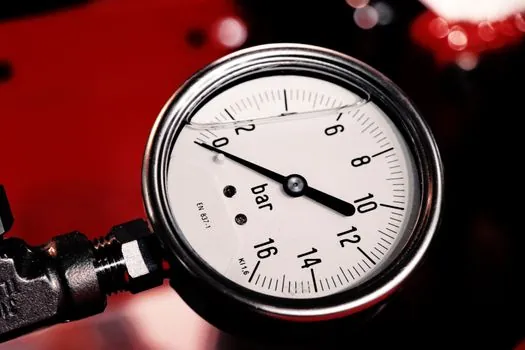
Working pressure for commodity nylon 12 and PU at 23 deg C sits roughly in the 1.0-1.5 MPa (145-220 psi) window, with a 3:1 safety factor to burst typical; high-pressure PU goes higher but is a special-order line. Temperature windows split sharply: PU is rated from about -40 deg C to +80 deg C, nylon 12 from -40 deg C to +100 deg C, FEP and Kynar push to +200 deg C, and PVC tops out near +60 deg C. Polyconn lists PU coiled, nylon, PE, PVC, FEP, Kynar, D.O.T. nylon, static-dissipative, multi-bore PU, multi-color ribbon PU, and weld-spatter variants as separate stocking categories, each with its own pressure/temperature envelope rather than a single shared rating [S3]. Bend radius for PU at 8 mm OD is roughly 25 mm, against 40-50 mm for nylon 12, which is why moving axes pick PU every time.
Vacuum and suction-side runs invert the pressure logic: collapse pressure, not burst, is the limit, and thin-wall PU under-vacuum must be supported against collapse by a stiffener or a larger wall. Static-dissipative tubing (typically conductive carbon-loaded PU or PE) is specified where a spark from air-borne particulate is unacceptable, such as paint lines and solvent dosing skids; this is a safety selection, not a performance one [S3].
When to deviate from the default nylon 12 or PU
Default nylon 12 covers 70-80% of general industrial compressed-air panel work, and default ether-based PU covers most moving-cable and short-coil applications; deviation has to be justified by one of four triggers [S3]:
1. Chemical exposure (solvents, oils, acids) where nylon 12 and standard PU swell or embrittle, forcing FEP or Kynar.<br>2. High temperature (above +80 deg C ambient or +60 deg C fluid) where PU softens and PVC loses its pressure rating, forcing nylon 12, FEP, or Kynar.<br>3. Outdoor or UV-exposed runs where standard PU yellows and embrittles, forcing carbon-black-loaded PU or PE.<br>4. Weld-spatter or spark exposure where standard PU burns through, forcing the dedicated weld-spatter PU variant.
For most other duties, the cost gap between the premium polymers and commodity PU/nylon is not justified; an FRL prep section with standard 80 psi clean dry shop air, ambient 20-40 deg C, and indoor routing is the textbook case for either a 6 mm or 8 mm OD nylon 12 reel on a 500 ft pack [S6].
Comparison: PU vs nylon 12 vs PE vs FEP vs Kynar

Across the four main polymers stocked by the major pneumatic distributors, the spec windows line up like this (values reflect typical catalog limits, not a single part number): [S4]
- Polyurethane (PU, ether-based): best flex memory and lowest bend radius; working pressure ~1.0-1.5 MPa at 23 deg C; temperature -40 to +80 deg C; poor chemical resistance to strong acids and ketones; default for robotics, short coils, bonded twins, and pick-and-place pneumatic actuator feeds [S3][S9].<br>- Nylon 12 (PA12): semi-rigid, best general-purpose air, lower permeability to air than PU, working pressure similar to PU but with better creep behavior at elevated temperature; temperature -40 to +100 deg C; not for strong acids or chlorinated solvents; default for control panels and long straight runs [S3][S6].<br>- Polyethylene (PE): lowest cost, lower pressure (~0.7-1.0 MPa), temperature -40 to +60 deg C; default for low-pressure instrument air and water; UV-stabilized grades for outdoor drip irrigation [S3].<br>- FEP (fluorinated ethylene propylene): chemically inert, semi-rigid, higher cost; temperature up to +200 deg C; default for chemical dosing and lab gas lines where PU and nylon both fail [S3].<br>- Kynar (PVDF): the toughest of the fluoropolymers in this group, with the best mechanical strength and chemical resistance; higher cost than FEP; used where FEP creeps or where the line sees mechanical loading plus aggressive chemistry [S3].
Procurement, standards, and sourcing gates
HS code 3917.32 covers plastic tube, pipe, and hose with fittings, and HS code 3917.29 covers plastic tube, pipe, and hose without fittings, which is the line used on the AutomationDirect bonded PU part [S9]; this matters for customs paperwork and country-of-origin claims, not for the in-line spec. D.O.T. nylon (FMVSS 106/49 CFR 393.45 air-brake nylon) is a separate sub-line for vehicle air-brake systems and is not interchangeable with general-purpose nylon 12 [S3]. ISO 9001 certification of the tubing manufacturer, not the distributor, is the baseline QA gate; Pneuflex publishes ISO 9001:2000 certification and operates 30+ country distributor coverage for metric and inch push-in systems [S8].
For OEM sourcing, the practical shortlist logic is: (1) confirm OD against the fitting maker's recommended tube list, (2) confirm pressure rating versus the FRL outlet (typical 1.0 MPa / 145-150 psi), (3) confirm temperature and chemical compatibility, (4) confirm reel length versus annual consumption to get the 500 ft reel discount tier, and (5) confirm HS code and country of origin for the import paperwork. Tracking signals to watch are: FDA- and EU 1935/2004-food-contact variants for food and beverage skids, static-dissipative variants for paint lines, and weld-spatter PU for body-in-white robotic cells, all of which are cataloged as separate stocking lines rather than specials [S3]. The cross-reference between fitting body port size, thread standard (NPT, BSPP, BSPT, metric), and tube OD is the part that trips the most RFQs, and the push-in fitting sourcing map lays out the factory-side view of that fit.