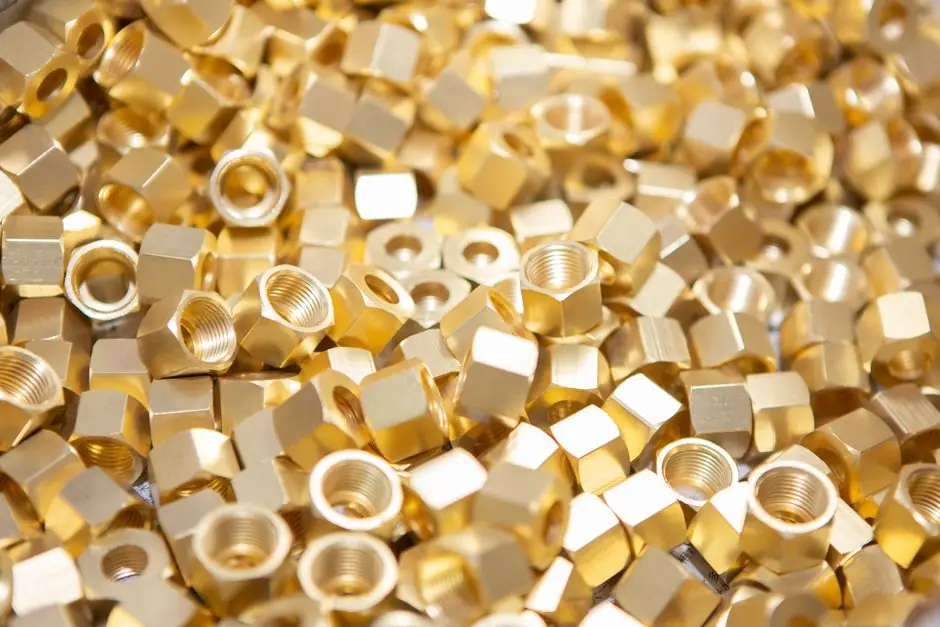
A push-in fitting is selected by four nested parameters: tube outside diameter, thread standard and size, body material, and rated pressure/temperature window. Pneuflex composite push-in fittings accept metric tube OD from 4 mm to 16 mm and inch tube OD from 1/8 in to 1/2 in, with thread sizes from BSPP G1/8 to G1/2 [S2].
Working pressure on the composite line is rated 0-1.0 MPa (0-150 psi) with a proof pressure of 3.0 MPa (435 psi) and negative-pressure tolerance of -100 kPa (-29.5 in Hg) [S2]. All-metal variants such as the Festo NPQM series target harsher media and higher thermal duty where the PBT body of a composite unit would soften or swell [S1].
Tube OD and Thread Family: The First Gate
The tube OD determines the collet (gripper) size; a 6 mm OD tube cannot seal in an 8 mm bore, and an 8 mm tube cannot enter a 6 mm fitting, so OD matching is the first hard gate [S2]. Inch and metric OD families are not interchangeable, even when nominal sizes look close (e.g. 1/4 in = 6.35 mm vs metric 6 mm), because the gripper and O-ring land are machined to the exact OD.
Thread family is the second gate. BSPP (G-thread) is dominant on European pneumatics including the Festo NPQM and Pneuflex composite lines, while NPT is common on North-American equipment and R/Rc taper threads on Japanese machines [S2]. Mixing an NPT male into a BSPP female will seal for a few cycles and then weep, because the thread flanks have different angles (60° vs 55°) and pitch counts differ between the two systems.
Seal strategy follows the thread family: BSPP parallel threads rely on a bonded O-ring or a captive sealing washer, while NPT and R taper threads seal on the thread flanks with PTFE or anaerobic paste. Push-in fittings are almost always supplied with a pre-applied O-ring on the male thread; reusing the O-ring is fine, but losing it on disassembly is a common leak path on field-serviced manifolds [S2].
Body Material and Pressure Class Comparison
Three body constructions cover nearly every push-in specification a buyer will see: all-polymer, composite (polymer body with metal thread and collet), and all-metal. Pneuflex publishes the composite variant as nickel-plated brass thread with a PBT (polybutylene terephthalate) body, stainless-steel lock claw, and NBR O-ring, working 0-60 °C at 0-1.0 MPa [S2]. The Festo NPQM is the cost-effective metal counterpart for higher-temperature and chemically more aggressive service [S1].
The selection question is which duty window applies. The table below lines the three constructions against four decision criteria a process engineer actually weighs:
All-polymer bodies: lowest cost, lightest weight, suited to OEM cabinet builders running dry air below 60 °C and 0.8-1.0 MPa. Limited chemical resistance; acetone, MEK, and brake-fluid vapours will craze PBT and PA bodies within weeks.
Composite (PBT body + brass thread + stainless collet, NBR seal): the workhorse. Working pressure 0-1.0 MPa, working temperature 0-60 °C, proof pressure 3.0 MPa, accepts PU, PA, PE, and PVC tubing, and tolerates vacuum down to -100 kPa [S2]. This is what shows up on 80% of factory pneumatic manifolds and on most packaging machinery.
All-metal (e.g. Festo NPQM, QS series in nickel-plated brass or stainless): the duty choice. Higher temperature ceiling (commonly up to 150 °C on stainless bodies, depending on seal), wider chemical compatibility, and resistance to mechanical damage in washdown or outdoor cabinets. Costs 3-6x the composite price for the same thread/OD combination, based on the QS-1/4-4 line-item pricing visible in third-party listings [S4].
Pressure, Vacuum, and Temperature Ratings You Must Respect
Working pressure, proof pressure, burst pressure, and vacuum tolerance are four distinct numbers; a fitting rated 1.0 MPa working is typically proof-tested at 3.0 MPa and bursts above 6 MPa, so the 1.0 MPa figure is the operating ceiling, not the safety margin [S2]. Pneuflex states proof pressure 3.0 MPa (435 psi) on its composite line, which is a 3:1 safety factor over the working pressure, consistent with ISO 14743 for pneumatic compression fittings on thermoplastics tubing.
Vacuum service is rated to -100 kPa (-29.5 in Hg), which covers every practical pick-and-place vacuum generator downstream but does not reach deep rough vacuum below 1 kPa absolute [S2]. If the application is a vacuum clamp holding a sheet-metal panel at -90 kPa, a composite push-in fitting is fine; if it is a vacuum chamber for degassing at 10 Pa, the collet seal will leak and a flare or compression fitting is the correct call.
Temperature window on composite PBT/NBR bodies is 0-60 °C (32-140 °F) for the working fluid [S2]. Below 0 °C, the NBR O-ring stiffens and the PBT body becomes notch-sensitive; above 60 °C, the body's heat-deflection threshold is approached. All-metal NPQM-type fittings raise the ceiling substantially, with the residual limit usually being the FKM or EPDM seal rather than the metal body [S1].
Tubing Compatibility and Sealing Behaviour
Push-in fittings grip by a stainless-steel lock claw (typically SUS304 or SUS316) biting into the OD of the tube; the harder and smoother the tube, the more secure the grip and the more re-installation cycles the joint survives. Pneuflex lists PU, PA, PE, and PVC as applicable tube materials, and the Festo NPQM metal series uses the same plastic-tube list plus limited PTFE and FEP support depending on the collet variant [S2].
PU (polyurethane) is the softest of the four and gives the easiest insertion, the lowest disconnection force, and the best seal on slightly oval tube ends. PA (nylon / polyamide) is stiffer, holds pressure surges better, and is the default for factory airline drops. PE is the cheapest and is used in low-cycle applications; PVC is specified when the line must be transparent for visual bubble checks during commissioning.
Hardness is not optional: most push-in manufacturers require the tube to be in the Shore D 50-70 range, and harder polyamide 12 (PA12) is preferred over PA6 for hot-moisture applications because PA6 absorbs more water and changes OD. The connection relies on the O-ring on the thread and the collet-to-tube friction for sealing; thread sealant is not used on BSPP and must not be applied to the seating face [S2].
Common Configurations and Where Each Fits

Straight, elbow, tee, Y, banjo, and bulkhead are the six geometries stocked by every major brand; Pneuflex publishes all six on its metric composite line in the 4-16 mm OD window [S2]. A straight connector is the cheapest and the default for cabinet-to-actuator drops; an elbow is used where the tube has to rotate 90° relative to the port without kinking; a tee is for pilot-air distribution to two devices from one upstream port.
Banjo fittings allow a bolt-through stud on the cylinder port so the fitting can swivel, useful on compact cylinders where the port orientation has to be set after assembly. Bulkhead fittings pass through a panel and seal on both sides with an O-ring and a locknut, and they are the right answer for enclosure walls where the air supply must enter from outside without a hose barb.
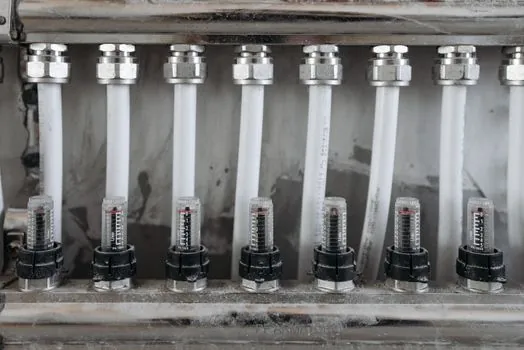
Manifold-style push-in blocks (multi-port distributors) reduce fitting count on densely packed valve terminals; the Festo MS series and equivalent Pneuflex manifolds use the same push-in OD on every port, which simplifies tube-bundle layout [S3]. For higher-pressure hydraulics, refer to the related guide on threaded and compression pipe fittings rather than push-in, because hydraulic pressure ratings of 21-35 MPa are far above the composite push-in working ceiling.
Selection Shortlist: Who Push-In Fits and Who It Does Not
Push-in fittings are the right answer for dry compressed air, vacuum to -100 kPa, and inert gas at 0-1.0 MPa in ambient factory conditions, which covers roughly 80% of pneumatic control circuits on packaging, assembly, and material-handling lines. Composite PBT/brass units with NBR seals are the default for cabinet builders and OEM machine builders, while all-metal NPQM-style units are specified where temperature, chemical exposure, or mechanical abuse rules out polymer [S1][S2].
Push-in is the wrong answer for hydraulic oil at 10-35 MPa (use pneumatic-class fittings only as a reference, not as a substitute, and select hydraulic flare or O-ring face-seal fittings instead), for high-temperature steam above 150 °C (use stainless compression fittings), and for ultra-high-purity semiconductor or pharmaceutical process fluids where dead-leg volume, extractables, or particle generation matter. A related selection discipline for vacuum generator duty uses push-in fittings on the vacuum and exhaust ports of a Venturi or cartridge generator, and the same pressure gates apply [S2].
Spec the fitting in this order: (1) tube OD, (2) thread family and size, (3) body material vs media and temperature, (4) pressure class, (5) seal elastomer (NBR default, FKM or EPDM for chemicals or heat), (6) geometry. Festo offers the NPQM push-in fitting in a metal, standard configuration [S1], and Pneuflex supplies metric composite push-to-connect fittings accommodating metric tubing O.D from 4 mm to 16 mm with BSPP thread sizes from G1/8 to G1/2 [S2].
The underlying component specifications are covered under lighting equipment and electric lamps.