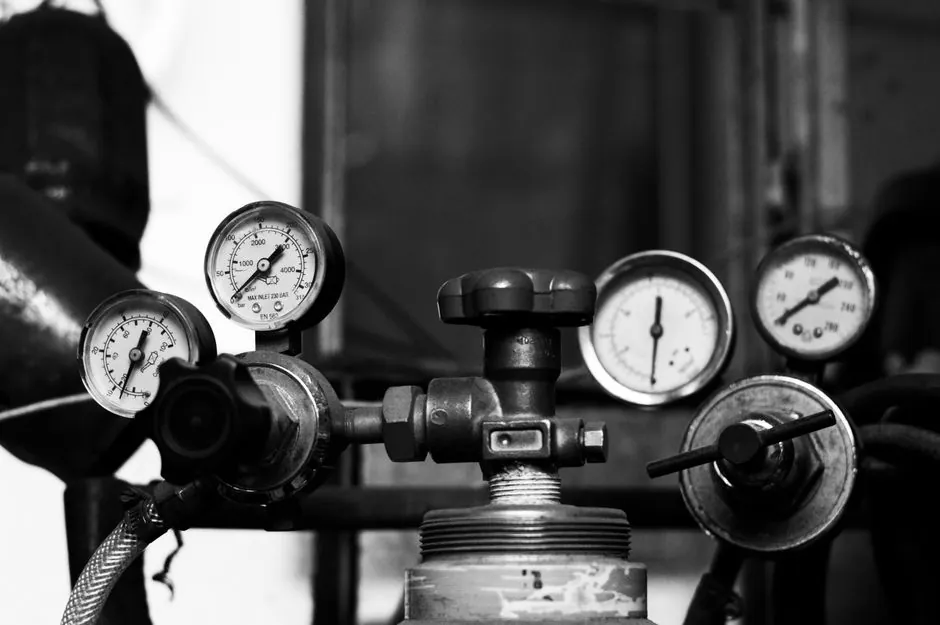
Electronic pressure sensors can respond in 2–4 ms on typical modern models, while pneumatic systems may add line-transmission and pneumatic response delays beyond the sensing element [S5].
The comparison depends on whether response time means the sensor element alone or the complete measurement loop, including conditioning, transmission, sampling, and control action.
Response time starts at the pressure element
Response time is the interval required for a pressure sensor to reach the specified portion of a final pressure change; a 1 ms response commonly means reaching 90% of the full change [S1].
That distinction matters because a fast element does not guarantee a fast field signal. A complete pressure transmitter can include a sensing element, signal conditioning, power supply, and standardized output, with electronic output commonly provided as 4–20 mA dc or a digital signal [S2][S4].
Most standard and modern pressure sensors have a stated response of less than 2–4 ms depending on the model, while specialized environments can have substantially different dynamics [S5]. Published examples range from 250 microseconds for a high-performance engine application to 10 ms for a weather-station application [S1].
Pneumatic and electronic delays occur in different places
A pneumatic pressure transmitter produces a 3–15 psig analog pneumatic output, whereas an electronic pressure transmitter produces a 4–20 mA dc or digital electronic output [S2]. The pneumatic path can include a restricted manifold, tubing, and receiving-controller dynamics, so the pressure-sensing element is only one part of the observed response.
Electronic systems avoid pneumatic air-column delay, but they do not eliminate processing delay. Analog outputs can provide a direct, continuous signal with minimal processing delay in simple systems, while transmitter electronics may still amplify, filter, linearize, and convert the measurement before transmission [S3][S4].
The practical comparison is therefore: pneumatic response is dominated by mechanical and pneumatic path behavior, while electronic response is dominated by element dynamics, signal conditioning, filtering, conversion, and acquisition. Neither architecture is automatically faster without comparing complete assemblies.
Compare speed, transmission, and installation
Electronic pressure measurement is normally the better choice when milliseconds-level tracking, compact installation, or direct controller input is required. A pressure sensor converts mechanical pressure in a gas or liquid into an electrical signal, and modern models can provide 2–4 ms or faster element response [S5][S6].
Pneumatic pressure measurement remains relevant where pneumatic control infrastructure already exists or where electrical interference at the sensor-to-controller link is a governing concern. It is less attractive for compact installations, long cable runs, distributed data acquisition, or applications requiring a digital process value.
For high-speed engine or machinery testing, neither a generic pneumatic transmitter nor a standard electronic sensor should be selected from broad category descriptions alone. The sensor's stated settling criterion, full pressure step, sample rate, and filtering configuration must match the pressure waveform being measured [S1][S4].
Use the correct time metric
Response time, resolution, and sampling rate are separate specifications. Resolution describes the smallest detectable pressure increment, sampling rate describes how often a value is captured, and response time describes how quickly the output settles after a pressure change. [S1]
A sensor can therefore have fine resolution yet a slow response. The medical-sensor example in the research detects 0.1 psi changes but has a 50 ms response, while an engine-speed sensor has a 1 ms response with 1 psi sensitivity [S1].
For digital systems, acquisition rate and any additional filtering also affect the displayed result. Response specifications should be compared under equivalent conditions, including pressure step size, media, temperature, excitation, output loading, and the percentage of final value used to define settling [S1][S5].
Match the architecture to the application

Use electronic pressure sensing for fast transient measurement, modern distributed control, compact panels, or installations where 4–20 mA and digital data are preferred. Published electronic examples include 250 microseconds, 1 ms, and generally less than 2–4 ms across different models and applications [S1][S5].
Use pneumatic pressure transmission when the control loop is already pneumatic, the installation distance is manageable, and the operator needs a 3–15 psig signal rather than an electrical current or digital value [S2]. Do not use the sensor element's response figure as the complete pneumatic loop response.
Pneumatic systems are not the right fit for high-bandwidth waveform capture unless the full pneumatic path is characterized. Electronic sensors are not automatically suitable for every hazardous or electrically noisy location; enclosure ratings, hazardous-area certification, media compatibility, and grounding must be checked separately.
Specify the complete signal chain
A fair procurement comparison requires four numbers: pressure-sensor response time, transmitter response time, controller or receiver update time, and overall loop settling time. For electronic transmitters, record the output type, sampling rate, filter settings, and whether the quoted time applies to the sensor element or the complete transmitter [S2][S4].
For pneumatic transmitters, record the 3–15 psig output, manifold and tubing restrictions, receiving-controller characteristics, and measured step response. For electronic systems, record 4–20 mA or digital output, cable length, shield and grounding arrangement, input impedance, and data-acquisition sampling rate.
Before acceptance, apply the actual pressure step and compare the captured waveform against the required settling percentage. Trackable signals are the manufacturer's specified response criterion and the measured end-to-end delay from pressure change to usable controller or recorder value.