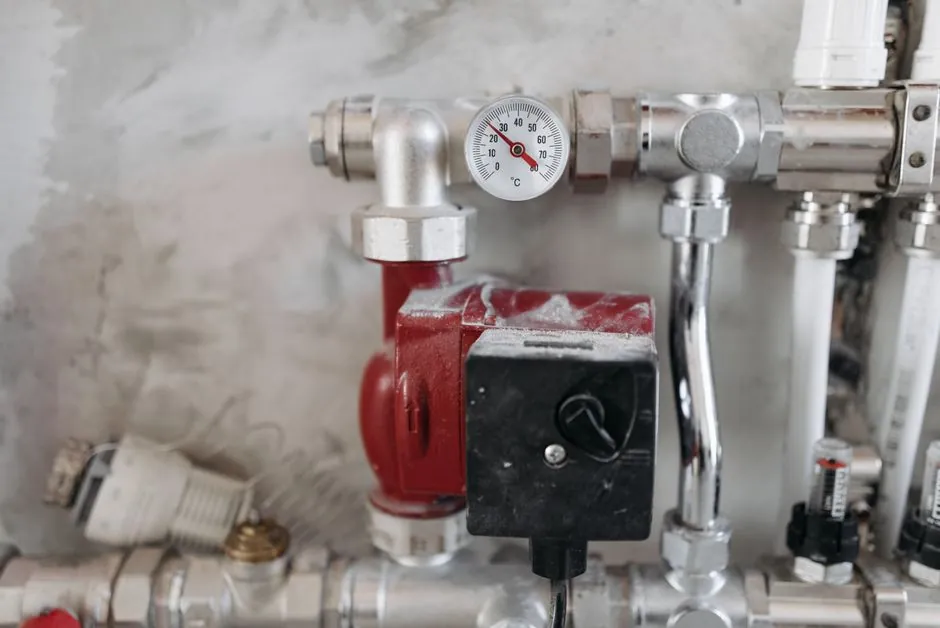
Hydraulic hand pumps commonly reach 10,000 psi, or approximately 700 bar, making them the practical choice for high-pressure testing and force generation [S2][S5].
Pneumatic hand pumps can produce useful pressure, but their practical ceiling is lower and more dependent on pump construction, air supply, trapped volume, and outlet restriction; a universal pneumatic maximum cannot be stated from the available engineering data [S1][S4].
Maximum Pressure by Pump Type
Hydraulic hand pumps provide a portable source of hydraulic pressure where electricity and compressed air are unavailable [S2]. Hydraulic hand pumps supply pressure for testing, adjusting, and calibrating measuring instruments [S3][S5].
Pneumatic hand pumps do not share a corresponding industry-wide maximum rating. Their output depends on the compression chamber, leakage path, check-valve arrangement, and resistance imposed by the connected pneumatic cylinder, valve, hose, or test instrument.
The practical comparison is therefore hydraulic at 700 bar for high-pressure work, versus pneumatic at a lower pressure whose rating must be taken from the specific pump data sheet. The research supports the hydraulic ceiling but does not establish a defensible universal pneumatic ceiling, and values above 3,000 psi should not be inferred from a general pump description [S6].
Why Hydraulic Reaches Higher Pressure
Liquid hydraulic oil is nearly incompressible, allowing a small pump displacement to create a large load at the outlet. The pump transmits force to the fluid, and system resistance converts that flow into pressure [S1]. This behavior is the basis for using a manual hydraulic pump in testing, calibration, lifting, and emergency backup applications.
Air is compressible, so more energy is required to raise its pressure.
That efficiency gap applies to pneumatic equipment generally, not only hand pumps, but it explains the engineering penalty at the cylinder. For the same force, hydraulic pressure can be lower because incompressible oil transmits force more efficiently than compressed air [S4]. A pneumatic hand pump is consequently more appropriate where clean exhaust, moderate force, cyclic motion, or low equipment cost matters more than very high pressure.
Pressure Versus Flow and Control
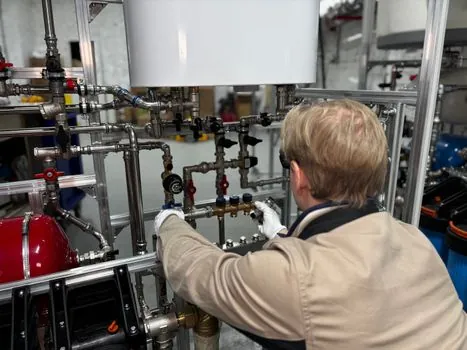
Maximum pressure alone does not identify the better pump. A two-speed hydraulic hand pump uses a high-flow, low-pressure stage to position a cylinder quickly and a low-flow, high-pressure stage for controlled lifting or fine pressure adjustment [S2]. A single-speed pump provides consistent flow on each stroke and is simpler to maintain, but it is less efficient when both rapid positioning and high final pressure are required [S2].
By comparison, pneumatic output is more affected by compression and expansion of the gas, making stable pressure control dependent on the regulator, receiver, valve arrangement, and load behavior.
The hydraulic actuator must also be rated for the full pressure and duty cycle. Selecting a 10,000 psi pump for an application needing 5,000 psi can add unnecessary cost and handling burden without improving the work [S2]. Match the pump, cylinder, hose, valve, and instrumentation to one pressure basis rather than treating the pump nameplate as a complete system rating.
Use Cases and Selection Criteria
Hydraulic hand pumps suit pressure calibration, lifting, and operation where electricity or compressed air is unavailable [S2][S3][S5]. For these jobs, a unit rated to 10,000 psi or 70 MPa provides a documented high-pressure capability [S5].
Compare options by four criteria. First, pressure: hydraulic reaches about 700 bar, while pneumatic requires a model-specific rating. Second, force efficiency: hydraulic is favored because oil is nearly incompressible, whereas compressed air loses more energy through compression and expansion [S1][S4]. Third, control: hydraulic is stronger for fine adjustment and high-pressure testing, with adjustment stated within 0.01 to 0.069 kPa [S5].
Limits, Failure Modes, and Sourcing
Do not select from generic “maximum pressure” claims alone. Confirm the rated working pressure, proof pressure if specified, fluid compatibility, outlet connection, reservoir capacity, and temperature limits in the pump's own documentation. The 10,000 psi figure describes common hydraulic hand-pump capability, not permission to expose every hose, coupling, valve, or cylinder to that pressure [S2][S5].
For pneumatic equipment, include the receiving pneumatic actuator, supply-air pressure, regulator capability, receiver volume, hose losses, and service restrictions. A pump can reach its apparent peak while the connected system cannot safely hold it. Mechanical stops, dead-head heating, leakage past seals or check valves, and operator fatigue are more relevant than headline pressure when evaluating repeated duty [S1].
No specific standard is needed to make the broad pressure comparison because the available material does not establish a universal pneumatic hand-pump pressure rating. For procurement, record the pump model, rated pressure in psi and bar or MPa, operating medium, maximum operating temperature, stroke type, flow behavior, and the pressure rating of every connected component. These records make a 10,000 psi hydraulic selection auditable and prevent an unverified pneumatic maximum from entering the equipment specification.
Next, record the actual downstream resistance and required force, then compare the pressure rating of the pump, cylinder, hose, valve, and gauge on one unit basis. The decision signal is simple: use a hydraulic pump for 5,000 to 10,000 psi class work, and require a model-specific rating before accepting a pneumatic hand pump for any application above ordinary plant-air service.