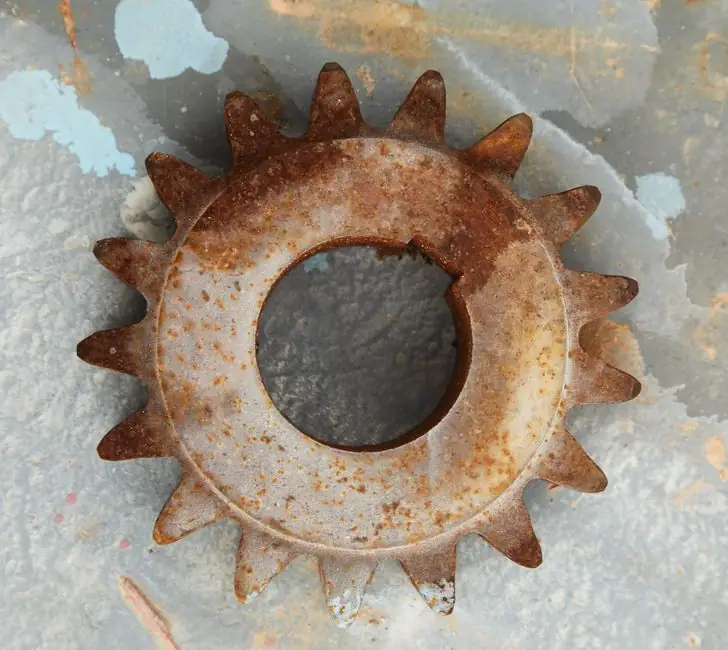
POM homopolymer delivers higher tensile strength (68-70 MPa) and fatigue endurance, while POM copolymer provides better hydrolysis resistance above 60°C and freedom from centerline porosity in thick sections [S3][S4].
Both grades share a density of 1.41-1.42 g/cm3, water absorption of 0.2-0.25%, and a coefficient of friction against steel of roughly 0.2, so the gear decision is driven by service environment, cycle count, and section thickness rather than headline numbers [S3].
Mechanical Baseline: Stiffness, Strength, and Fatigue
Unfilled acetal grades deliver tensile strength of 60-75 MPa, flexural modulus of 2,500-3,200 MPa, and compressive strength of 100-140 MPa, with POM-H sitting at the upper end of each range because of its 70-80% crystallinity and uninterrupted oxymethylene chain [S2][S3]. POM-H also posts the higher heat deflection temperature within the family, typically 136°C versus 110°C for POM-C at 0.46 MPa load, which translates directly into a stiffer tooth root at elevated gear-housing temperatures [S3].
For gear-tooth bending and pitting life, the practical advantage of POM-H is fatigue endurance: its continuous chain resists cyclic crack initiation better than POM-C, and Delrin is the named homopolymer grade that gear designers default to when cycle count is the design driver [S4][S5]. POM-C is not weak, only slightly lower in stiffness and creep modulus, so it remains acceptable for low-cycle or lightly loaded gears where the trade is worth the chemical and machining benefits [S2][S4].
Service Environment: Heat, Moisture, and Chemicals
POM-C retains useful properties in hot water and steam above 60°C because the comonomer units (typically ethylene oxide or 1,3-dioxolane) interrupt the chain and resist the unzipping reaction that attacks POM-H in the presence of moisture and heat [S3][S4]. POM-H is sensitive to strong alkalis and sustained hot water, with documented microcracking at stress concentrations in steam-sterilized medical gear assemblies after roughly three months of service [S3].
For chemical resistance beyond water, POM-C also tolerates strong bases better than POM-H, while both grades perform poorly against strong acids and cannot be painted or bonded without surface treatment [S2][S4]. A 2024 Guangdong medical-device failure is the textbook example: homopolymer gears in a steam-sterilized assembly cracked at stress raisers within 90 days, and the root cause was a material mismatch, not a design error [S3].
Centerline Porosity and Machining Geometry

POM-H is prone to centerline voids, sometimes called pith, especially in large-diameter rod stock above about 3 inches, which can produce leak paths and cosmetic defects in machined gears [S4][S5]. POM-C is virtually porosity-free because the comonomer disrupts the crystallization pattern, making it the default choice for thick-section gears, large-diameter pinions, and any part that must be leak-tight or visually clean after machining [S4].
Machinability is excellent for both grades with standard carbide tooling, but POM-C is more forgiving on deep cuts, thin walls, and demanding setups where chip evacuation and dimensional consistency matter [S2][S4]. POM-H machines to a cleaner surface finish under controlled conditions, which matters for gear flanks where surface roughness drives contact stress and noise [S9].
Decision Matrix for Gear Selection
Four criteria sort almost every gear application: fatigue cycle count, peak service temperature in the presence of moisture, presence of alkaline chemicals, and section thickness. Match them as follows: high-cycle dry gears below 60°C in moderate section thickness select POM-H (Delrin); gears exposed to hot water, steam, or alkaline cleaners select POM-C; gears in large-diameter rod stock above 3 inches select POM-C to avoid pith; gears requiring the highest stiffness and heat deflection within the acetal family select POM-H [S3][S4][S5].
When temperature climbs above 100°C continuous or strong acid exposure appears, neither unfilled POM grade is the right answer; PEEK, at 10-15x the cost, becomes the correct selection per the high-performance comparison [S5]. For dry, lubricated, or grease-fed gears with moderate humidity variation, PA66 is the relevant alternative to evaluate, and the trade-off is moisture-driven dimensional change versus higher continuous service temperature [S5][S6].
Additive-Modified Grades and Lubrication
POM-H filled with PTFE, commonly marketed as POM-H+PTFE or Delrin AF-grade equivalents, adds Teflon fibers that create a self-lubricating surface and lower the coefficient of friction further, which is the standard path for high-load dry-running gears where external lubrication is impractical [S4]. PTFE-filled POM-H is also harder and wears better in dry sliding than unfilled homopolymer, at the cost of slightly reduced tensile strength compared to neat POM-H.
For oil- or grease-lubricated gears, the choice between unfilled POM-H and POM-C is less critical because the lubricant carries the wear load, and the selection logic reverts to temperature, chemical exposure, and section thickness rather than tribology [S5][S6]. Nylon 66 absorbs lubricant and remains competitive in oil-fed gearboxes, but its 1.0-2.0% water absorption at saturation causes dimensional drift that POM's 0.2% avoids, which is why POM remains the default for precision instrument gears regardless of lubrication scheme [S2][S6].
Selection Workflow and Trackable Signals
The shortest path to a defensible gear spec: confirm continuous service temperature and moisture state, confirm chemical exposure above 60°C, confirm stock diameter and required flaw-free depth, then match to POM-H for fatigue-critical dry gears or POM-C for hot-water, alkaline, or thick-section gears [S3][S4][S5]. When the application demands both fatigue life and hot-water resistance, step up to a PTFE-filled POM-H grade and verify the manufacturer-specific hot-water data sheet, because unfilled POM-H will still fail in steam regardless of additive package [S3][S4].
Track the next revision of the POM material selection guide and any updates to helical gear reducer POM gear data sheets from DuPont, Celanese, and BASF for revised fatigue curves and steam-sterilization ratings, as these typically drive the next round of POM grade qualifications in medical and food-processing gear assemblies. For deeper context on how POM compares to alternative gear materials in industrial gearboxes, the industrial gear and gear reducer references are useful cross-checks when validating a new POM gear spec against the rest of the drivetrain.
See also our earlier report, High ENB vs Low ENB EPDM: Cure Rate, Compression Set, and Selection.