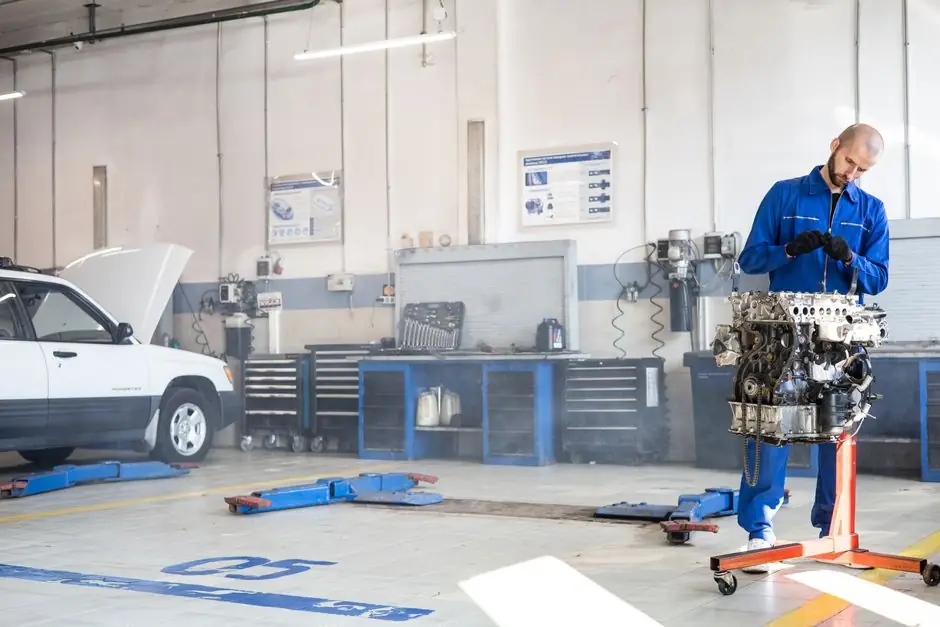
Virgin PTFE operates continuously across -200°C to +260°C and resists nearly all automotive fluids (fuel, brake fluid, ATF, coolant), which is why it remains the default polymer for fuel-system seals, O-rings, and wear strips on press and paint lines [S4].
For automotive applications, PTFE is rarely used neat: glass-filled (typically 15-25% glass fibre), carbon-filled (10-25%), and bronze-filled (40-60%) grades are specified to raise compressive strength, lower cold flow, and improve wear life, with each filler shifting the operating envelope [S4].
Operating envelope: temperature, pressure, and chemical resistance
PTFE's continuous service ceiling sits at +260°C, with a melting point near +327°C and a useful lower limit of -200°C, exceeding the -40°C to +150°C window of most passenger-car under-hood zones [S4]. The polymer is chemically inert to gasoline, diesel, biodiesel blends, automatic transmission fluid, brake fluid (DOT 3/4/5.1), engine oil, and ethylene glycol coolant, which is the primary reason fuel-rail, injector, and crankshaft-deck seals default to PTFE or PTFE compounds rather than nitrile or silicone [S4].
Reinforced PTFE compounds lift the maximum allowable pressure (often called PV, pressure x velocity) by a factor of 3 to 10 versus virgin material; for automotive dynamic seal applications the published PV limit commonly falls in the 5-15 MPa·m/s band depending on filler and counterface hardness [S4].
Fillers and grades: a side-by-side for auto plants
For an automotive process engineer weighing candidate compounds, the four workhorse grades line up as follows [S4]:
1. Virgin PTFE: best chemical resistance, lowest friction (coefficient 0.04-0.10 against steel), weakest compressive strength (~10 MPa), highest wear rate. Specified for static gaskets, valve seats, and chemical-contact diaphragms.
2. Glass-filled (15-25% glass fibre): compressive strength climbs to ~14-17 MPa, wear rate drops by 4-8x versus virgin, but HF and strong caustics can attack glass; commonly used on hydraulic cylinder seals, wear rings, and press-line bearings where dimensional stability matters more than chemical purity.
3. Carbon-filled (10-25% carbon or graphite): conductive (anti-static), thermal conductivity roughly 5x virgin PTFE, good wear under dry running, common in fuel-handling pump parts and dynamic valve seats where static dissipation is required.
4. Bronze-filled (40-60% bronze): highest compressive strength (~20-25 MPa) and best thermal conductivity (~6 W/m·K vs 0.25 W/m·K for virgin), which suits high-PV bushings in chassis and driveline; not acceptable for chemical or food-grade service due to copper catalysis of elastomer degradation and oxidation of adjacent rubbers [S4].
Where PTFE actually lives on a press line
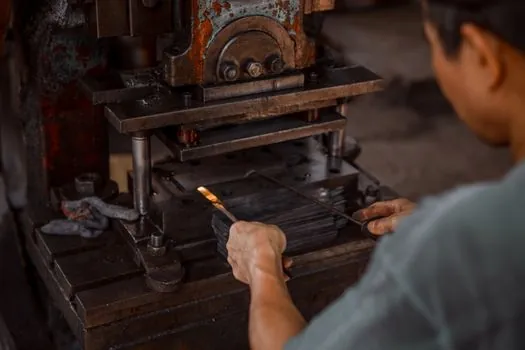
On automotive press and stamping lines, PTFE and PTFE compounds appear as wear strips and guide bushes on transfer rails, die-set slide plates, and scrap-chute liners because of dry-running, low-stick behaviour against steel and aluminium [S1]. Mitsubishi Electric documents that die changeover pattern switching on modern servo-driven presses (using MELSERVO-J5 and MELSERVO-JET drive families with the MR-CV power regeneration converter on a common DC bus) is the typical mechanism for producing mixed-model bodies on a single stamping line [S1].
Inside that context, polymer wear components must tolerate thousands of cycles per shift and survive incidental exposure to drawing lubricant, rust preventative, and hydraulic oil. Filled PTFE strip (often 3-10 mm thick, glass- or bronze-filled) is the default for slide contact, while virgin PTFE tape and sheet is used for static seal faces on hydraulic and pneumatic manifolds on the press [S1][S4]. A relevant process-side companion to material selection is the FA platform architecture itself, where servo life prediction and common-bus energy recovery directly reduce the per-part energy and changeover penalty that PTFE-lined tooling has to absorb.
PTFE versus competing polymers in the same seat
When PTFE is over-specified for cost or manufacturability reasons, three alternatives show up: UHMWPE, PEEK, and PPS. UHMWPE shares PTFE's low coefficient of friction but maxes out near +80-90°C, so it loses in engine-bay and brake systems. PEEK operates continuously to +250°C, has roughly 10x the tensile strength of PTFE, and tolerates the same automotive fluids, but at a material cost typically 10-20x virgin PTFE; it is the right pick when a single plastic part must replace both a seal and a structural housing [S4].
PPS sits between the two: continuous service around +200-220°C, good chemical resistance, easier to mould to tight tolerances than PTFE, but its coefficient of friction (~0.3-0.4) is several times higher, so it rarely substitutes PTFE in dynamic sliding interfaces. For typical automotive seal, wear-strip, and bushing applications, PTFE compounds remain the lower-cost default and only lose the specification to PEEK when temperatures push past +200°C under load or when dimensional precision on a moulded net-shape part outweighs material cost [S4]. Readers comparing these polymer decisions against adjacent automotive selection work, such as line-frequency furnace selection for automotive parts foundries, will see the same filled-vs-unfilled trade-off played out with refractory and metallic materials rather than polymers.
What PTFE will not do on the line
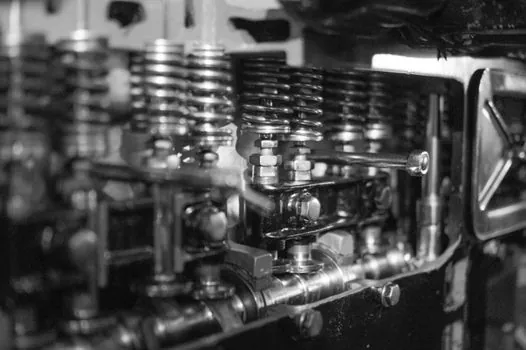
PTFE has well-known limits that engineers should price in up front: poor radiation resistance, susceptibility to creep under sustained load (mitigated but not eliminated by fillers), and a coefficient of thermal expansion roughly 10x that of steel (~10-12 x 10^-5 /K), which is why PTFE seals need wider gland clearances than elastomer equivalents [S4]. Bonded or welded metal-PTFE backers, or overmoulded rubber-capped PTFE, address differential expansion in engine and transmission seal applications.
Inside the broader automotive supply chain, Flex positions itself as a global manufacturing partner for power-electronics, compute, and motion platforms rather than a polymer supplier, which is why the material discussion in this article sits separately from OEM-level programme decisions [S3]. For the typical process engineer, the practical gate is this: if a seal or wear part in an automotive line will see fuel, oil, or coolant and cycle temperatures inside -40°C to +200°C, a filled PTFE grade is almost always the lowest-risk spec; if the part must also be conductive, specify carbon-filled; if the part sits in a high-PV dry-running bushing, bronze-filled wins; if the application pushes +220°C under load with structural demands, escalate to PEEK rather than chase a PTFE compound beyond its published envelope [S4]. The next verification node is a bench wear test on the actual lubricant and counterface hardness, since published wear-rate multipliers (4-8x for glass-filled, similar for carbon-filled) hold for clean laboratory conditions and degrade in contaminated press-shop environments.
For the relevant spec sheets and selection criteria, see ptfe, additive manufacturing material, and pressure transmitter.