
Push-in fittings are quick-connect couplings that grip a polymer or metal tube by an internal collet and seal it with an O-ring; release happens by depressing an external sleeve, no tools required [S1]. On industrial panels they are the default termination for 4-14 mm OD nylon (PA) and polyurethane (PU) tubing used at -0.5 to 12 bar across 106 manufacturers and 516 product listings catalogued by DirectIndustry [S1][S2].
Selection is more than matching a port thread: the four binding variables are tube OD and wall/durometer, thread and port standard (BSP, BSPT, NPT, metric), media chemistry (water, oil, vacuum, inert gas), and duty cycle (vibration, pulse, temperature). The variants below fail or succeed on exactly these four axes, and the cheapest body on a distributor shelf is the most expensive line stop the day the wrong one is fitted.
Tube Material and OD Tolerance: The Most Overlooked Anchor
Push-in fittings are designed for calibrated polymer tubing - nylon (PA11/PA12) and polyurethane (PU) being the dominant choices - with OD ranging from 3 mm to 14 mm on the SAF S.R.L. RR series, 0.118-0.551 in [S2]. Nylon carries a higher working pressure and a wider chemical envelope but costs more and is dimensionally less forgiving in long runs. PU is more flexible, easier to route in tight panels, and cheaper, but cold-creeps under sustained pressure and softens above 60-80 °C, which raises the practical duty ceiling regardless of the fitting's body rating.
Wall thickness and OD tolerance are where most field leaks start. A 6 mm OD tube with 1 mm wall (PU) and a 6 mm OD tube with 1.5 mm wall (PA) both mate to the same fitting body, but the polymer that flexes under the collet grips differently. Buyers should pin both OD and minimum wall in the purchase spec, not just OD, and treat metric and inch variants as separate SKUs.
For installations where the line will see temperature swings below 0 °C or where the fluid is anything other than dry air or water, nylon (PA12) is the safer default; PU belongs on indoor, dry-air, room-temperature panels only.
Thread and Port Standard: BSP vs BSPT vs NPT vs Metric
Two parallel families show up in the same catalogue. The SAF RR series is offered with Gas pre-tefloned taper (BSPT) and Gas parallel (BSP) threads, plus a captive O-ring on the parallel version for sealing [S2]. Parker's Phastite® and CPI™ ranges (in the same comparison feed) sit on NPT and inch-based compression threads, the legacy instrumentation profile [S1]. Mixing the two is the single most common field error: a BSPT male stud does not seal reliably in an NPT port, even if the diameter appears to thread in by hand.
Metric parallel threads (M5, M7) appear on Asian-built and some European pneumatic valves, typically sealed by a captive O-ring rather than tape. Where the panel is all metric, matching the fitting's thread standard is enough; the moment an NPT gauge block, a BSP manifold, and a metric valve island share a cabinet, an adapter becomes cheaper than a rework.
Selection rule of thumb: pin the port standard (BSP, BSPT, NPT, or M-series) on the valve/cylinder side, then choose the fitting family that natively matches. Cross-standard adapters belong in the spares drawer, not the build-of-material.
Pressure, Temperature, and Vacuum: Where Push-In Stops
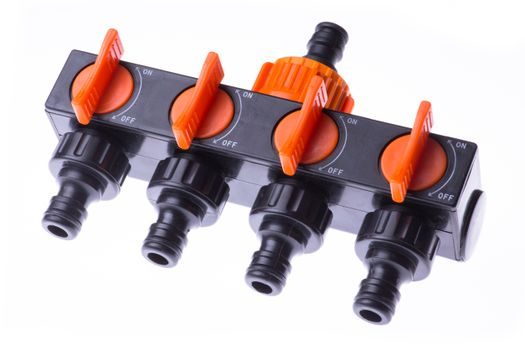
Push-in fittings are not general-purpose. The SAF RR series is rated 0.5-12 bar (7.25-174.05 psi) across 3-14 mm tube OD [S2]. The PNEUMAX RAP family in the same product feed is fixed at 8 bar working pressure with tube OD 4-14 mm [S1]. For high-pressure hydraulics, Parker's Phastite® permanent compression line extends up to 22,500 psi (1,550 bar), but that is a swaged compression technology, not a releasable push-in collet [S1].
Vacuum service is a different envelope: the negative-pressure version of a push-in fitting (collet grip resists external pull-out) is the same body as the pressure version in many lines, but the sealing O-ring compound and the collet spring load change. Where duty crosses from -0.9 bar vacuum to 10 bar pressure, the O-ring and gripper must both be specified for the duty; mismatched O-rings are the leading cause of slow leaks on vacuum-pickup tooling.
Hard ceiling on push-in: once duty exceeds 12-16 bar in pneumatic service, or any hydraulic pressure, the selection moves to compression (single or double ferrule) or permanent swage - covered in detail on the industrial valve and pneumatic fitting reference pages.
Media Compatibility: Body, O-Ring, and Gripper Together
Three material decisions ship in every push-in fitting: body, O-ring, and (sometimes) gripper insert. The RR series is nickel-plated brass [S2], a common default for dry air and water, but brass dezincifies in hot, low-pH water and corrodes in ammonia-bearing coolants. Stainless (typically 1.4404 / 316L) bodies are specified for pharmaceutical, food, and marine duty; PBT (polybutylene terephthalate) or PPS bodies for corrosive chemical dosing panels at the cost of lower pressure rating.
O-ring compound is the second filter. NBR is the stock seal for oil and air, EPDM for hot water and deionized water, FKM (Viton-class) for solvents and higher temperatures, and FFKM for aggressive chemistry where a low-decay seal is mandatory. A brass body with the wrong O-ring leaks; a stainless body with the wrong O-ring leaks faster because nobody suspects the seal first.
For drinking-water and food panels, the China-made sprinkler and drinking-water push-in fittings tracked in the 2026-05-31 wholesale feed use lead-free brass and EPDM by default [S6]. Confirm the certification (e.g. WRAS, KTW, NSF/ANSI 61) per project; do not assume "lead-free" on a generic brass SKU.
Duty Cycle: Vibration, Pulse, and Reconnection Count
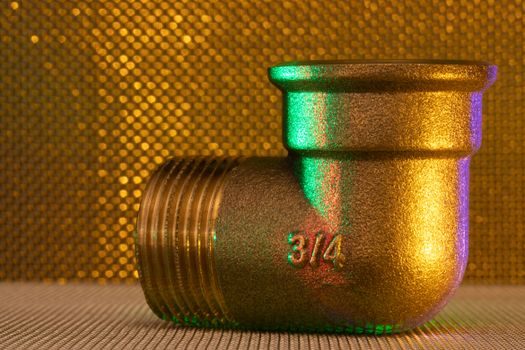
Push-in fittings are designed to be released and re-mated many times; the better lines spec a 50-100 cycle minimum on the collet without grip loss, but the real wear mode is the O-ring and the collet spring. In high-vibration panels (mobile hydraulics cabs, compressor skids, presses), the O-ring and the tube OD both work-harden; a polymer collet loses grip first. For these duties, the rule of thumb is to step up to a compression fitting (CPI/A-LOK class) or to lock the tube with a collet clip [S1].
Reconnection count matters more than most datasheets show. A panel that is reworked every quarter (a robot tool-change head, a test bench) needs a fitting rated for the full lifetime cycle count, not just for the static pressure. Pull the figure from the manufacturer's catalogue, not from the marketing PDF.
Configuration, Size, and the Layout Constraint
Push-in fittings ship in straight, 90° elbow, T, Y, and bulkhead variants. The RR series from SAF is offered in stud, elbow, T, and Y bodies with both internal and external hex for mounting in narrow places [S2]. Where the panel is dense, the stud-with-internal-hex version is the right pick: a 6 mm socket fits the same envelope that a 17 mm external hex would not. PNEUMAX's RAP line carries colour-coded release sleeves (green, black, metal) so the line is identifiable at a glance during service [S1].
Tube OD drives both the fitting body size and the smallest bend radius. A 4 mm OD tube will fit a 6-8 mm panel hole, but a 14 mm tube needs a much larger port and a 35-50 mm bend radius. Lay the panel out for the largest tube, then drop the rest in around it; a 4 mm line routed through a 14 mm bracket hole wastes space and increases snag risk.
Selection Map: Four Realistic Variants Against Four Criteria

Variants compared: (A) stock brass push-in, NBR O-ring, BSP thread - dry air, 8 bar, indoor, low-vibration; (B) stainless push-in, FKM O-ring, NPT thread - solvent panel, 10 bar, indoor, low-cycle; (C) plastic (PBT/PPS) push-in, EPDM O-ring, metric - deionized-water dosing, 6 bar, indoor, high-cycle; (D) compression ferrule (CPI/A-LOK), stainless, NPT - high-pressure instrumentation, 100+ bar, high-vibration, permanent. [S2]
Choose A for the default pneumatic panel - 80 percent of cabinet builds fall here. Choose B for solvent dosing, hot-oil lubrication, or any line that A's NBR seal cannot survive. Choose C only for water and chemistry where the duty is gentle and the panel is plastic-friendly. Choose D the moment the pressure ceiling or the vibration duty pushes A out, and accept the loss of tool-free release.
When Push-In Is the Wrong Choice
Push-in fittings should not be specified where (1) duty pressure exceeds 12-16 bar in pneumatic service or any pressure in hydraulic service - move to compression or swage; (2) the tube is stainless steel, copper, or PTFE without an internal sleeve, because the collet will not grip these materials reliably; (3) the line is in a hazardous area requiring ATEX/IECEx-certified terminations, where the fitting must carry a documented certification matching the valve/cylinder rating; (4) the panel is field-reworked more than once a month, because the collet wear becomes unpredictable; (5) the line carries potable water without explicit certification (WRAS, KTW, NSF/ANSI 61) on the body and O-ring lot. [S2]
For drinking-water and irrigation duty, a generic brass push-in without the lead-free and certification chain has no place on the build-of-material - the body in the 2026-05-31 wholesale feed explicitly advertises lead-free brass and sprinkler/drinking-water suitability [S6], and the certification should be on the datasheet, not on the box label.
Procurement and Field Checks
Three shortlist signals to verify before purchase. First, the catalogue must state the tube OD range, the working pressure at that OD, the temperature range with the O-ring compound called out, and the reconnection count - if any of the four is missing, the line is incomplete [S1][S2]. Second, the thread standard (BSP, BSPT, NPT, M-series) and the seal method (tapered thread, captive O-ring, bonded washer) must be in the model code, not just on the box. Third, the manufacturer should publish a chemical compatibility table covering at least water, oil, solvent, and acid/bases; the absence of that table is a red flag on duty suitability [S3][S5].
Shortlist logic: pin tube material and OD, pin thread/port standard, pin O-ring compound, pin pressure/temperature window. The fitting that matches all four anchors on the first page of the catalogue is the one to buy; everything else is a workaround that costs a service call.
Field check: the Festo NPQM line, the SAF RR series, the PNEUMAX RAP line, and the Parker Phastite/CPI ranges in the 2026 DirectIndustry and Festo CN feeds are the working reference set for this selection map [S1][S2][S3]. For deeper coverage of ferrule compression, instrumentation tube fittings, and adjacent component selection, the pipe fitting and pneumatic fitting reference pages carry the cross-comparison data. As next signals, watch for the autumn 2026 catalogue refreshes from the major pneumatic suppliers (Festo, SMC, PNEUMAX, Parker) on the metal-vs-polymer body trade-off, and verify any push-in line being added to a hazardous-area or potable-water panel carries the matching certification lot number in the delivery documents.
This topic is covered further in Self-Cleaning Filter vs Cyclone Separator: Spec, Flow, and Selection Map.