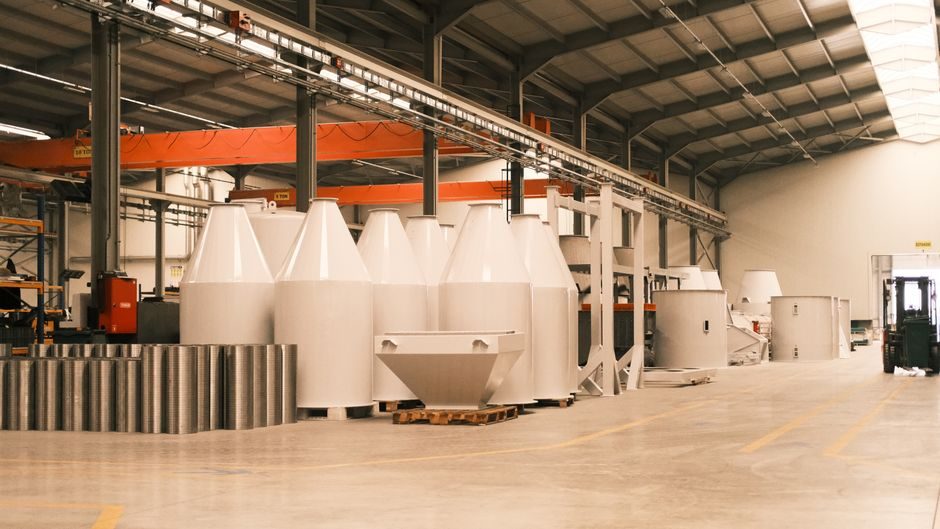
The headline split is simple: a self-cleaning filter is a positive-barrier device that physically captures particles on a screen and then back-flushes or scrapes them off, while a cyclone separator is a no-moving-parts inertial device that uses tangential flow and gravity to throw heavier particles outward and down a drain.
On current OEM datasheets the two technologies span very different envelopes. The Siga F451 self-cleaning filter covers 5–1,100 m³/h at 10 or 16 bar (145–232 psi) with a cast-iron body and 316SS internals, optionally upgraded to Super Duplex, Monel, or super-austenitic SS for seawater [S3]. The SOCLEMA MERLIN MLCS cyclone sits at the opposite end of the size scale: 1,000 l/h maximum recommended flow, 100 bar (1,450 psig) maximum pressure, 200 °C maximum temperature, with 1/4" FNPT inlet and 1/2" tube outlet, designed to protect liquid analyzers rather than to polish bulk process water [S1].
Operating Envelope: Pressure, Flow, Temperature, Viscosity
Where the two overlap is exactly the band that trips up buyers. Siga's F451 family runs DN32–DN300 on water and seawater at 10 or 16 bar [S3]. The SP Filtration ASC scraper-type self-cleaning filter pushes the upper viscosity limit to 800,000 MPa·s with 5 µm filter precision, addressing high-viscosity fluids that would choke a cyclone [S8]. Cyclone models listed in industrial catalogues extend to 4,000–28,000 m³/h in powder-coating recovery (Ransburg) and 1–24 m³/min for compressed-air condensate with 90/120 mm body diameters and 0.6–4.5 kg mass (Mattei Ciclone series) [S2].
Pressure rating is where the cyclone quietly wins. The MERLIN MLCS hits 100 bar / 200 °C in a maintenance-free package aimed at analyzer protection [S1]. A typical self-cleaning strainer on a process line runs 10–16 bar standard, with higher ratings available as specials [S3]. If the duty is high-pressure hot water or hydrocarbon, the cyclone should be on the shortlist first.
Filtration Precision and Cut Size
Cyclones are coarse by design. Self-cleaning filters are specified in microns: SP's ASC scraper type reaches 5 µm precision, while scraping (DF X), modular (MSC, MF), bag (BF), and basket (SF) product lines sit across the 5–1,000 µm band [S6][S8].
The Siga F451 datasheet confirms that self-cleaning filters are the workhorse for fine, repeatable cut points on water — process water, seawater, river water, groundwater, and rainwater — with flushing triggered by differential pressure switch or timer [S3]. The X Series external-scraping self-cleaning filter targets fluids where internal screen elements would foul and where a coarse pre-filter would not deliver the required cleanliness [S6].
Cleaning Mechanism and Service Pattern
Self-cleaning filters fall into distinct mechanism families. The SP MSC modular system is built around expansion and automatic flushing logic for high-reliability service [S4]. The ASC series uses a pneumatic scraper to remove particle impurities from the internal filter cartridge for online continuous filtration, deliberately engineered for high-viscosity applications up to 800,000 MPa·s [S8]. Filternox markets its suction-scraper type automatic filters for pump protection and cooling-tower water, with installation in 80+ countries since the company's 2004 founding in Istanbul [S5].
Cyclones have no cleaning mechanism. They rely on continuous tangential flow to keep particles in motion until they drop into a collection pot, and they are described in current vendor copy as "particularly maintenance-free" [S1]. That is true until the solids loading or particle shape changes, at which point the unit must be opened. The standard governing U.S. federal self-cleaning sediment strainers is A-A-59009 (22 July 1997), a 6-page commercial item description covering self-cleaning pipeline sediment strainers for federal-agency use [S9].
Decision Matrix: When to Specify Which
Side-by-side on the four criteria that drive most purchase orders, the comparison is clean. On cut size, a self-cleaning filter reaches 5 µm with the ASC scraper design [S8], while a cyclone typically delivers bulk separation down to roughly 10–20 µm only under optimum density and pressure-drop conditions. On flow, a self-cleaning filter is built for 5–1,100 m³/h on water duty per the Siga F451 datasheet [S3], and a cyclone scales from 1,000 l/h analyzer protection (MERLIN MLCS) to 28,000 m³/h in powder recovery [S1][S2]. On pressure, the cyclone's 100 bar ceiling [S1] beats the standard 10–16 bar self-cleaning strainer class [S3]. On service, the cyclone is maintenance-free, while the self-cleaning filter requires periodic flush-water, scraper-rotation, or differential-pressure checks. For related process decisions like pump protection and instrument-grade liquid conditioning, the centrifugal pump vs plunger pump selection map lines up neatly with the flow-band logic above.
The decision rule of thumb that holds up across the datasheets: specify a cyclone when the particles are coarse, the flow is high, the fluid is hot or pressurised, and analyzer or compressor protection is the goal. Specify a self-cleaning filter when cut size is in the micron range, the duty is water, and continuous downstream cleanliness matters more than zero maintenance. In steam and condensate lines, both technologies appear together — a steam separator typically handles bulk condensate while a polishing self-cleaning strainer downstream catches fines.
Material Selection and Corrosion Allowance
Material grade is the second decision axis after flow. The Siga F451 ships with a cast-iron body and 316SS internals as standard, with Super Duplex, Monel, and super-austenitic SS upgrades offered for seawater service [S3]. Cyclone separator bodies in vendor catalogues are commonly carbon steel with rubber lining, stainless steel, or specialty alloys for abrasive or corrosive duties, and instrument-protection units like the MERLIN MLCS use stainless wetted parts compatible with the analyzer's process chemistry [S1][S2].
Filternox's industrial water-filtration systems, exported to 80+ countries, default to stainless wetted construction for chemical-process and cooling-tower use [S5]. For hydrocyclone-based desanding in oilfield service, the 12" (305 mm) cyclones listed in the Kosun KD-100 desander module handle 0–100 m³/h mud flow with combined shaker and desander stages [S2]. Where abrasive solids are the dominant wear mode, hardened internals on the cyclone extend service life.
Integration, Standards, and Failure Modes
Integration effort is asymmetric. A cyclone drops inline with the inlet tangent aligned to design — no power, no control wiring, no flush water — and runs until the collection pot is emptied. A self-cleaning filter needs a flush valve, a drain, a pressure differential switch or timer, and in pneumatic-scraper designs a clean dry-air supply. SP's ASC scraper design uses pneumatic drive specifically to keep the mechanism independent of the process fluid for high-viscosity service [S8]. The MSC modular system is built on "flexible expansion" so additional stages can be added to a battery of filter modules in parallel as flow grows [S4].
Failure modes differ in character. Cyclones fail by re-entrainment of fine particles when flow drops below design, when the inlet becomes eroded, or when the underflow nozzle plugs — the unit does not "tell" you, it just lets fines through. Self-cleaning filters fail by exhausting flush water, by a clogged scraper, or by a pressure-differential switch that drifts and triggers constant flushing, which is detectable on the panel but costly in water. A self-priming pump upstream of either device, sized for the flush-water demand of a self-cleaning filter, is the common pattern where the suction run is long or the fluid is foamy.
The verifiable next signal to track: how many cyclone vendors on DirectIndustry's manufacturer index have added ATEX-certified variants for solvent and dust-handling service — the BTUX 305 pilot separator is already listed as meeting ATEX requirements for hazardous materials [S2], and that share is the most concrete proxy for cyclones moving deeper into chemical-plant service.