
Aerospace quartz reinforcement is a woven or tape form of amorphous fused-silica filaments (typically 5–10 μm filament diameter) with SiO2 purity of 99.95% or higher, selected where dielectric transparency, continuous thermal endurance, and low mass must coexist in a single reinforcement [S2][S3].
Fused-quartz (also called fused silica) is the high-purity end of the broader quartz material family, and its aerospace form is distinct from commodity glass cloth because both the fiber chemistry and the weaving process are controlled to keep dielectric loss and outgassing inside radome and antenna-window budgets [S3][S4].
Material Definition and Property Envelope
Aerospace-grade quartz fabric is made from high-purity silica-based glass filaments drawn to a few micrometers in diameter, then woven into textile forms that can be used dry, infused as a prepreg, or laid up with high-temperature resin systems [S2][S4]. The defining property envelope is dielectric loss tangent (tan δ) in the 1–10 GHz radar band, continuous-use temperature above 1000 °C for the fiber itself, and a density of roughly 2.2 g/cm³, which is the same value cited for fused silica across the broader advanced material reference set [S2][S3].
Saint-Gobain lists the key properties driving aerospace use as ultra-high purity, near-zero coefficient of thermal expansion, and excellent dielectric behaviour across a wide frequency range, with the fiber’s low dielectric constant allowing RF signals to pass with minimal attenuation [S2]. Cristex CAM’s qualified material, supplied by Fabric Development Inc (Kordsa group) into approved military and commercial platforms since 1972, is positioned for radomes, antenna systems, aerospace insulation, and defence structures where consistent RF performance and high-temperature capability are critical [S3].
Where Quartz Wins, Where It Loses
Quartz fabric is the correct choice when the application exposes the reinforcement to a radome or antenna window with a strict loss-tangent budget, or to a thermal protection system above 600 °C where E-glass would lose integrity [S2][S4]. For radomes, the combination of low dielectric constant, low loss tangent, and thermal stability is what allows the antenna to look through the airframe skin with minimal pattern distortion [S3][S7].
Quartz loses on three axes engineers should price in early. First, raw fiber cost is several times that of E-glass per kilogram, which is why E-glass remains the default for non-RF structural panels. Third, because the material is amorphous silica, it has a relatively low Young’s modulus compared with high-modulus carbon or aramid reinforcements, so pure-quartz laminates are usually hybridised with aramid or glass scrim for damage tolerance, as noted in JPS Composite Materials’ survey of Astroquartz® applications in thermal protection and heat-shield systems [S7].
Decision Criteria vs Fiberglass (E-Glass)
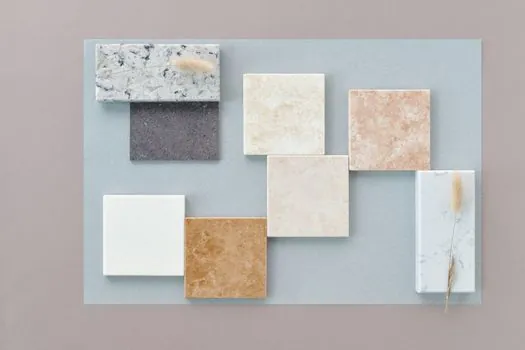
Quartz and fiberglass are both silicate-based reinforcements, but they target different points on the temperature–dielectric–cost curve, and the right call depends on which axis dominates the part [S4].
On continuous-use temperature, aerospace quartz fabric is rated for service in the 1000 °C range for the bare fiber, while standard fiberglass fabric tops out near 550 °C and begins to lose strength well below that, which is the headline reason quartz is picked for thermal protection and re-entry-adjacent structures [S4]. On dielectric performance, quartz shows lower dielectric constant and lower loss tangent than E-glass at radar frequencies, which is why it is the default for radomes and antenna windows and not for general composite panels [S2][S3]. On chemical and dimensional stability, the higher silica content gives quartz better resistance to thermal shock and to most acids except hydrofluoric and hot phosphoric, while E-glass is more sensitive to alkaline and humid environments [S4]. On cost and availability, fiberglass fabric is cheaper, easier to source in large rolls, and supported by a deeper converter base, so it remains the right pick when RF transparency is not on the bill of materials [S4].
Form Factors and Qualification Path
Quartz reinforcement is supplied as woven fabric in standard industry weave styles (plain, 4-harness satin, 8-harness satin, mock leno), as narrow tapes and ribbons from 0.25 in to 5 in width for complex radome geometries and antenna integration, and as prepreg after the woven cloth is impregnated by a qualified converter such as Axiom Materials [S3]. Tape widths below 0.25 in are unusual because filament breakage rises sharply at very narrow slitting tolerances.
Qualification typically follows a platform-specific material spec that references the woven style, basis weight (commonly 100–300 g/m² for aerospace radome cloth), areal density tolerance (often ±5%), volatiles content under 1%, and a dielectric verification at the operating frequency. The CAM/FDI material lineage has been on approved military and commercial aerospace platforms since 1972, which is the practical evidence that the dielectric and outgassing values are stable enough to lock into a part drawing [S3]. For new programmes, the typical sequence is laboratory dielectric screening, then a panel-level mechanical and thermal test campaign aligned to the airframer’s material specification, before the part is released to production.
Process Windows and Failure Modes

Quartz fabric is processed much like other dry reinforcements, but the cure cycle is set by the resin system, not the fiber, and the high softening point of fused silica (around 1650 °C) means the fiber is essentially inert during any normal 120–180 °C epoxy or 200–250 °C cyanate-ester cure [S2][S3]. The real process risk is mechanical: filaments abrade and fracture at sharp tooling edges, so most aerospace shops cut with hardened or ceramic-coated blades, ultrasonically, or with laser to keep the cut edge clean and to prevent stray filaments becoming dielectric hot spots in a radome wall.
The dominant in-service failure mode for quartz-reinforced radomes is not fiber fracture but moisture absorption and surface erosion. Fused silica is hygroscopic to a small degree, and absorbed water shifts the dielectric constant and loss tangent enough to retune a radome; for that reason, radome surfaces are usually sealed with a compatible rain-erosion coating. The secondary failure mode is impact damage at high particle loading (bird strike, hail), which is why aramid or S-glass hybridization is common in the outer ply of military radomes rather than pure quartz [S3][S7].
Cross-Reference to Adjacent Selection Logic
Quartz selection is structurally similar to other B2B reinforcement picks: a small set of measurable properties, a standard form factor, and a clear downstream converter chain. Engineers who already work through structured spec maps for adjacent parts will recognise the pattern in mold base selection for electronics housings, where the same property-driven logic (dielectric, thermal, tolerance) drives the call. The aerospace case adds two extra gates: a controlled dielectric verification at frequency, and a thermal protection envelope that rules out E-glass. [S4]
The fiber itself is part of the wider glass quartz family of amorphous silica products, and the same SiO2 chemistry underpins both, so lessons from one (thermal shock resistance, low CTE, HF acid attack) transfer to the other. For readers building out an internal material knowledge base, treat aerospace quartz as a sub-category of quartz material, with a tighter purity spec, a controlled filament-diameter distribution, and a documented weave genealogy [S2][S3].
Standards and Specification Discipline

Aerospace radome and TPS specifications typically invoke a platform-specific material spec (for example, an OEM drawing that names a qualified style, basis weight, and resin system) rather than a single public ISO or ASTM number, and the underlying fiber and fabric tests are run against standard methods for dielectric constant and loss tangent, tensile strength of filaments, and volatiles content. Engineers should always confirm the exact test method, conditioning, and frequency cited on the callout, because dielectric values are not interchangeable between 1 GHz, 10 GHz, and 18 GHz, and a fabric that passes one radome band can fail another [S3][S4].
Where finishing is in scope (sealing coatings, rain-erosion topcoats, anti-static surfaces), the finishing material compatibility with the chosen resin system is the part of the spec that most often gets missed on a first article. The same caution applies to chemical exposure: pick quartz where the chemical environment excludes hydrofluoric acid and hot concentrated phosphoric, and fall back to a different reinforcement otherwise; for the broader chemical-side selection logic the chemical reagent grade selection guide walks through a comparable purity-and-application matrix.
Trackable signals over the next sourcing window: (1) whether the chosen quartz style is on an active OEM-qualified products list (QPL) and the last audit date of that listing, and (2) the dielectric verification certificate for the actual production lot at the exact operating frequency of the radome or antenna window, since lot-to-lot dielectric drift is the leading cause of in-service retuning [S3].