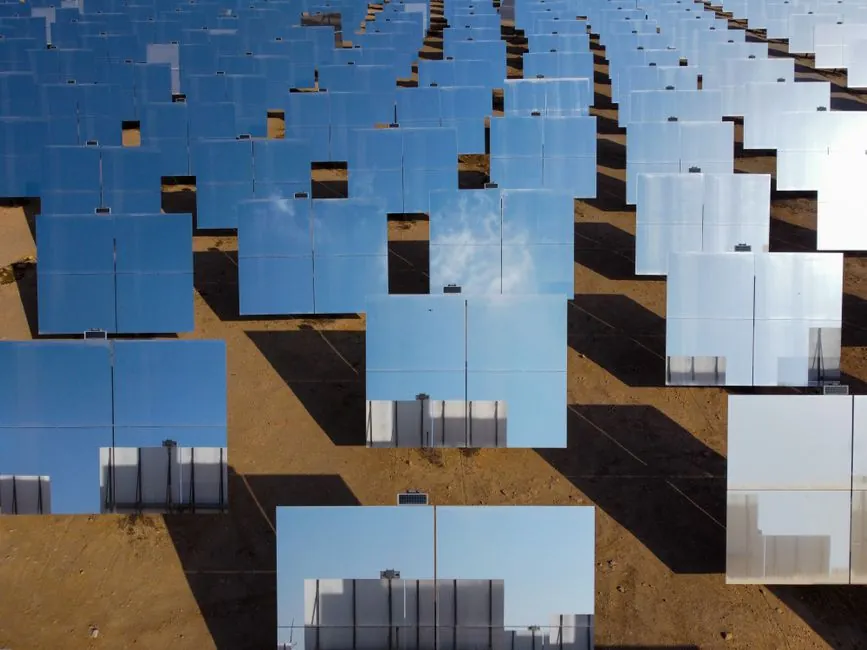
Energy-system optical builds in 2026 are specified against six glass families: N-BK7 borosilicate (n ≈ 1.5168, Vd ≈ 64), fused silica (n ≈ 1.458, Vd ≈ 67), SF11 high-index glass (n ≈ 1.784, Vd ≈ 25), CaF2 crystal (n ≈ 1.43, transmission 0.15-8 µm), B270 crown, and LaK lanthanum series, each mapped to a different thermal, UV, and power-density window [S4].
Selection is driven by four measurable parameters (refractive index n, Abbe number Vd, spectral transmission band, coefficient of thermal expansion), plus application-specific exposure to UV load, laser fluence, or thermal cycling, and the dominant wavelength band of the energy source the glass must transmit or focus [S2][S4].
Core Spec Parameters That Drive Glass Choice
Refractive index controls focal length and lens curvature: N-BK7 sits at 1.5168, fused silica at 1.458, SF11 at 1.784, and CaF2 at 1.43, with most optical glasses clustering near n = 1.5 because light travels roughly 1.5x faster in vacuum than in the glass [S2][S4]. A 0.3 n difference between BK7 and SF11 is the lever that lets designers fold chromatic correction into a 2- to 4-element lens stack instead of a 6-element one.
Abbe number (Vd) sets chromatic dispersion: BK7 at 64, fused silica at 67, and SF11 at 25, so SF11 produces roughly 2.5x more chromatic spread per lens than BK7 and is paired with a high-Vd partner to cancel colour fringing [S4]. Transmission band is a hard pass/fail: CaF2 covers 0.15-8 µm for deep-UV to mid-IR, BK7 spans 350-2000 nm, and B270 is restricted to visible and near-IR, so any optics that must see below 350 nm or above 2 µm are ruled out of BK7 on band alone [S4].
Six Glass Families and Their Energy-Equipment Niche
N-BK7 is the default for visible and near-IR windows, prisms, and lenses where cost and homogeneity matter more than UV or extreme thermal stability, with a refractive index near 1.5168 and Vd ≈ 64, and it is the workhorse substrate for solar concentrator housings, laser diagnostic ports, and inspection viewers [S4][S2]. Fused silica is specified when UV transmission, laser damage threshold, or low thermal expansion is non-negotiable: its n ≈ 1.458 and Vd ≈ 67 keep deep-UV to IR behaviour stable, which is why high-power laser optics and space solar payloads default to it over BK7 [S4].
SF11 (n ≈ 1.784, Vd ≈ 25) is the high-index corrector glass for compact multi-element lenses, used when a short focal length or chromatic correction in a tight package outweighs its lower thermal stability, and it is routinely paired with BK7 or LaK in achromatic doublets [S4]. CaF2 (n ≈ 1.43, transmission 0.15-8 µm) is the standard window and lens material for high-energy laser systems, excimer optics, and IR metrology, where its chemical stability and radiation resistance outweigh its brittleness and cost [S4]. B270 is a low-iron crown specified for visible/NIR imaging lenses and protective covers where cost dominates; LaK lanthanum glasses round out the set for high-end camera and projection objectives needing a higher index than BK7 with manageable dispersion [S4].
Solar and Photovoltaic Use: Glass as an Energy Material, Not Just an Optic
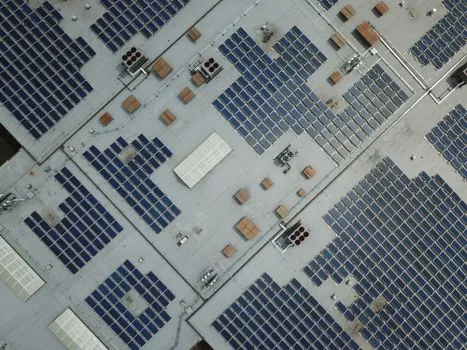
Glasses serve a dual role in solar: as transparent covers for photovoltaic cells and as absorber-side or envelope material in concentrating solar power (CSP) systems, with surface structuring and coatings credited in published reviews for substantial efficiency gains in both PV and CSP [S3]. Silica glasses are the reference material for hot transparent sections of CSP receivers, while borosilicates dominate evacuated-tube solar collectors and heat-pipe insulation because they tolerate the thermal gradient between absorber and ambient [S3].
Container-glass lightweighting, cited at 25% mass reduction (around 300 kg CO2 per 1000 kg glass), is one of the documented energy-savings levers inside the glass value chain itself, and continuous-filament glass fibre for wind-turbine blades, mineral wool, and foam-glass insulation multiplies the energy payback several times over the service life of the product [S3]. For PV module frontsheets, low-iron soda-lime and borosilicate covers with anti-reflective coatings remain the workhorse because they cut reflection loss in the 400-1100 nm band where crystalline silicon cells respond.
Selection Criteria: A 4-Axis Decision Map
Choosing a glass for an energy-system optic reduces to four axis checks, and the trade-off table below lines the six families against the two axes that flip a build most often: UV-IR band and thermal expansion. [S4]
Axis 1, spectral band: BK7 covers 350-2000 nm and is rejected for any wavelength below 350 nm; fused silica and CaF2 both pass deep-UV, with CaF2 extending to 8 µm in the IR where BK7 and B270 cut off [S4]. Axis 2, dispersion: BK7 (Vd 64) and fused silica (Vd 67) are low-dispersion, SF11 (Vd 25) is high-dispersion and only sensible inside an achromat, CaF2 is very low dispersion across its full band, and LaK sits between BK7 and SF11 [S4]. Axis 3, thermal expansion: fused silica has the lowest CTE of the set, which is why it is specified for space solar payloads and high-power-laser optics that must hold figure under thermal load; BK7, B270, and SF11 are all higher and need mount design compensation. Axis 4, optical purity and damage threshold: CaF2 wins for absorption-critical UV and IR laser windows, BK7 wins on cost-per-piece for visible instrumentation, SF11 wins on refractive power per mm of thickness, and B270 wins on raw cost for protective windows that are not imaging-critical [S4][S2].
The shortcut rule is: deep-UV or high-fluence laser window, pick CaF2 or fused silica; visible or near-IR metrology under cost pressure, pick BK7 or B270; compact achromat or short-focal-length lens group, bring in SF11 and LaK; broadband IR or thermal-imaging core, default to CaF2.
Who Optical Glass Selection Is, and Is Not, For
Spec-driven glass selection pays off for design engineers building laser-based process tools, solar-CSP receiver optics, PV module covers, IR metrology cameras, and UV-curing or lithography systems, where a wrong glass costs a re-tool and a service-call, not a chip [S3][S4]. Engineers sourcing plain protective windows for non-imaging enclosures, commodity display covers, or general architectural glazing do not need this level of optical spec work: standard soda-lime float, low-iron soda-lime, or tempered borosilicate covers suffice and are bought on impact rating and cost per square metre, not on n and Vd [S3].
For workers handling the optics or servicing the equipment, optical glass selection is also a safety question: solar-field, wind-turbine, and battery-plant maintenance crews need ANSI-rated prescription safety eyewear, not optical-grade substrate glass, and that is a separate spec chain entirely [S6]. Reference data on optical glass properties and on NDT equipment windows used in inspection cells both feed back into energy-plant QA, so the selection logic overlaps with non-destructive-testing window choices.
Limits, Failure Modes, and Sourcing Constraints
Every glass in this set has a hard limit: BK7 darkens under sustained UV and is ruled out below 350 nm; fused silica is expensive and slow to grind, pushing lead times on large optics; SF11 has lower thermal stability and thermal-shock resistance, so it must be paired with a low-expansion partner in any heated enclosure; CaF2 is brittle, costly, and water-soluble, which rules it out for outdoor unprotected optics unless AR-coated and hermetically sealed; B270 and other crown glasses are iron-bearing enough to tint in the UV and IR, so they are not chosen where broad spectral neutrality matters [S4][S2].
Absorption is the silent killer in lens stacks: clear optical glass absorbs 2-4% of incident light, prismatic compositions 5-10%, and absorption scales with thickness, so a doublet made of two 10 mm elements loses 4-8% before coatings are counted, and AR coatings are mandatory rather than optional on any energy-system optic that sits in a converging beam [S2]. Vendors publish the data: SCHOTT, Edmund Optics, and Swift Glass all publish refractive-index, Abbe, transmission, and thermal data per glass code, and the spec should be written against that datasheet, not against a generic 'optical glass' line on a purchase order [S1][S5].
Standards and Sourcing Discipline
Optical glass for energy equipment is bought against ISO 10110 (optical drawing indications), and laser-rated substrates additionally against ISO 21254 (laser-induced damage threshold test methods), while PV cover glass is qualified to IEC 61215 and IEC 61730 for crystalline-silicon module design and safety qualification, and CSP receiver glass is tested against the relevant solar-concentrator standards published by ASTM and IEC [S3][S7]. No revision dates, effective dates, or future regulatory timelines are asserted here because they are not stated in the research; engineers should pull the current revision of each cited standard at the point of order.
Trackable signals worth watching in 2026: SCHOTT and Edmund Optics continue to publish per-glass refractive-index and Abbe data online, and those pages are the live spec source for procurement [S1][S5]; fused-silica and CaF2 capacity remains the rate-limiter for high-energy-laser and excimer-optics builds, so lead time on those two materials is the procurement signal to monitor.
Detailed specification references: energy management.
See also our earlier report, Anti-Static Equipment Selection for Oil and Gas Facilities.