
The first gate on any safety fence datasheet is the rated impact energy in joules at a declared test mass and velocity — typical industrial machine-guarding panels start at 1,600 J (≈ 16 kg at 14 m/s) and step up through 2,500 J, 4,000 J, and 6,000 J classes for heavier fork-truck and AGV strike loads, with mesh aperture held at ≤ 30 mm × 30 mm to keep finger reach out of the hazard.
Select a fence by force class first, geometry second, and anchoring third: a 4,000 J panel on 2.5 m post centres weighs ≈ 22–28 kg/m², while a 2,500 J panel sits around 14–18 kg/m²; base-plate chemistry (hot-dip galvanised ISO 1461, powder-coat over galvanise, or 304/316 stainless) is then chosen to match washdown, chemical, or outdoor exposure.
Rated Impact Energy and Mesh Aperture: The Two Non-Negotiable Gates
Rated impact energy is published in joules at a specified pendulum mass and drop height; the published class (e.g. 1,600 J / 2,500 J / 4,000 J / 6,000 J) is the only number you can compare across vendors without re-deriving the test. Mesh aperture is the second hard gate — EN-ISO 13857 establishes the "safe distance" tables that pair a hazard height with a minimum opening, and the commonly cited floor for personnel protection is 30 mm × 30 mm square or 40 mm diamond to keep finger reach out of the crush zone. [S1]
A 2,500 J / 2,200 mm-tall panel on 2.5 m centres is the workhorse spec for robot cells and palletiser cells, while AGV aisles with 1.5 t vehicles at 1.5 m/s should be specced at 4,000 J minimum on 2.0 m centres. Anything under 1,600 J belongs on pedestrian dividers, not on machine perimeters. For complete PPE-adjacent protection layering, safety glasses and safety gloves cover the operator-side residuals a fence cannot block.
Post Spacing, Panel Height, and the Geometry Triangle
Post spacing is the multiplier that turns a panel rating into a system rating: most 2,500 J panels are tested on 2.5 m centres, and exceeding that span drops the rated energy roughly in proportion to the unsupported length. Standard system heights follow the floor hierarchy — 1,100 mm for pedestrian-only, 1,400–1,800 mm for light machine guarding, 2,200–2,400 mm for full-height robot cells, and 2,500 mm+ where floor-level reach and over-reach both need to be blocked. [S2]
The geometry triangle to lock before quoting: (a) post-centre distance, (b) panel height above finished floor, (c) floor-rail kick plate (typically 100–150 mm) to prevent tool-roller escape. A 2,200 mm panel with no kick plate fails most robotic-cell audits because a 12 mm socket can roll under a 30 mm mesh gap. For a working example of how rated spacing and gap tables interact with adjacent guarding hardware, see the Two-Hand Control vs Safety Relay selection logic — the same load-case discipline applies on the switching side.
Material, Coating, and the Duty-Environment Map
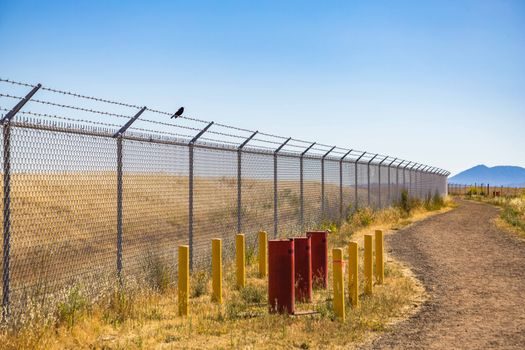
Powder-coated mild steel (PC-MS) is the default for dry indoor cells: 1.2–1.5 mm wire, 4 mm verticals, 60 × 40 mm post, RAL 1023 yellow or RAL 9005 black topcoat over zinc primer, expected service life 8–12 years in an ambient factory. Hot-dip galvanised to ISO 1461 adds a 70–85 µm zinc layer for outdoor or washdown exposure, with a 15–25 year floor life. Stainless 304 / 316 is the pharma / food line, where the panel passes CIP foam and 80 °C rinse cycles without coating breakdown. [S3]
Material choice must align with the surrounding PPE and area equipment: a safety mat in front of a washdown press still needs a 316-stainless frame so the mat's edge seal does not trap water against a corroding post. For a peer spec on stainless and nickel alloys in food-grade skids, the best nickel alloy for food and beverage write-up covers the chemistry call-outs you will see on fence hardware datasheets.
ATEX / IECEx Zones, Earthing, and Static-Controlled Sites
In ATEX 2014/34/EU zone 1/21 and zone 2/22 footprints, the fence must be electrically continuous and bonded to the plant equipotential bus; powder-coated panels need a separate 4 mm² earth strap across every joint because the coating breaks DC continuity. Stainless 316 panels are inherently conductive but still require tested bond points at ≤ 2 m spacing. Non-sparking composite panels (FRP with aluminium core) exist for zone 1 chemical sites but cost roughly 2.5–3× the equivalent galvanised system. [S4]
For dusty grain / flour / wood-chip lines, a sealed mesh (aperture ≤ 10 mm in the bottom 400 mm band) is often written into the dust-HACCP layer to prevent chip ingress that can carry ignition load. Earthing and zone layout are usually reviewed alongside safety barrier selection — a fence without a tested barrier edge is a documented audit finding on most EU sites.
Doors, Interlocks, and the Fence-Line Transition
The fence is only as good as its access points: hinged or sliding gates must drop the system to a lower class unless fitted with a Category 3 or 4 interlock, and the gate frame must carry the same impact rating as the run of fence — a 2,500 J line with a 1,000 J gate is the most common spec mismatch in the field. Gate post sections are typically upsized by one step (60 × 60 mm instead of 60 × 40 mm) because the hinge reaction concentrates load at one post. [S5]
Specify the interlock to the same PL/SIL as the cell risk assessment: a Cat 3/PIL3 guard door on a robotic palletiser is the typical floor, while a press brake with full-closure guarding usually requires Cat 4/PLe on the hinge switch path. For price-band and module-fit guidance on the switch side, see the safety interlock switch cost guide.
Comparison: System Class vs Application (4,000 J / 2,500 J / 1,600 J)
On four decision criteria, the three standard industrial system classes line up as follows. (1) Rated impact energy: 4,000 J > 2,500 J > 1,600 J. (2) Typical post centre: 2.0 m / 2.5 m / 3.0 m respectively. (3) Indicative mass per m² of panel: ≈ 25 kg / ≈ 18 kg / ≈ 12 kg. (4) Target application: 4,000 J for AGV / fork-truck aisles and heavy-robotic cells; 2,500 J for standard robotic cells, palletisers, and CNC tending; 1,600 J for pedestrian dividers, light-machinery perimeters, and warehouse racking-end protection. [S1]
Common failure modes that drop you a class without re-rating: oversized post centre (e.g. 3.0 m on a 2,500 J panel → effective class drops to ≈ 1,600 J), missing kick plate (12 mm tool-roller escape), non-conductive joints in a zoned area (static-discharge ignition source), and gate panels one class below the run of fence. Spec discipline on these four points is what separates an audit-passing install from a 30-day retrofit.
Where Safety Fence is NOT the Right Choice

Safety fence is the wrong tool where the hazard is above the fence line (overhead crane load paths need a hard overhead structure, not a perimeter mesh), where the risk is a projectile ejection rather than a reach or impact (use a safety helmet policy plus fragment-rated guarding), or where the access frequency is greater than ≈ 20 cycles/shift (a light curtain or safety mat is faster and less mechanical-wear prone). It is also the wrong choice for temporary or relocatable cells: modular aluminium extrusion panels with bolted bases deploy in ≈ 40 % of the time and re-rate cleanly when the line is re-laid. [S2]
Use safety fence when the perimeter is fixed, the access count is low, and the rated impact class can be matched to the heaviest credible in-cell vehicle. Anything else and you are paying for impact capacity you do not need while under-protecting the access-side risk.
Trackable signals for the next spec cycle: EN-ISO 13857 table updates and the next harmonised version of the machine-guarding test method are the two reference points most procurement teams will need to check before re-issuing a fence specification in late 2026; rated-energy datasheets that drop the pendulum-mass figure should be rejected on first review.