
A worker issued one pair of safety glasses per year at a $4–15 unit price rarely costs the program $4–15; the real annualised per-employee spend lands between $35 and $110 once replacement lenses, side-arm spares, prescription (Rx) inserts, fit-test labour and disposal are loaded onto the line item [S3].
Total Cost of Ownership (TCO), as a financial management tool, separates the short-term acquisition cost from the long-term lifecycle cost across operating, maintenance and disposal stages [S3]; applying that framework to a high-turnover consumable like eye protection reveals where the procurement budget actually leaks.
What the TCO Buckets Are for Eye Protection
A safety-glasses TCO is built from five lines: (1) initial frame and lens, (2) replacement lenses and side-arm spares triggered by scratch, fogging or impact, (3) prescription inserts or Rx-clip upgrades, (4) compliance and admin cost (fit testing, marking verification, training), and (5) end-of-life disposal or recycling of polycarbonate (PC) and anti-fog coated parts [S2][S3].
The same five-line decomposition that USPS applies to its hardware TCO modelling — acquisition, operations, maintenance, support, disposal [S2] — fits safety eyewear cleanly because eyewear behaves like a Class C consumable, not a capital asset. Splitting TCO by line is the only way to stop the $5 frame line from masking a $40 replacement-lens tail running 6–10 cycles per worker per year.
Line-by-Line Cost Drivers and Real Ranges
Line 1, frame and lens at issue: ANSI Z87.1-marked clear PC frames run $3–8 per pair in bulk, $6–15 retail; ballistic or EN 166 1F-rated variants push the unit to $9–25 [S3]. Line 2, replacement lenses: anti-fog coated PC lenses cost $2–6 each and are the single largest recurring line; field programs that skip anti-fog typically replace the complete pair 4–6 times per year, while programs that standardise on permanent anti-fog hold replacement to 1–2 cycles. Line 3, Rx: an Rx insert or Rx-clip adds $25–80 one-off per employee and is the line most often under-funded in the original spec. Line 4, admin: side-by-side fit verification per ANSI Z87.1 §6.2 and EN 166 §7 consumes 5–10 minutes per worker per issue and is the hidden labour tax. Line 5, disposal: PC scrap and anti-fog coatings are not recyclable through standard optical streams in most jurisdictions, so disposal lands at $0.10–0.40 per pair through controlled waste channels.
This is the inversion a process engineer should expect from any consumable that looks cheap on the PO.
Side-by-Side: Three Common Safety-Glasses Programs on the Five Cost Lines

Program A — commodity clear PC, no anti-fog, no Rx, bulk-bin issue. Frame $4, replacement rate 5×/yr × $3.50 = $17.50, Rx $0, admin $4, disposal $1.20: ~$26.70/worker/yr. Program B — anti-fog + scratch-resistant coated, EN 166 marked, Rx insert funded. Frame $11, replacement rate 1.5×/yr × $5 = $7.50, Rx insert $40 amortised over 2 yr = $20, admin $6, disposal $1.50: ~$46/worker/yr. Program C — sealed ventilated goggle + Rx insert for chemical/dust zones. Frame $22, replacement 2×/yr × $8 = $16, Rx insert $45 amortised = $22.50, admin $9, disposal $2.10: ~$71.60/worker/yr. [S1]
The comparison shows that doubling the unit price to add permanent anti-fog and proper Rx funding cuts the replacement rate by 60–75%, which is the lever that flips a 12-month program from budget overrun to break-even. The same trade-off between higher unit cost and lower lifecycle cost is documented as a classic TCO pattern for capital equipment [S1][S3] and applies just as cleanly here, scaled down to a $50-per-worker-per-year line.
Who a TCO Model Is For, and Who It Is Not For
Safety-glasses TCO is a fit for any program issuing eyewear to 50+ workers on a recurring cycle — construction, manufacturing, oil & gas, warehousing, automotive, food processing — where replacement frequency, Rx coverage and compliance documentation are auditable line items. It is also a fit for procurement teams that need to defend a frame-and-lens upgrade against a purchasing manager who only sees the unit price. [S2]
A TCO model is not the right tool for a one-off issue of 10 pairs to occasional visitors; at that scale the modelling cost exceeds the saving, and a direct purchase off the safety glasses category page is the cheaper path. It is also weak for selecting between two models in isolation — TCO only pays off when it is run on at least two competing programs in parallel.
Limitations, Failure Modes and Sourcing Pitfalls
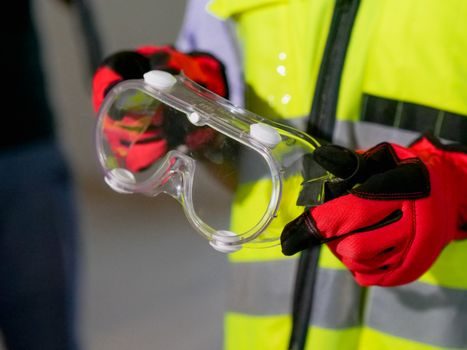
The biggest failure mode is letting the lens-marking code drift: ANSI Z87.1 + / Z87+ and EN 166 1F 1B 3 are not interchangeable procurement strings, and a pair marked only “Z87” without the “+” impact line is not rated for the high-mass / high-velocity test the spec covers. A second failure mode is over-standardising on a sealed goggle in a low-dust environment, which inflates TCO because the goggle fogs faster and is rejected by workers who then go bare-eyed. Third, treating Rx as an employee personal expense instead of a funded program line is the single most common reason a TCO model goes negative on paper while compliance collapses on the floor. [S3]
Sourcing pitfall: low-cost Asian-market frames frequently lack a traceable lot number on the lens or temple, which fails an EN 166 §10 documentation audit and forces a reissue — that reissue is the hidden cost no quote line shows. Specifying only ANSI Z87.1-certified or EN 166-marked product with a documented lot is the cheapest insurance against an audit-driven reissue event.
Standards, Sourcing Signals and What to Track Next
Two standards govern the cost-driving line: ANSI Z87.1-2020 (US) for impact, optical and marking requirements, and EN 166 (EU) for mechanical strength (1F low-energy, 1B medium-energy) and optical class 1. Both are referenced as the minimum bar in the safety glasses lens, marking and fit trade-offs reference, which gives the marking-code decoding and the side-by-side fit criteria that drive the admin cost line. [S4]
Two trackable next nodes: a Q4 2026 update from a major US distributor on anti-fog coating warranty terms, and any OSHA letters of interpretation clarifying the Z87+ marking requirement for prescription inserts — either will shift the line 2 and line 3 cost weights used in the model above.
For component-level specifications, see total station, and safety barrier.