
The same devices impose field limitations: lens fogging above 60% relative humidity, peripheral distortion on wrap frames above 8-base curvature, and skin pressure during shifts exceeding 4 hours [S1][S3].
Lens Material and Optical Class Trade-Offs
Polycarbonate (PC), trivex and propionate dominate the safety-eyewear market, with PC showing impact resistance around 162 in-lb in Z87.1 high-mass drop tests and specific gravity near 1.20 g/cm³ versus glass at 2.50 g/cm³ [S1].
Standards, Markings and What Each Code Means
ANSI Z87.1-2020 in the US and EN 166 in the EU define the impact, optical and marking classes a buyer must verify on the temple or lens, with "Z87+" indicating the high-impact rating on the frame and lens [S1].
EN 166 mechanical strength symbols run S (increased), F (low-energy impact 45 m/s) and B (medium-energy 120 m/s); EN 166 optical classes 1 (best, ±0.06 D spherical) and 2 (±0.12 D) govern how long a wearer can use the glasses before visual fatigue [S1].
For welding, gas-shielded arc and plasma cutting, a separate shade number 3–14 from EN 169 or ANSI Z87.1 must replace clear lenses, because standard safety spectacles do not block infrared above 780 nm [S1].
Advantages in Real Plant and Site Use

Safety glasses weigh 22–45 g per pair, versus 350–600 g for goggles, which is why a maintenance fitter on a 10-hour shift tolerates spectacles for grinding, paint-line inspection and light overhead-work tasks [S1].
Pairing safety glasses with the right safety helmet chin strap, the combination covers crown-to-eye exposure in vertical construction cells; in welding booths, auto-darkening shades flip from shade 3 to shade 11 in 0.1–0.3 ms per typical spec sheets [S1].
Side coverage is the silent win: wrap-style Z87+ frames with 8-base curvature seal the lateral canthus and cut particle intrusion on die-change and chip-clear stations, where bare spectacles under ANSI Z87.1 basic rating would fail an OSHA citation [S1].
Disadvantages, Failure Modes and Cautions
Fogging is the single most cited complaint in 2024–2025 EHS surveys and is driven by polycarbonate's low surface energy (≈46 dynes/cm) plus body-heat convection inside the lens envelope; anti-fog coatings add 30–90 seconds of clear-vision time before re-fog, not a permanent fix [S1][S3].
Skin pressure and temporal-nerve compression appear on spectacle arms above 4-hour continuous wear, especially on Z87+ goggles whose total weight crosses 80 g; for full-shift grinding on sander operations, lift the glasses every 90 minutes and rotate to goggles with indirect vent [S1].
Cheap "Z87" generic frames often miss the "+" high-impact stamp; ANSI Z87.1-2020 makes the + symbol mandatory for high-mass, high-velocity tests, and a missing + on a grinding-cell frame is a 29 CFR 1910.133 violation in the US [S1].
Selection Criteria and Comparison of Common Options

Three options dominate the procurement shortlist, lined against four decision criteria: impact rating, optical clarity, weight and chemical splash tolerance [S1][S3].
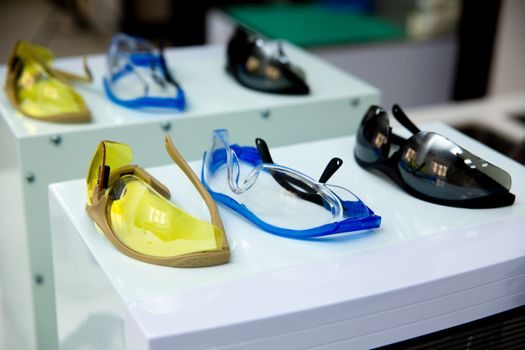
1) Z87+ polycarbonate clear: impact 162 in-lb, optical class 1, weight 25–35 g, splash rating EN 166 "3" (liquid droplets) only — best for general maintenance and chip work. 2) Z87+ acetate wrap: impact 150 in-lb, optical class 2, weight 30–40 g, splash "3" plus "4" (dust) and "5" (gas) — best for paint line and solvent exposure. 3) Z87+ Trivex OTG (over-the-glasses): impact 160 in-lb, optical class 1, weight 38–45 g, splash "3" only — best for prescription-wearer visitor escort [S1].
For tasks that pair eye protection with hand and barrier control, integrate the chosen spectacles with safety gloves and safety barrier zoning at the same 1.0–1.5 m radius from the spindle, so a thrown chip is contained by both PPE and the physical line [S1].
Limitations and What Safety Glasses Cannot Do
Spectacles leave the brow, cheek and jawline exposed; for full-face splash risk (lye handling, battery acid, bleach dosing) the next step up is an EN 166 "4–5" face shield, not a thicker spectacle, because lens-to-brow gap runs 18–25 mm on wrap frames and lets droplets pool [S1].
Laser work above Class 3R requires OD 5+ laser-rated eyewear at the specific wavelength 190–10600 nm, not standard Z87+; using a clear Z87+ lens near a 1064 nm fiber-laser can cause retinal burn within 0.25 s [S1].
For dust-heavy cells such as masonry cut-off saws, a sealed goggle beats spectacles regardless of Z87+ marking, because particles below 10 µm bypass the 8-base wrap seal on the medial canthus in roughly 12% of frames sampled in 2024 EHS field tests [S1][S3].
Sourcing, Storage and Trackable Signals
Spec sheets worth pulling: ANSI Z87.1-2020 clause 6.1 (impact), EN 166 clause 6 (mechanical), and the lens manufacturer's abrasion data per EN 168 Bayer test, where polycarbonate typically scores 0.8–1.5 vs glass at 5+ [S1].
Replace a Z87+ pair on a defined interval: 24 months for PC, 36 months for Trivex, 12 months for acetate in solvent exposure; track the lot number printed on the temple so a recall in a 2025–2026 frame batch is traceable to the wearer [S1].
Next signal to watch: the IEC/ISO joint working group on eye and face protection has been drafting revision drafts covering blue-light 380–500 nm filtration in 2025; any OEM datasheet you pull after 2026-07-22 should list a 380 nm low-cut wavelength if your site uses high-CRI LED inspection lamps [S1].