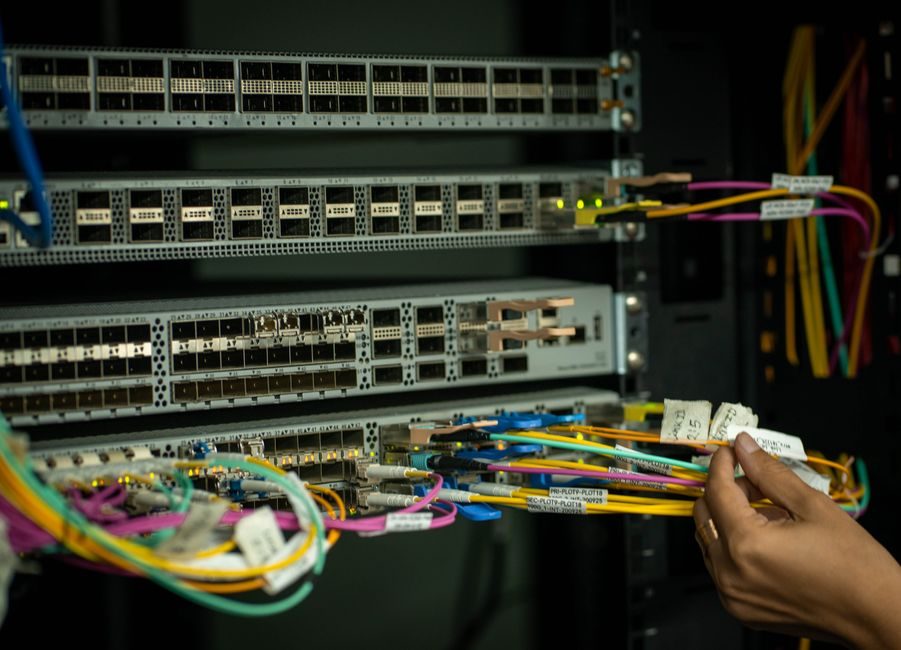
Tongue, hinge, non-contact RFID, and trapped-key interlock switches split into ISO 14119 Type 1, Type 2, Type 3, and Type 4 families, with the type number setting minimum defeat resistance and dictating which safety relay or controller PL/SIL the device can support [S2][S5][S6].
Across the 440K, XCS, GS, HS, and Prosafe ranges, four physical principles dominate: mechanically actuated tongue with positive-opening contacts, hinge-shaft rotary cam, coded-magnet or RFID non-contact, and mechanically trapped-key interlocks combined with electrical contacts [S1][S3][S4][S5][S6][S7][S8][S9][S10].
Type 1 and Type 2: Mechanical Tongue Interlocks With Positive-Opening Contacts
Type 1 and Type 2 are mechanically actuated tongue switches where a separate keyed actuator enters the switch head and mechanically forces a normally-closed contact open; the contact block is rated as a positive-opening element per IEC 60947-5-1, meaning the contacts cannot fail to open through contact welding alone [S4][S5][S6]. Schneider's XCS metal turret-head (XCSA/XCSB/XCSC/XCSE/XCSL) and plastic double-insulated XCSM/XCSP/XCST families, plus the Allen-Bradley 440K Elf, Cadet 3, Trojan T15, and Trojan 5/6, all sit in this class with IP67 enclosures and up to eight possible actuator entry points to ease door-alignment tolerance [S4][S5].
Type 1 devices are unfitted actuators that can in principle be defeated with a simple tool; Type 2 adds a coded actuator — typically a unique key shape — that raises tamper resistance. The Allen-Bradley 440K-Trovan T15 and MT-GD2 carry the Type 2 designation explicitly in their datasheet, with safety classification listed as "Type 2 Interlocking Device per ISO 14119" alongside ISO 14119 and IEC 60947-5-1 [S5]. For an engineering team deciding between the two, Type 2 is the default spec for hinged guard doors on packaging machinery, with safety relay installation rules governing how the dual-channel output is wired into the safety circuit. A common specification band is 250 V AC / 10 A conventional thermal current, snap-action or slow-break contacts, and either 1 NO + 1 NC or 2 NC contact arrangement to support cross-fault monitoring.
Type 3 and Type 4: Non-Contact Coded Switches (Magnetic and RFID)
Type 3 and Type 4 are non-contact devices with no mechanical actuator entry; they use either a coded magnet (Type 3, low-code) or a coded RFID transponder (Type 4, high-code) to detect guard closure, which removes mechanical wear and tolerates wide guard-door misalignment [S6][S8][S9][S10]. ISO 14119 explicitly defines Type 4 as requiring a high-level coded actuator with at least 1,024 variations, raising the bar above simple magnet pairs that can be defeated with a spare magnet [S6].
Idem's HC-1, HC-3, and HC-SS series, IDEC's HS3A RFID safety switch with three contacts and "high protection against tampering," and Keyence GS-10 non-contact RFID switches all target the Type 3/4 segment [S6][S8][S10]. Typical IP67 or IP69K stainless-steel housings suit hygienic washdown, and outputs are commonly OSSD (output signal switching device) PNP dual-channel to drop into a safety relay or safety PLC at PL e / SIL 3. The trade-off versus tongue switches is real: non-contact devices cannot provide a hold-force figure in newtons, so where a guard must be kept physically closed against gravity or stored energy, a guard-locking tongue or trapped-key switch is the correct device, not a Type 4 RFID switch. For a quick primer on adjacent safety hardware, see safety interlock switch fundamentals.
Guard Locking and Trapped-Key Interlocks: Type 2 With Mechanical Lock
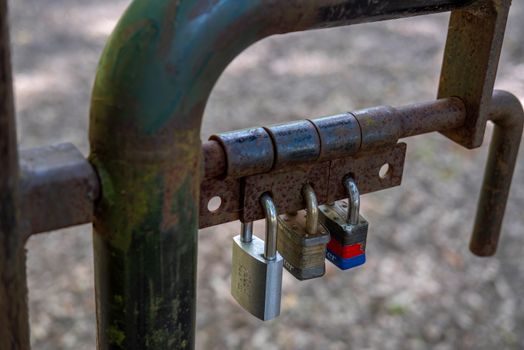
Guard-locking switches are Type 2 tongue interlocks with an integrated locking mechanism that prevents the guard from opening until a separate electrical signal releases the actuator, and trapped-key interlocks transfer a mechanical key between lock and switch so that a defined sequence is physically enforced rather than electrically [S1][S3][S7][S10]. Allen-Bradley 442G multifunctional access interlocks and 440G guard-locking switches, the Keyence GS-50 power-to-release and GS-70 power-to-lock models, and the Prosafe Slamlock with 316L stainless-steel construction and replaceable code barrel all implement guard locking with a holding force typically rated 1000 N to 2500 N [S1][S3][S7][S10].
The choice between power-to-release and power-to-lock is safety-driven, not convenience-driven: per the IEC 60204-1 / ISO 14119 logic, power-to-release is the default for personnel safety because loss of the locking signal releases the guard and lets a trapped operator escape; power-to-lock is only acceptable where an opened guard creates a worse hazard (e.g. a robot cell where a wandering operator must be excluded rather than released). Prosafe Slamlock's electrical contacts combined with trapped-key enforced sequence and weatherproof stainless-steel dust cap is the typical spec seen on outdoor mining, food, and pharmaceutical skids [S3]. One verbatim datasheet requirement worth quoting: ISO 14119 mandates that a guard-lock auxiliary signal must be monitored by a tested routine that "stops or prevents the machine from starting if the test is not done" [S6].
Selection Criteria: Hazard Severity, Defeat Risk, Environment, and Locking Need
Selection reduces to four decision criteria, in this order: (1) ISO 13849-1 Performance Level or IEC 62061 SIL required by the risk assessment, (2) tampering risk that drives Type 1 to Type 4, (3) whether the guard must be physically held closed (locking required) or merely proven closed, and (4) the chemical and cleaning environment that drives material and IP rating [S2][S5][S6][S9].
For comparison, the four families line up as follows against four decision criteria. Tongue switches (Type 1/2): lowest cost band, mechanical wear over ~1 million cycles, no lock function, IP65–IP67 typical, suited to light-duty packaging line doors [S4][S5]. Hinge switches (440H family): replace the door hinge, no separate actuator, limited tamper resistance — typically Type 1 [S7]. Non-contact RFID (Type 3/4): no wear, tolerates misalignment up to ~10 mm, supports PL e / SIL 3 in OSSD form, but no hold force and higher unit cost [S6][S8][S10]. Guard-locking and trapped-key: highest cost and largest footprint, holds door against stored energy, stainless variants (316L) for hygienic or outdoor service, mandatory for process skids with long run-down times [S1][S3][S7]. A practical shortcut: if the hazard is "guard opened during running machine causes access to rotating shaft," start with a Type 2 tongue switch plus a safety relay; if the hazard is "guard opened during running machine exposes a robot with 4-second stop time," start with a guard-locking switch with a release relay timer.
Use Cases and Limitations Across Machine Categories

Type 2 tongue switches are the workhorse on packaging machinery, small-format palletisers, and [manual pallet jack-style] service doors where alignment tolerances are tight and the cost-per-door matters across a 20-door cell; IDEC HS7A-DMP and Keyence GS-50 are common picks with 3 or 4 contacts and IP67 ratings [S5][S8][S10]. Type 4 RFID non-contact switches dominate semiconductor and pharmaceutical cells where any particulate shedding from a mechanical actuator is unacceptable, and where the same guard must be defeated-resistant against deliberate bypass by maintenance staff [S6][S8].
Known limitations are concrete: tongue switches fail at the actuator entry on misaligned guards, hence the eight-entry-point head design as the practical mitigation [S4][S5]; non-contact switches can be triggered out of position by ferrous debris on magnet-type versions, which is why RFID Type 4 is preferred over plain coded-magnet Type 3 in washdown lines [S6][S8][S9]; guard-locking switches add a solenoid power feed and a separate safety-rated monitoring channel, so wiring complexity roughly doubles versus a plain tongue switch and the safety relay panel needs a dedicated lock-monitoring input [S1][S3][S7]. For broader facility-protection context beyond the switch itself, the safety fence and safety barrier categories define the perimeter layer that the interlock is mounted on.
Standards Map and Sourcing Signals
Three standards govern almost every selection decision on the datasheet: ISO 14119 (interlocking devices, the Type 1–4 taxonomy, and the test-pulse requirements), IEC 60947-5-1 (positive-opening contacts, electrical ratings, and the B10d / mechanical-life data that feeds PL calculation), and ISO 13849-1 (the PL a–e target reached when the switch is wired into a safety function) [S5][S6]. EN 60204-1, EN 62061, and UL 60947-5-1 appear in the same datasheet conformity list as the regional or sector overlays, and Idem's HC-1/HC-3/HC-SS data sheet lists all five together as the default compliance footprint [S6].
The Prosafe Slamlock datasheet is the August 2025 revision listing 316L stainless steel construction and a replaceable code barrel assembly as standard features [S3]; Keyence, Schneider, Allen-Bradley/Rockwell, IDEM, and IDEC each publish safety interlock switch product lines covered by their respective technical documentation [S1][S4][S5][S6][S7][S8], and the underlying taxonomy is anchored to ISO 14119 as cited in vendor specifications [S5][S6]. Where an interlock sits on a guarding door that an operator routinely reaches across, the next node in the spec chain is the safety-rated stop time and the safety relay or controller PL — the missing link in many "interlock-only" bills of material.