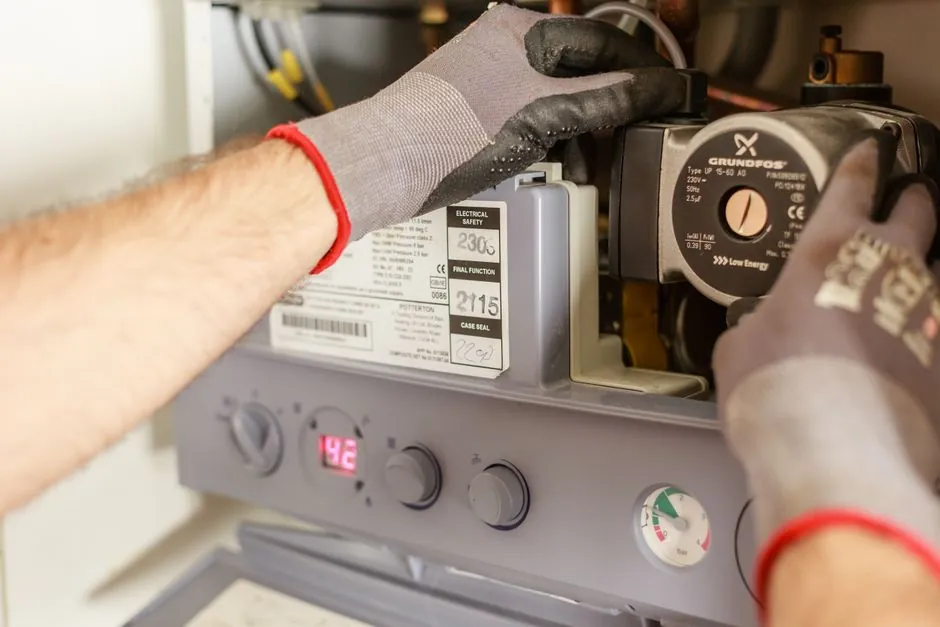
A centrifugal HVAC pump should be selected at the intersection of its performance curve and the system resistance curve, with required flow, total head, NPSH, and speed verified before ordering.
For chilled-water and hot-water systems, the usual choices are circulators, end-suction pumps, inline pumps, and split-case pumps, while positive-displacement pumps are normally reserved for chemical dosing rather than bulk circulation [S1][S2].
Define the hydraulic duty before choosing a pump
HVAC pump selection begins with required flow and total head, not with a nominal pump size. Required flow is normally expressed in gallons per minute or liters per second, while total head combines static elevation, friction losses, and pressure losses through equipment such as chillers, boilers, coils, valves, strainers, and headers [S1].
A pump does not create an independent pressure setting in a closed hydronic loop. Its flow is determined by the resistance it works against, so a larger pump does not necessarily deliver a useful increase in system pressure. A pump that is oversized for the loop can operate away from its best-efficiency region and waste energy, while an undersized pump may fail to meet the design flow [S2][S3].
At least 3 operating points should be documented for variable-flow plant: minimum flow, design flow, and maximum flow. At each point, compare pump head with system head, verify that NPSH remains above the manufacturer's required NPSH, and record brake horsepower, motor efficiency, and estimated power. The hydraulic pump reference is useful for separating hydraulic performance from motor and drive selection.
Compare the principal HVAC pump configurations
For a typical low-pressure, low-capacity hydronic branch, an inline circulator is compact and easy to install in the pipe, but its usable capacity and pressure rating must be checked against the actual branch. Published guidance describes circulating pumps as typically serving systems below 150 gpm and no more than 125 psig operating pressure; these are application limits, not universal ratings [S3].
An end-suction pump is a better candidate when the duty is larger or the installation needs horizontal suction and vertical discharge. Circulating pumps are typically used in low-pressure, low-capacity systems under 150 gpm and not rated above 125 psig. A base-mounted flexible-coupled unit gives more installation and alignment flexibility, while a close-coupled unit reduces floor space and holds motor-shaft alignment more consistently [S3].
A double-suction split-case pump is appropriate where flow, head, or redundancy makes a large single-suction arrangement less attractive. Double suction reduces hydraulic imbalance, multiple impellers can add head in one casing, and a horizontally split casing permits impeller access without removing the complete upper casing [S3]. These benefits carry a larger footprint and higher installed cost than a small inline circulator.
Choose speed and drive for changing demand

Variable-speed operation is usually the practical choice for HVAC pumps whose load changes with building demand, because throttling or bypassing a fixed-speed pump wastes hydraulic energy. The pump should still be capable of meeting design flow and head at its maximum required speed, not merely at its rated speed [S1].
The cited selection material identifies 2-pole operation at approximately 3,500 rpm as suitable for low-flow, high-head service, with the other speed families covering progressively higher-flow or lower-head duties [S6]. The final motor must be checked against local voltage, frequency, service factor, starting method, and variable-frequency-drive limits.
For variable speed, affinity relationships can be used as a first-pass check: head varies approximately with the square of speed, flow approximately with speed, and hydraulic power approximately with the cube of speed. The hydraulic valve and control-valve selections also affect the resulting system curve and should be coordinated before the pump duty is frozen.
Verify suction conditions and piping constraints
NPSH is the minimum pressure at the pump suction required to prevent cavitation, and available suction pressure must exceed the pump's required NPSH [S4]. This check must use the worst combination of low tank level, high flow, warm water, low suction pressure, and maximum speed. A suction-pressure reading at design flow is not a substitute for checking the minimum available condition.
Installation practice directly affects bearing life, alignment, vibration, and seal reliability. Base-mounted end-suction pumps should be properly grouted and aligned, while flexible-coupled installations require the coupling to be checked for alignment after maintenance rather than assumed to remain correct [S3][S4].
Service clearance is part of the selection, not an installation detail. Horizontal split-case construction provides direct impeller access, while close-coupled and inline pumps may require removal of adjacent piping or the entire unit [S3][S4].
Match materials and seals to the actual fluid

The selected pump must be compatible with the circulating fluid, including water or glycol concentration, temperature, system pressure, and contamination level.
For conventional closed-loop HVAC service, the design team should identify the fluid type, maximum and minimum operating temperature, design pressure, and whether inhibitor or contaminant carryover is possible. Where the loop includes condenser or cooling-tower water, corrosion and fouling risk increase because the circuit is open to atmosphere. Positive-displacement equipment remains a specialized choice for chemical dosing, where metered flow and relief protection matter more than the smooth-flow characteristics valued in bulk circulation [S2].
Account for installation, service, and operating cost
The purchase price is only one part of installed cost. The comparison should include the pump, motor, variable-speed drive, piping and fittings, baseplate, grouting, alignment, electrical work, isolation, controls, and periodic service. The published maintenance discussion identifies bearing failure as the second leading cause of pump breakdowns and links proper lubrication, regular maintenance, and contaminant control to reliability [S4].
Total operating cost should be compared at the actual duty, not at catalog best-efficiency point. Input data should include flow in gpm or L/s, head in ft or m, fluid temperature and specific gravity, suction pressure, running hours, electricity price, and the expected minimum-flow requirement. If a variable-speed drive is part of the scope, document motor and drive compatibility instead of treating the drive as an accessory.
Specify the final pump with a complete data sheet
A purchase specification should identify the pump type, orientation, duty flow, total head, pump speed, motor power, voltage, frequency, fluid, temperature, pressure, materials, seal arrangement, NPSH required, and connection sizes. For staged or variable-flow systems, it should also state the minimum acceptable continuous flow and the control signal required from the building management system [S1][S5].
Applicable pump standards can be identified as applicable to the exact service rather than treated as interchangeable procurement labels. The training material lists Hydraulic Institute standards, ASME B73.1 for chemical-industry pumps, API 610 for oil-and-gas pumps, DIN 24256, ISO 2858, ISO 5199, and nuclear and fire-pump specifications, but these address different industries and duties [S2]. For ordinary commercial HVAC circulation, project specifications should identify the applicable standard and edition in the project documents.
The final shortlist is straightforward: use an inline circulator for a compact, low-pressure branch; use an end-suction pump for a larger conventional duty with practical floor space; use a double-suction or multistage split-case pump for high-flow or high-head service; and reserve positive-displacement pumps for metered dosing. Reject any candidate whose verified curve cannot satisfy flow, head, NPSH, speed, fluid service, and maintenance access at the worst operating condition.