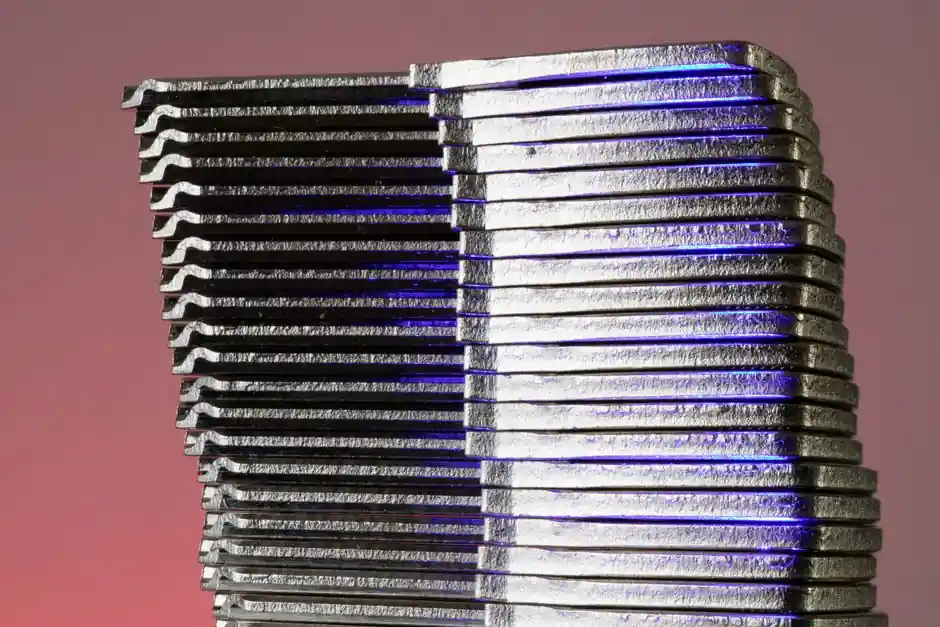
ASTM D522/D522M covers the resistance to cracking of attached organic coatings on sheet metal and rubber-type substrates, with cylindrical and conical mandrel configurations used to assess flexibility under bending [S1][S2].
The procedure compares a cured coating against defined bend radii, identifies cracking, flaking, or adhesion loss, and is intended for coated products that will be bent, wound, roll-formed, or press-braked after coating [S3][S4].
What the Mandrel Bend Test Measures
ASTM D522/D522M-17(2021) is the cited ASTM test method for the resistance to cracking, or flexibility, of attached organic coatings [S1]. The test subjects a uniformly coated and cured panel to bending around a defined mandrel, then examines the coating for damage [S5].
The result is used to rank coating deformation resistance and determine whether a coated sheet can tolerate fabrication forming. Relevant forming operations include roll-forming, press-braking, and profiling of prepainted steel or aluminium [S3]. Coated strips may also be bent, wound, or reshaped during manufacturing and service [S4].
This is not a general abrasion, hardness, or impact test. Its measured failure mode is cracking during flexure. For broader coating qualification, cross-hatch versus pull-off coating adhesion testing addresses adhesion separately, while reverse impact testing addresses deformation caused by a falling indenter rather than controlled mandrel bending [S3].
Cylindrical Versus Conical Mandrel Options
Cylindrical testing bends a coated strip around mandrels of defined diameters, while conical testing covers a continuously changing range of radii in one operation [S2][S4]. The cylindrical approach suits fixed-radius pass/fail control, while the conical approach provides a continuous deformability profile [S4].
ASTM D522 includes cylindrical and conical mandrel testing, while ASTM D4145 covers T-Bend testing. ISO 1519 is used for cylindrical mandrel testing, and ISO 6860 for conical mandrel testing [S4].
A smaller accepted mandrel diameter represents greater flexibility because the substrate is bent through a tighter radius [S3][S4]. That makes mandrel diameter a useful specification value, but only when the substrate, coating thickness, cure condition, test configuration, and inspection criterion remain controlled.
How Results Are Evaluated
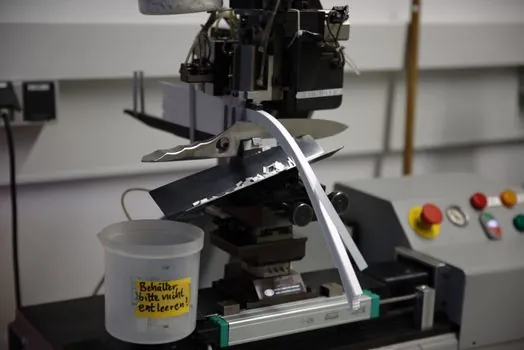
Cylindrical testing starts with a larger radius and progressively reduces the mandrel size until cracking or flaking appears. The smallest diameter at which the coating remains undamaged defines the maximum deformability for that specimen [S4].
A conical apparatus covers a broad range of bending radii in one bend.
After bending, the coating is checked visually or microscopically for cracks, flaking, and other damage [S4]. In the conical procedure, the sample is wrapped in paper during bending to reduce scratching, the crack endpoint is marked after paper removal, and its distance from the narrow cone end is measured [S4].
For coated prepainted sheet, the T-Bend test provides a separate forming convention under ASTM D4145 and EN 13523-7. Results use spacer values such as 0T, 1T, 2T, and 3T, with 0T producing the highest bend strain and larger T values producing lower strain [S3]. A result such as 1T crack-free therefore belongs to a T-Bend specification and should not be presented as a mandrel diameter.
Variables That Can Distort a Flexibility Ranking
Coating formulation, binder crosslink density, glass transition temperature, dry-film thickness, cure level, substrate alloy and temper, and test temperature all affect measured flexibility [S3]. A thicker film at the same bend radius is more prone to cracking, while lower test temperatures reduce coating flexibility [S3].
Substrate selection also controls the outcome because the coating and substrate are strained together. The test scope includes sheet metal and rubber-type substrates, and coating performance is evaluated as an attached system rather than as a free coating film [S1][S5].
Preparation must also be controlled across the comparison. Uniform coating thickness, drying or curing before bending, consistent mandrel geometry, and a defined damage-inspection rule are necessary for repeatable comparisons [S4][S5]. A pass/fail specification should identify the substrate, coating system, dry-film thickness, mandrel diameter, bend direction, conditioning period, and acceptance criterion rather than requiring only the word “flexible.”
Choosing the Right Acceptance Criterion

Cylindrical mandrel testing fits procurement and production inspection when the product has a defined minimum bend radius. Conical testing fits coating development because one specimen supplies a continuum of bend radii and can locate the transition to cracking [S2][S4].
The method suits coil-coated steel and aluminium intended for architectural panels, appliance covers, garage doors, automotive parts, and other formed building products [S3]. It also serves painted, powder-coated, or otherwise organic-coated metal where later bending could expose cracking [S4].
It is less suitable as the sole acceptance test for a coating expected mainly to resist abrasion, hard-body impact, corrosion, or chemical exposure without forming. Those service risks require separate methods. A mandrel result also cannot establish long-term coating durability because it applies a short, controlled deformation rather than the combined mechanical, thermal, and environmental exposure of service.
Specification and Reporting Checklist
A defensible ASTM D522/D522M specification needs a defined minimum mandrel diameter, coating identity, substrate description, application method, dry-film thickness, and cure condition [S1][S3]. It should also identify whether the cylindrical or conical procedure applies and whether the coating or substrate side faces outward during bending [S4].
Report the smallest passed diameter for cylindrical testing, the crack endpoint or strain result for conical testing, and the observed mode of failure [S4]. If post-bend adhesion is required, cross-hatch adhesion testing under ASTM D3359 Method B can evaluate whether adhesion remains after mandrel deformation [S3].
For comparisons with other coating attributes, the broader technical scope of industrial coating matters because flexibility is only one property in a system that may also require corrosion protection, appearance retention, and adhesion after forming.
The next trackable signal for a forming qualification is the bend radius used in production compared with the smallest laboratory mandrel diameter passed, with coating thickness and substrate grade recorded under the same revision of the selected method.