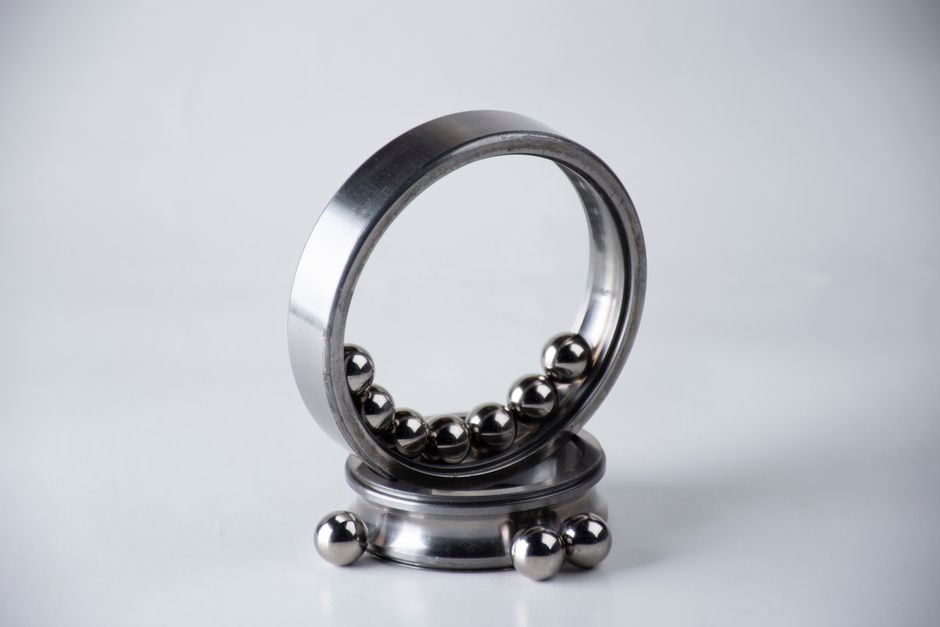
Self-aligning ball bearing units from CMW are stocked in 12-90 mm bore, 40-160 mm OD and 22-96 mm length envelopes, the dimensional envelope that defines the maintenance clearances a plant must leave around the shaft [S2].
The compatibility question is mechanical, not electrical: the bearing will absorb 1.5°-3° of static misalignment, but the housing style sets whether a technician can grease, pull, or replace it without dismantling surrounding structure, and the wrong choice burns an 8-hour turnaround into a 3-day one [S1][S3].
Interface Layers That Decide Fit
Mounting interface: pillow-block (UCPE-style) units bolt through two cap screws on a flat sole, require roughly 1.5× housing height of axial puller space behind the shaft, and ship in cast iron, pressed sheet steel, stainless steel, or zinc "Silver/Stainless Silver" alloys per the OEM's published list [S3]. Cartridge and flanged-cartridge units drop into a machined bore and lock with a single set-collar, which collapses axial access to roughly 0.5× bore diameter but demands a concentric housing shoulder, not a flat pad [S1].
Shaft interface: the inner ring typically locks via set-screws (UCPE208 pattern) or an eccentric locking collar, with an internal pin in the pillow block preventing inner-ring rotation on the shaft; misalignment is corrected by the sphered outer race, not by shimming the shaft [S3].
Sealing and lubrication interface: double-sealed inserts ship greased for life on many light-duty units, but higher-radial-load pillow blocks expose a grease fitting on the housing cap, and that fitting's position relative to the nearest guard rail is the single most-overlooked clearance check on a layout drawing [S2][S3].
Selection Criteria: Load, Speed, Misalignment, and Access
Static load, dynamic load, and speed limits must come from the manufacturer's catalog for the chosen insert and housing combination, and exceeding any one of them invalidates the self-aligning benefit; CMW publishes the envelope for its ball-bearing line as 12-90 mm bore and 40-160 mm OD, with corresponding load curves in the product datasheet [S2].
Misalignment budget is the second gate: self-aligning ball bearings accept typically up to 1.5°-3° of static shaft-to-housing misalignment, while self-aligning roller bearings tolerate more but require heavier housings and more relubrication, so the housing style has to absorb the resulting access penalty as well [S4].
Temperature and environment come third: cast-iron pillow blocks suit most general industrial floors, pressed-sheet units suit lightweight conveyors, stainless blocks suit food and washdown, and ASAHI-pattern high-temperature inserts extend the envelope when process heat migrates down the shaft, all options the Melucci catalogue enumerates against load class [S3].
Who Self-Aligning Pillow Blocks Are For, and Who Should Walk Away
Open-frame conveyor drives, fan shafts, and aggregate screens are the right fit: long spans of troughing or screen media deflect under load, and a self-aligning pillow block absorbs that deflection without daily re-alignment, while still allowing a single-technician grease-gun pass through a hand-port in the guard [S2][S3].
Cartridge/expansion units earn their place inside gearbox housings, pump bearing frames, and motor housings where the shaft must be axially positioned, not just supported, and where the surrounding casting is the access constraint, not the housing [S1].
Skip the self-aligning style when the application demands sub-arc-minute positioning (machine-tool spindles, encoder feedback couplings), when the radial-to-axial load ratio is too high for a ball insert, or when the surrounding structure cannot be opened for bearing extraction, because the sphered outer race will not save a design that the maintenance team physically cannot reach [S4].
Comparison: Housing Styles Against Access and Load
Two-bearing pillow block (UCPE208, cast iron, double-sealed): low-to-medium radial load, ~1.5°-3° misalignment, axial access ~1.5× housing height for puller, grease zerk on cap [S3].
Pressed-sheet pressed-metal pillow block: lightweight radial load, similar misalignment, narrower axial envelope, often grease-for-life with no zerk, suits conveyor idler frames [S3].
Stainless-steel pillow block: same misalignment envelope as cast iron, washdown-rated, slightly higher cost, zerk retained or sealed per spec, suits food and pharma [S3].
Cartridge/flanged-cartridge unit (CMW self-aligning insert in cartridge housing): medium-to-high radial load, same misalignment budget, axial access collapses to ~0.5× bore, requires machined housing shoulder, suits enclosed pump and gearbox frames [S1][S2].
Real Use Cases and Failure Modes
CMW positions its self-aligning ball-bearing line across manufacturing, energy, construction, and marine, with the operating-condition checklist calling out correct alignment, static/dynamic load limits, speed limits, lubrication, and temperature envelope, exactly the five parameters that show up in failure-mode reviews [S2].
Misalignment remains the dominant killer: even a self-aligning insert only corrects 1.5°-3°; beyond that, the inner ring runs true while the outer race pivots, edge-loading the ball complement, generating heat, and prematurely fracturing the retainer, a sequence the GlobalSpec bearings chapter attributes to skipping the alignment step rather than to a defective bearing [S4].
Access failure looks different but costs the same: a pillow block that mounts tight against a structural channel cannot be pulled with a standard 2- or 3-jaw puller, so the technician cuts the housing and replaces the bearing, insert, and housing together, tripling the bill of materials on what should have been a 30-minute grease job [S3].
Sourcing, Standards, and Verification
For aeronautical and high-demand industrial sliding self-aligning bearings, SAE AS 21154B-2011 (plain self-aligning, grooved outer ring) and SAE AS81936/2-1998 (plain self-aligning, beryllium-copper ball, CRES race, -65 to +350 °F) remain the cited qualification documents, with the latter covering a defined -65 °F to +350 °F operating window [S7][S8].
Verify on the supplier listing: DirectIndustry product pages (CMW, Melucci) list the insert type, bore/OD/length envelope, material options, and a response-time signal (CMW's "under 24 hours" is published on the listing itself), and a sourcing engineer should treat those numbers as the datasheet, not marketing [S1][S2][S3].
For higher-volume OEM sourcing, Alibaba indexes more than 450 self-aligning roller-bearing suppliers, with the leading country cluster shipping from China, which matters for lead-time planning rather than for compatibility itself [S5].
Limitations and Constraints
Sphered-outer-race self-aligning inserts trade speed for misalignment, so catalog speed limits must be checked before reusing an existing housing with a heavier insert, and the dynamic load curve typically drops faster than the static curve as speed rises [S2][S4].
Grease-for-life inserts remove the relubrication maintenance task but remove it permanently, so the access question morphs from "where is the zerk" to "where is the bearing-pull path," and that path must be designed in at the layout stage, not retrofitted after a failure [S3].
Materials matter more than the catalogue suggests: the Melucci "Silver" and "Stainless Silver" zinc-alloy housings extend options into corrosive environments, but the bearing insert's corrosion behaviour still follows the steel-race specification, so the housing alone does not buy washdown rating [S3].
Layout Checklist Before You Sign the Drawing
Confirm bore, OD, and length fit the published envelope (12-90 mm / 40-160 mm / 22-96 mm for the CMW ball-bearing line, and 90-160 mm OD for the heavier end) and that the chosen housing has the same envelope plus the axial puller clearance the technician will need on site [S1][S2].
Confirm grease-zerk position, double-seal rating, and material against the environment, and require the supplier to publish the misalignment limit and the speed/load curves on the datasheet, not just on the brochure [S2][S3].
For ceramic-hybrid inserts and high-temperature motor enclosures, cross-check against the ceramic bearing certification checklist, since housing access for hybrid inserts has tighter thermal-clearance rules than standard steel-race units.
For limit-switch interlocks guarding the same shaft envelope, see the limit-switch selection spec map, since the same access volumes that govern bearing puller space also govern actuator rod travel.
For the broader rolling-element picture and how self-aligning units compare with ball bearings on a plain conveyor, the CMW product list pairs the self-aligning insert with deep-groove and spherical roller siblings under the same supplier umbrella, which simplifies single-vendor qualification [S1][S2].
Track these signals over the next sourcing cycle: whether the OEM publishes a 3D model with the access envelope called out (CMW currently lists dimensions only, not CAD), and whether the supplier's stated response time holds on a real RFQ, since both are leading indicators of whether the maintenance story will survive plant handover [S2].
For component-level specifications, see self aligning bearing, and access control.