
X-ray filament life has no universal replacement interval because tube loading, filament temperature and thermal cycling determine wear, while a radiography tube may serve 50,000–200,000 exposures [S4].
Industrial tubes span 25 kV to over 400 kV, with stationary-anode models often operating at 1–20 mA for long periods and rotating-anode models exceeding 1,000 mA in pulses of about 1 millisecond to 10 seconds [S1].
Why a fixed filament interval is unreliable
Less than 1% of the energy in an X-ray tube becomes useful X-rays, while approximately 99% becomes heat, making thermal control the dominant constraint on tube life [S1].
Filament damage is cumulative. US5901197A describes the same mechanism: continued use weakens the filament until it fails, making filament life a principal determinant of tube life [S8].
Exposure count alone cannot define the interval. A radiography tube may be rated for 50,000–200,000 exposures, equivalent to roughly three to seven years in a clinical room, but that range describes a complete tube rather than a universal filament service period [S4].
Compare the main tube architectures
Stationary-anode tubes are suited to industrial inspection from 25 kV to over 400 kV and commonly operate at 1–20 mA in nearly continuous duty, sometimes for many hours [S1]. Rotating-anode tubes, used mainly in medical radiography, can exceed 1,000 mA and normally work in pulsed mode over roughly 1 millisecond to 10 seconds [S1].
Openable tubes offer a virtually unlimited life because they can be opened to maintain and replace parts such as the filament and target. In a conventional sealed assembly, filament failure normally requires replacement of the complete X-ray tube [S5].
Build the replacement rule around four variables

First, record kV, tube current, exposure duration and pulse frequency for every operating mode. A stationary tube drawing 1–20 mA continuously [S1] and a rotating-anode tube producing pulses above 1,000 mA [S1] create different thermal histories even when both complete the same number of exposures.
Second, control filament drive within the generator and tube limits. For most micro X-ray tubes, one maker specifies 1.0 A preheat and a 1.7 A maximum current limit [S7].
Third, treat startup and shutdown as fatigue cycles, not free transition periods. The filament experiences extreme temperature changes during operation, and thermal stress is the leading cathode-failure mechanism [S2].
Fourth, verify that the equipment performs at the required duty. Stationary industrial tubes may remain on for many hours, and
Use condition monitoring before replacement
A condition-based program should distinguish normal burnout from acceleration or application mismatch.
That limitation matters operationally: a monitoring model can identify a wear trend, but it cannot establish a universal alarm threshold without validated data for the tube, filament material, geometry and operating profile.
For industrial inspection, tie filament condition to the same equipment history used for output and geometry checks. An industrial X-ray system should be evaluated for voltage, current, duty cycle, cooling and tube-family compatibility rather than judged by filament age alone.
Match the maintenance method to the equipment
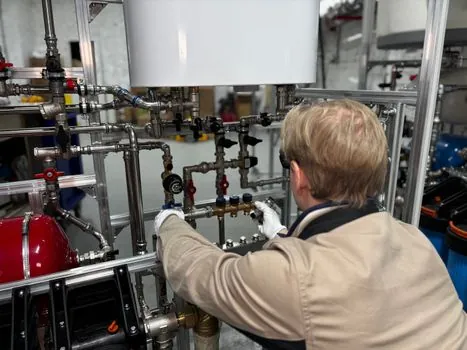
For a sealed tube, replacement is normally a complete-tube operation after filament failure [S5]. The replacement assembly must match the original envelope, target, focal spot, ratings and generator interface. Tube service is also constrained by the heat-management design, since approximately 99% of the input energy becomes heat [S1].
For an openable tube, replacement can include the filament and target. This option is attractive where the enclosure is already designed for service, but
Do not confuse filament replacement with periodic proof testing of the complete imaging chain. A coating thickness gauge also depends on detector response, source geometry and calibration, while filament condition determines whether the tube can maintain stable electron emission [S1][S5].
Set a defensible replacement interval
Use a three-part rule: monitor actual operating load, trigger investigation when the operating profile exceeds the tube rating or when abnormal exposure behavior appears, and replace on confirmed filament failure unless a validated condition model supports preventive replacement. The first two actions follow the documented effects of application mismatch, improper power-supply drive and thermal stress [S1][S2].
A published 2026 medical guide states that radiography tubes typically deliver 50,000–200,000 exposures. Those figures can frame maintenance records, but they do not authorize a generic filament replacement interval. Industrial duty, thermal exposure and drive settings remain the controlling variables.
The next trackable signals are filament-condition trend data, exposure history expressed in kV, mA and seconds, and the date of any open-circuit or unstable-emission event. Together, these records support a tube-specific interval rather than a false precision calendar rule.