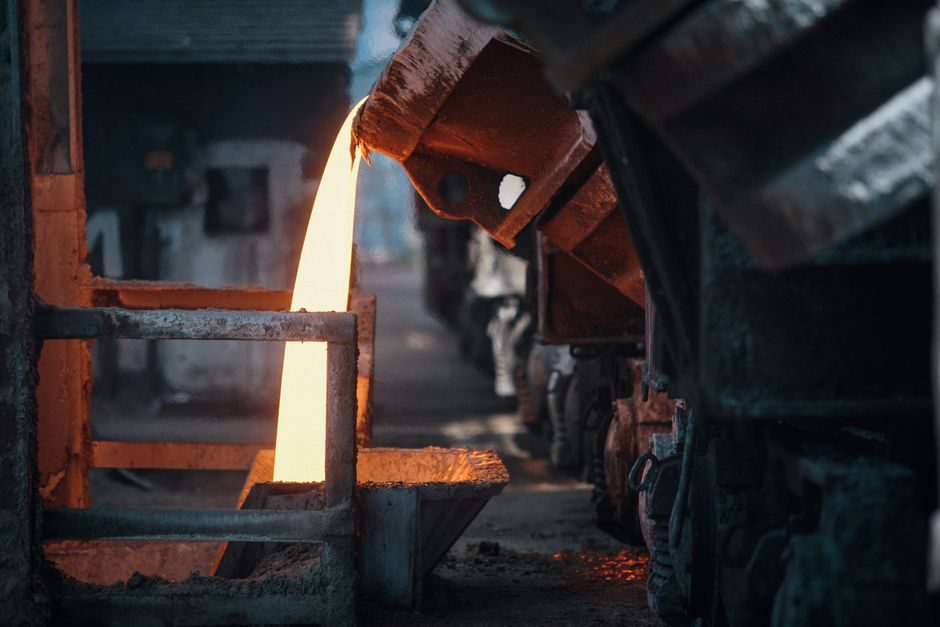
A shot blasting machine is a high-velocity abrasive-propulsion cell, typically running cast steel shot or cut wire at 40–80 m/s through a centrifugal wheel (commonly 8–15 inch / 200–380 mm diameter) to clean, descale, or peen ferrous castings and fabricated steel [S1][S3]. A sand cooler is a fluidised-bed or rotary vessel sitting inside the sand reclamation loop, designed to drop return foundry sand from roughly 250–350 °C down to a moulding-usable 30–50 °C while stripping fines and controlling moisture [S1].
They share no working chamber: one throws media at a part, the other conditions bulk granular media. Mis-spec'ing a sand cooler as a cleaning machine — or vice versa — is one of the most expensive line-design errors in a green-sand or no-bake foundry, because the equipment footprints, dust loads, dust-collector sizing, and electrical classifications do not overlap [S1][S8].
Scope, Function and Where Each Sits in the Line
A shot blasting machine is normally downstream of shakeout and shot decore: castings arrive hot and sand-laden, the wheel throws steel shot (S230–S460 is the common cast-shot grade band) at the casting surface, and the abrasive rebounds into a screw conveyor or auger return for media/sand separation [S3]. A sand cooler sits on the return-sand side of the same moulding loop, between shakeout/screen and the moulding line hopper, and its only mechanical interface to a blast cell is the bucket elevator or pneumatic conveyor that feeds new shot to the wheel hopper [S1].
Cleanliness class drives the blast cell spec: ISO 8501-1 Sa 2.5 (commercial blast) and Sa 3 (white metal) are the typical acceptance bands for steel-structure and offshore-fabrication work, and they directly fix the abrasive size, exposure time, and number of wheels in a tumble-belt or roller-conveyor machine [S3]. Sand coolers carry no such surface-grade requirement; their spec is thermal output (kW removed per t/h), outlet temperature stability, and moisture tolerance for the downstream muller or continuous mixer [S1].
Selection Criteria That Actually Differ
Five gates separate the two specs, and confusing them is the most common sourcing mistake in greenfield foundry tenders: [S1]
1. **Process goal.** Blast cell = surface finish or fatigue-life improvement on the part; cooler = thermal and moisture conditioning of bulk return sand, no part is touched [S1][S8].<br/>2. **Energy profile.** A tumble-belt blast machine with a 15 kW wheel motor pulls 30–80 kWh/t of castings cleaned; a fluidised-bed sand cooler rated for 20 t/h of return sand typically draws 15–30 kW of fan and motor power for the same period, dominated by the induced-draft blower and the vibrating fluidisation deck [S1].<br/>3. **Abrasive vs media.** Blast cells consume cut wire, cast steel shot, or aluminium oxide — wear-parts budget is the wheel blades (8–15 kWh blade change intervals at 8 h/day are typical on heavy cells); coolers consume water spray nozzles, fluidisation air filters, and refractory-lined cyclones, with media-as-consumable limited to small top-up sand losses [S3].<br/>4. **Dust and ATEX envelope.** Both generate combustible dust, but the Kst class of the cloud differs: a clean steel-shot blast on cold castings trends to Class 1 dust (Kst < 200 bar·m/s), while a hot return-sand stream carrying organic binder fines (furan/phenolic) trends toward Class 2 (200 ≤ Kst < 300 bar·m/s), so cooler ducting and dedusting must be specified for the higher rating [S1].<br/>5. **Footprint and integration.** A 5 t/h tumble-belt blast machine is roughly 4 m × 3 m × 3 m plus the elevator; a 20 t/h fluidised sand cooler trains the bucket elevator, fluidised bed, cyclone, and ID fan into a vertical envelope of 5–6 m height and 3 m × 3 m floor — adjacent, but not interchangeable, and not shareable on a single structural skid [S1][S8].
Who Each Machine Is For — And Who It Is Not For
A shot blasting machine is the right answer for a foundry or forge shop that needs to remove burnt-on sand, oxide scale, or investment shell residue from castings, or to deliver a peened surface to a defined Almen intensity for fatigue-critical components such as leaf springs, gear blanks, and aerospace structural parts [S8][S9]. It is the wrong tool for cleaning high-value thin-wall castings that will chip or bend under shot impingement, and it is the wrong tool for any process whose goal is sand conditioning — the part-to-media force chain goes the other way in a cooler.
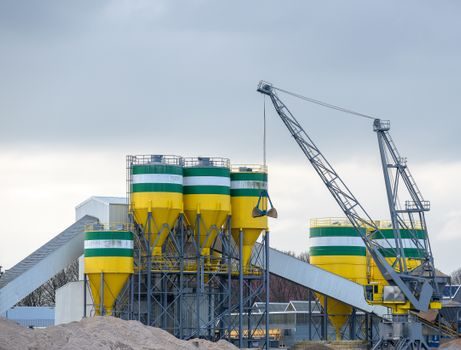
A sand cooler is the right answer for any green-sand, sodium-silicate, or chemically bonded no-bake line returning shakeout sand at 200–350 °C to a continuous mixer that requires sand at 30–50 °C with 2–6% moisture, depending on the binder system [S1]. It is the wrong tool for a small job-shop foundry running under 2 t/h of return sand (a simple rotary drum with water spray is usually cheaper), and it is the wrong tool as a stand-alone dedusting solution — dust must be handled upstream in the shakeout hood and downstream at the cooler stack [S1].
Criteria-Based Comparison
The decision matrix below is what gets laid on the table in a 2026 capex review; both rows are standard-foundry acceptance language, not lab oddities. [S2]
• **Decision criterion 1 — what flows through the cell:** Shot blasting machine = castings (0.5–500 kg typical part band, depending on machine size); sand cooler = return sand (5–60 t/h typical band) [S1][S8].<br/>• **Decision criterion 2 — primary process output:** Blast cell = surface cleanliness ISO 8501-1 Sa 2.5 / Sa 3, or peened surface to Almen A/SAE spec; cooler = outlet sand temperature 30–50 °C and controlled moisture 2–6% [S3].<br/>• **Decision criterion 3 — main wear / consumable cost:** Blast cell = wheel blades and control cage, plus steel-shot top-up (S330/S390 is a common operating grade) at 0.3–1.5 kg per tonne of castings cleaned at Sa 2.5 [S3]; cooler = fluidisation air-filter elements, spray nozzles, and cyclone refractory [S1].<br/>• **Decision criterion 4 — main failure mode if mis-applied:** Blast cell on hot sand = blade erosion and dust explosion risk; cooler on castings = no cleaning action, plus thermal-shock damage to the bed plate and downstream ductwork [S1][S8].
Common Configurations Sourced in 2026
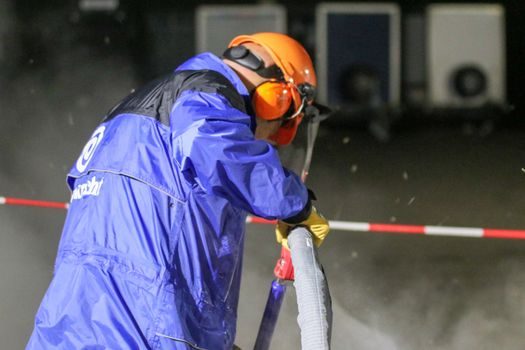
For blast cells, the 2026 OEM catalogue skews to four build formats: tumble-belt (small parts, 0.1–5 t/h), tumble-blast barrel (delicate castings, batch), roller-conveyor (plate, structurals, 5–30 t/h), and overhead monorail / hook (large fabrications, engines, gearboxes) [S1][S7][S8]. For sand cooling, the two dominant formats are the fluidised-bed cooler (higher thermal throughput, 10–60 t/h, better moisture control) and the rotary drum cooler (lower capex, 3–15 t/h, more maintenance on trunnion seals) [S1]. Chinese OEMs in Qingdao and Dongguan — including QGMA Group, Kunyuan, Disa, Jichuan, and the Processblast catalogue — now ship both machine families from a single regional supply base, with rotary, hanger-type, and roller-conveyor blast cells listed alongside fluidised coolers on the same vendor page [S1][S2][S5][S6][S10].
Capacity overlap is the trap: a small foundry at 3 t/h of return sand can be served by either a fluidised cooler or a rotary drum, but only a rotary drum is reasonable below 5 t/h on capex grounds, and only a fluidised bed can hold ±2 °C outlet temperature stability under variable shakeout load [S1]. On the blast side, a 5 t/h tumble-belt cell is the lower limit for cost-justifying a screw-return system; below that, a batch hanger-type machine on a simple monorail is the more common 2026 build, particularly for job-shop casting work in the 50–500 kg per part band [S7][S8].
Standards, Ratings and What Auditors Will Check
Surface-prep audits default to ISO 8501-1 for visual cleanliness, ISO 8503 for roughness, and ASTM E428 for magnetic-particle shop reference comparators on peened surfaces [S3]. For sand coolers on chemically bonded lines, the binding control point is the resin-supplier's moisture and temperature window for the furan, phenolic-urethane, or silicate binder in use, which the cooler must hold against the sand flow into the sand mixer or resin sand line [S1].
Explosion protection on both cells is governed by the regional hazardous-area framework: ATEX 2014/34/EU in Europe, IECEx for IEC-region builds, and NFPA 654 in the U.S. for combustible-dust handling — all three are written in dust-explosion-protection documents used as the Kst-class basis quoted in §2 above [S1]. Wheel-head rebuild intervals and cage balance records are the standard shop-floor documentation requirement for blast cells; thermal-mapping logs of the cooler bed plate and inlet/outlet thermocouples are the parallel requirement for coolers [S1][S8].
For buyers cross-shopping the two machines on a single BOM, the realistic 2026 price band — pulled from current export catalogues — is roughly USD 3,000–10,000 for a small wet-blast or suction-blast cabinet [S4], USD 15,000–60,000 for a single-wheel tumble-belt machine, USD 80,000–250,000 for a multi-wheel roller-conveyor cell, and USD 60,000–300,000 for a 10–30 t/h fluidised-bed sand cooler skid including ID fan and cyclone — the cooler line item is comparable in capex to a mid-size blast cell, and that is the line-item ratio a project engineer should expect to defend in the 2026 capex review [S1][S4].
Limits, Failure Modes and Sourcing Traps
The two equipment families have three constraints that bite in 2026 builds. First, dust-explosion zoning is non-negotiable on the cooler side when organic binders are present; a Kst Class 1 rating on a steel-shot blast cell does not extend automatically to a hot-sand duct, and deducing it does is a fire-safety non-conformance [S1]. Second, abrasive cost is a much larger share of lifetime OPEX for a blast cell than for a cooler — the S330/S390 cast steel shot consumption figure of 0.3–1.5 kg/t at Sa 2.5 is the number to track month over month, and a step change in that figure is the first sign of wheel-blade wear or cage-balance drift [S3]. Third, thermal recovery is now a 2026 tender line item: a fluidised sand cooler exhausting 200–300 °C air carries enough enthalpy to preheat combustion air on an adjacent heat-treatment furnace, and refusing to integrate that loop will show up in the next energy audit [S1].
The single most common 2026 sourcing trap is treating the two machines as substitutes in a retrofit. They are not. A foundry that needs both surface cleaning and sand conditioning must plan for two pieces of equipment, two dust collectors (rated to their respective Kst classes), and two maintenance crews, and that needs to be visible in the 30%-definition engineering package before the procurement RFQ is issued [S1][S8].
Two trackable signals will tell you whether the line is correctly split: (1) blast-cell blade-change interval — if it drops from 8 h to 4 h after the cooler is commissioned, the cooler is leaking hot fines back into the shot return and the bucket-elevator seals need rework; (2) outlet sand temperature stability — if the fluidised-bed cooler drifts more than ±5 °C under steady load, the bed plate is fluidising unevenly and casting-defect rates on the moulding line will follow within a shift, per current OEM guidance from Chinese and Indian blast-and-cooler builders in the 2026 export catalogues [S1][S2][S5][S6][S8].
For related coverage, see Carton Erecting Machine Selection Criteria: 5 Spec Gates for 2026 Lines.