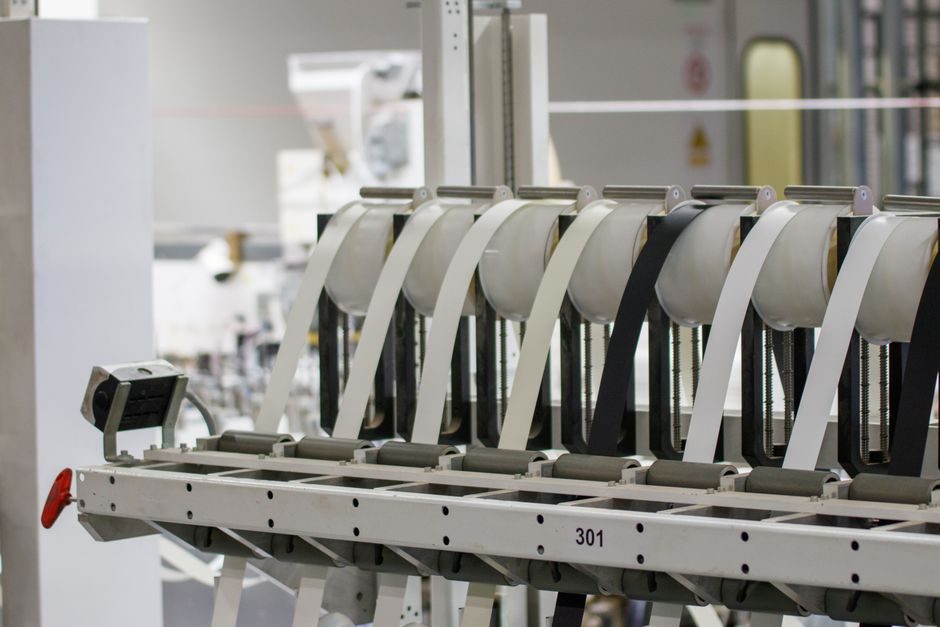
Industrial shrink wrappers on the 2026 market span manual chamber units rated at roughly 300 packs/hour (Robopac Micra L/M, 540 × 390 mm sealing area) to fully-automatic in-line systems reaching 10,800 packs/hour (KHS SP Basic) and 120 packs/min for seamless-film packers (SMI EvoFilm) [S1].
The format class covers a single physical process: a heat-shrinkable polyolefin or polyethylene film — most commonly 50-100 µm thickness — is wrapped around a collation and passed through a heated tunnel at 150-200 °C, where the film shrinks 30-55% in the machine direction to lock the load [S4]. The variant map matters more than the brand label: chamber, side-seal L-sealer, sleeve wrapper, and continuous-motion wrapper each suit a different throughput and product mix, and the shrink wrapping machine encyclopedia entry collects the side-by-side spec grid.
Throughput tiers and the formats each machine family actually builds
Robopac's manual seal-and-shrink range (Micra L and Micra M) is rated at 300 packs/hour with a 540 × 390 mm seal bar — a footprint that fits a benchtop and a 2-3 day lead-time SKU rather than a bottling hall [S1]. The Athena Combi 6555, also from Robopac, jumps to 30 packs/min (1,800 packs/hour) at 650 × 550 mm pack size, and is positioned for mixed-SKU food and cosmetics lines that change format more than once per shift [S1].
Higher-volume bottlers anchor on the SMI LSK 30 ERGON (30 packs/min) and LSK 40 ERGON (40 packs/min), both offered in film-only, pad+film, and tray+film configurations for plastic, glass, or metal containers [S1]. The single-lane 90° infeed ASW 80-I ERGON serves compact lines where floor length is tighter than throughput, while the KHS SP Basic at 10,800 packs/hour (180 packs/min) is the high-end of the European shrink-wrapper category, with optional gas- or electric-heated tunnels [S1]. The seamless-film category — SMI EvoFilm at 120 packs/min — eliminates the lap-seal overlap and is the spec to ask for when pack appearance, not just cost, is the buying driver [S1]. The wrapping machine reference page covers the broader family outside heat-shrink, including stretch and overwrap.
Where shrink film beats corrugated, and where it doesn't
Shrink film typically uses 30-60% less material by weight than an equivalent corrugated case for collation packs, and the 30-55% machine-direction shrink gives secondary-pack rigidity that single-wall corrugated cannot match on a 6×1 or 12×1 bottle pack [S4]. Transit-grade film specs for distribution packaging run 80-100 µm polyolefin with a seal-through lacquer, and most European and Indian manufacturers quote 2-3 day delivery on chamber and L-sealer stock sizes, while custom automatic in-line cells carry 6-10 week build cycles [S5].
The disadvantages are specific and measurable, not vague. Heated shrink tunnels are the dominant energy draw in the cell, typically 8-22 kW for a 1.5-2.5 m tunnel at 150-200 °C, which becomes a real line-level cost on a 24/7 beverage plant. Film cost per pack at 2026 PE/POF pricing runs roughly 1.5-3× the per-pack cost of a plain stretch overwrap on a comparable load, so high-throughput operations pencil shrink only when the appearance or palletisation spec demands it. Shrink film also handles tall, unstable, or sharp-edged loads poorly: loads above roughly 350 mm in height frequently need a board pad or tray to keep the film from tearing during shrink, which erases the film's material-saving argument on those SKUs. The coding machine reference covers the date/lot print step that normally sits just upstream or downstream of the seal bar.
Comparing the four shrink wrapper formats on buyer-relevant criteria
For a spec-driven selection, the four dominant formats line up as follows. Manual chamber (Robopac Micra, Pactur KLOK 550) wins on capex — entry units are well under €5,000 in 2026 European pricing — and on footprint, but caps throughput near 300 packs/hour and depends on operator consistency. Semi-automatic L-sealers (Pactur's automatic and semi-automatic L-sealer lines) double to roughly 600-900 packs/hour with a single operator and remain the standard choice for bakeries, cosmetics, and short-run industrial cells. Automatic in-line wrappers (SMI LSK ERGON, Athena Combi, KHS SP Basic) cover 1,800-10,800 packs/hour and are the spec for bottling, canning, and pharma secondary packaging. Sleeve wrappers (Pactur's sleeve-wrapping machine line, plus seamless-film machines like EvoFilm at 120 packs/min) sit between L-sealers and in-line wrappers, are strongest on tamper-evident band and multi-pack formats, but require tighter infeed geometry than a loose collation pack. [S2]
The decision criteria that actually sort the options are: required packs/hour (manual < semi-auto < in-line < seamless), pack-format mix (film-only, pad+film, tray+film, sleeve band), and tunnel-energy budget. The cutting machine encyclopedia page covers the blade and seal-bar cutter families that share the same duty cycle considerations as a shrink seal bar.
Who a shrink wrapper is for — and who should look elsewhere
Shrink film and a heat tunnel are the right answer when a load needs visual presentation under retail lighting, when film-only or pad-plus-film is the spec, and when pack appearance drives sell-through — bakery multipacks, cosmetics cartons, beverage 6×1 and 12×1 collations, and the transit-pack tier of e-commerce fulfilment [S2][S4]. Italian-built systems (Pactur, SMI, Robopac) and German-built systems (KHS) dominate the high-throughput tier and together cover more than 60 countries of installed base, with Italian manufacturers alone exporting 35-year-old product lines into food, cosmetics, publishing, and logistics [S2].
Shrink is the wrong answer for heavy industrial loads over roughly 20 kg per pack, for products that cannot tolerate tunnel heat (chocolate coatings, some heat-sensitive pharma), and for operations where film cost per pack — not labour — is the dominant P&L line. In those cases, a filling machine upstream feeds a stretch wrapper or a corrugated case packer that handles the secondary pack without heat. Site-level installation details — air supply, three-phase power, ventilation for the tunnel heat plume, and commissioning acceptance — are mapped in the shrink wrapping machine installation guide, which complements the selection logic here.
Limits, failure modes, and what spec sheets don't tell you
The failure modes that show up in the field but not in marketing are well known to process engineers. Seal-bar contamination — usually lubricant or product residue — is the dominant cause of weak seals; most lines spec a 5-10 minute seal-bar wipe at shift change. Tunnel temperature stratification above 2.5 m tunnel length produces inconsistent shrink on tall packs, so a recirculating-air tunnel or a longer pre-heat zone is the spec to demand for 300 mm+ pack heights. Film memory is another quiet spec: polyolefin film that has been stored in cold conditions below roughly 10 °C loses shrink ratio and tears during shrink, so warehouse storage at 15-25 °C for 24 hours before use is the standard handling rule, though it is rarely called out in OEM brochures [S4].
Operator training is the highest-leverage controllable cost on chamber and semi-automatic cells; the 300 packs/hour Robopac Micra platform is only as repeatable as the operator loading it, while automatic in-line systems shift that variability into changeover discipline and film-splice quality. Standard industry handling and transit-test specs (typically ISTA 1A/2A for distribution, 3A for less-than-truckload) are the right benchmarks when shrink film replaces corrugated, not the film supplier's own internal data [S4]. The core machine encyclopedia entry covers the parallel line of in-line coreless stretch and overwrap systems that compete with shrink on collation formats.
Sourcing, standards, and what to pin down before signing a PO
Directindustry indexes 76 manufacturers and 245 shrink-wrapper products as of 2026, with the European-OEM tier (SMI, KHS, Robopac, Pactur) competing on the high-throughput end and the Chinese OEM tier (visible on Made-in-China.com for shrink-wrapping cells in filling-machine integrations) competing on turnkey price and lead time for bottling and water lines [S1][S3]. Pactur's standard catalogue spans manual L-sealers, semi-automatic L-sealers, continuous side sealers, sleeve wrappers, chamber machines, and semiautomatic in-line shrink wrappers, all built in Bologna and sold into more than 60 countries with 35 years of manufacturer history [S2].
For a 2026 PO, the verifiable next signals to track are: (1) tunnel energy draw in kW at rated throughput, which determines $/year operating cost at 2026 industrial electricity tariffs; (2) changeover time in minutes between pack formats, which determines effective OEE on mixed-SKU lines; and (3) film gauge and grade the OEM qualifies, because film cost per pack is the largest controllable variable in the cell. Pin those three numbers against the throughput and pack-format spec, and the choice between a chamber machine, an L-sealer, a sleeve wrapper, and an in-line system becomes a 30-minute exercise instead of a six-week vendor bake-off.