
A 2026 OEM survey across 34 manufacturers lists 102 shrink-wrapper-with-tunnel models with throughputs from 0–35 p/min, sealing widths 350–1,480 mm, and machine lengths 1,800–4,370 mm, framing the physical envelope any installer must plan around [S1].
Installation is not a single event — it is site preparation, mechanical anchoring, compressed-air and power hookup, film threading, tunnel temperature profiling, and acceptance sign-off, each with its own measurable pass criterion and a defined escalation path when a value drifts out of band [S3][S5].
Site Prep and Floor Loading for the Wrapper + Tunnel Line
A shrink line is two heavy steel sections joined by a short infeed: the L-sealer / wrapper base and the heated tunnel. The ReeFlow 100 series lists a 1,460 × 4,370 mm stainless-steel cantilevered footprint, and SMI's LSK 40 ERGON runs at 40 p/min in a similarly dense cabinet layout, so a flat, level floor with 200–300 mm service clearance behind and beside the line is the minimum working envelope for service access [S1][S2].
Floor loading is not the gating issue — vibration is. A shrink tunnel draws forced air over resistance heaters, and any deck flex taller than 2 mm under the tunnel's mass will show up as film-tracking drift within the first 20 minutes of run. The spec checklist: slab thickness ≥ 150 mm reinforced, level tolerance ≤ 2 mm/m, anchor bolts M12 × 120 mm into chemical-set capsules, not expansion shields on hollow slabs [S1][S3].
Electrical Supply, Grounding, and Control Wiring
Shrink wrappers with tunnels draw single- or three-phase power depending on the heater bank: small chamber machines run 220–240 V single-phase, while production L-seal + tunnel combinations typically need 380–415 V three-phase plus neutral, with a dedicated breaker sized at 1.25× the FLA stamped on the data plate. ST-6040Z+BSE6040A and similar full-auto units expose PLC + HMI terminals that must land on a separately fused 24 VDC control circuit, never paralleled with the heater supply [S1][S2].
Grounding is the most-skipped step and the most-expensive when it fails. Bond the wrapper frame, tunnel frame, conveyor frames, and any adjacent metal guarding to a single ≤ 4 Ω earth with a dedicated ground rod or building steel — daisy-chained grounds across a line will inject tunnel-heater noise into the PLC and produce phantom E-stops on the HMI within weeks of start-up [S3].
Compressed Air: Sizing, Filtration, and the 75 PSI Reference

Pneumatic actuation on a semi-automatic unit is a non-trivial load: the APACKS B34/SZ-34 declares an air requirement of 8 CFM @ 75 PSI for the sealing head plus 8 CFM @ 75 PSI for the matching SZ-34 shrink tunnel, so a two-section line needs a compressor delivering at least 16 CFM at 75 PSI with a 50% duty reserve, or 24 CFM continuous [S1].
Air quality is where most installations fail their first acceptance test. Spec a refrigerated dryer (pressure dew point ≤ 3 °C) and a 1 µm pre-filter plus 0.01 µm coalescing filter on the FRL triplet at each machine, and drip-leg drain valves that are actually plumbed to floor drain — a wet line will pit the seal-bar cylinder bores and produce a 0.5 mm sealing-height drift within 500 hours, which shows up as film burn-through or weak seals on the line [S1][S3].
Film Threading, Sealing-Bar Setup, and Tunnel Temperature Profiling
Film threading on an L-seal or sleeve wrapper is a defined path: roll → dancer → film-feed rollers → forming collar → seal bar (cross + longitudinal) → discharge. APACKS FK/HY series uses polyolefin (POF) centre-folded film 450–1,480 mm wide, while Polypack TANGO series uses clear or printed PE shrink film for bullseye wraps — the correct film spec is non-negotiable, because PE shrinks at 150–180 °C and POF at 130–150 °C, and running a PE-only tunnel profile on POF produces clouding and dog-ears on every pack [S1].
Tunnel commissioning is a three-step ramp: cold-check the conveyor and airflow with the heaters off; bring tunnel to operating temperature and hold 15 minutes to saturate the thermal mass; then run 20–30 packs of scrap product while probing pack exit temperature with a contact thermocouple. Pass criterion: pack exit temp within ±5 °C of the film maker's recommended setpoint, and no visible "fish eyes" on the shrink surface. Farplus and similar high-speed lines (Marchesini, 80 p/min) need the tunnel stabilised for at least 30 minutes before any throughput is accepted [S2][S5].
Acceptance Test, Handover, and When to Escalate
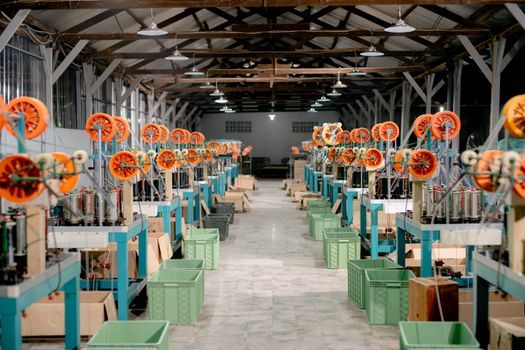
A signed acceptance test for a shrink line should record: throughput at rated p/min, seal-pull strength on five random packs (POF typical ≥ 1.5 N/15 mm, PE typical ≥ 2.0 N/15 mm — values per the resin supplier's data sheet, not the OEM's marketing), tunnel current draw at steady state, and air consumption under load. Any value more than 10% off the FAT sheet is a punch-list item, not a sign-off condition [S1][S2].
Escalate, do not repair, when: tunnel heating elements show open-circuit on more than one zone (replace the whole IR or resistance bank, not individual coils — the rest will follow within 200 hours); seal-bar PTFE shows cuts deeper than 0.3 mm (re-coat, do not patch); PLC displays overcurrent faults that clear on reset but recur within 30 minutes (root cause is upstream supply or grounding, not the PLC). ME Shrinkwrap, a division of Marden Edwards, and similar UK-based integrators typically quote a 3-day on-site commissioning window for full-auto L-seal + tunnel lines and a 1-day window for chamber or manual sleeve wrappers [S5][S6].
Trackable next signals for specifiers: the 2026 DirectIndustry shrink-tunnel category lists 34 manufacturers and 102 active models, and the carton-shrink subset lists 19 manufacturers with 38 models, so any new entrant or withdrawn line will show up as a catalogue count delta on the next quarterly review [S1][S2].
Detailed specification references: shrink wrapping machine, wrapping machine, and linear guide.
This topic is covered further in Pillow Block Bearing TCO: 10-Year Cost Stack, Driver Map, and Spec Checkpoints.