Specifying silicone rubber is a three-axis decision — temperature window, mechanical envelope, and cure route — and getting any of them wrong voids the others. The material is a semi-organic elastomer built on a silicon-oxygen backbone with organic side groups, which is why it holds elasticity where nitrile-rubber and EPDM go brittle at the low end and where fluoroelastomers go thick and expensive at the top [S1][S6].
For B2B specifiers the real questions are narrower: which polymer family fits the moulding or extrusion process on the shop floor, what durometer and tensile band the part must hit, and which compliance pack (food contact, medical, rail, ATEX) the end market demands. This guide walks those gates in order and flags the levers that move lead time and unit cost.
Polymer families: HCR, LSR, RTV, and where each one fits
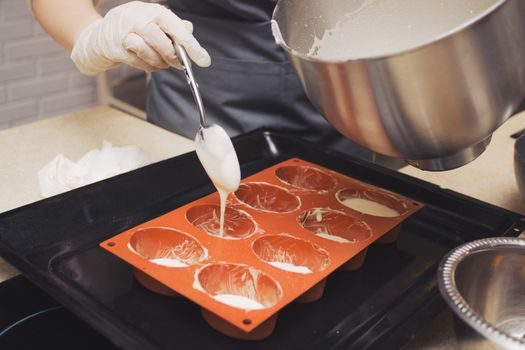
High Consistency Rubber (HCR), also called millable silicone, is supplied as a base gum plus filler (most often high-purity silica) and is shaped by compression moulding, transfer moulding, or extrusion; it is the default for solid silicone sheeting, gaskets, and profile [S1][S2]. Liquid Silicone Rubber (LSR) is a two-part pumpable A+B system with low viscosity, shot into injection moulds and cured rapidly in heated cavities — typical LSR part cycles run 30–90 s versus several minutes for HCR compression moulding, which is why LSR dominates high-volume medical and infant-care parts.
Room-Temperature Vulcanising (RTV) silicone is a one- or two-part system that cures at ambient via moisture or a catalyst; it is the right choice for potting, encapsulation, prototype tooling, and field-formed gaskets, and is the chemistry behind most silicone sealants and conformal coatings [S3]. A fourth bucket — silicone gel and foam — sits beside these, used for vibration damping, thermal pads, and low-stress sealing where compression set matters more than tensile strength [S2].
Selection rule: if the part is a high-volume moulded geometry under 200 g, pick LSR; if it is a sheet, profile, or large gasket, pick HCR; if it is a field joint, potting, or prototype, pick RTV. Cross-check the rule against cure inhibition — LSR and addition-cure RTV do not bond to many industrial-rubber substrates without a primer or plasma treatment.
Spec bands: temperature, durometer, tensile, elongation
Continuous service temperature for general-purpose HCR sits between -60 °C and +200 °C, with peak exposure up to +250 °C; phenyl-modified grades push the low end toward -100 °C and high-temperature peroxide-cured grades sustain +300 °C in static air [S1]. Compression set at 150 °C / 22 h for a properly post-cured HCR compound is typically 10–25%, and post-cure (4 h at 200 °C staged ramp) is mandatory for low-outgassing, food-contact, and medical parts.
Durometer (Shore A) for the bulk of moulded and sheeted silicone falls between 10 and 80; 20–40 Shore A covers soft gaskets and bellows, 50–60 covers general seals and O-rings, 70–80 covers high-modulus rollers and valve seats. Tensile strength for unfilled gum is roughly 3–5 MPa, but with reinforcing fumed silica the practical band is 5–10 MPa and elongation at break lands at 100–700% depending on filler loading and plasticiser content [S1][S2].
Specific gravity for most HCR and LSR compounds sits between 1.10 and 1.50 g/cm³; a 1.20 g/cm³ compound is a fair planning estimate when drawings are not yet finalised. Tear strength is the most under-specified property — die B tear of 20–40 kN/m is the working range for gasket-grade HCR, and anything below 15 kN/m will shred under dynamic flex.
Compliance pack: FDA, USP, EN 45545-2, WRAS, ATEX
Food-contact silicone in the EU and US is built on a positive-list raw-material set plus a documented cure cycle; FDA 21 CFR 177.2600 governs repeat-use food-contact articles, and EU Regulation 1935/2004 plus BfR recommendations cover the European side. Medical-grade compounds add USP Class VI or ISO 10993-5/-10 cytotoxicity and sensitisation testing, usually with a post-cure step to drive oligomer extractables below the action limit [S3].
Potable water requires WRAS, ACS, or KTW approval depending on the market, and each one constrains the curative and pigment palette.
For ATEX/IECEx enclosures, silicone gasket compression set and recovery at the rated temperature are the gating properties, not the polymer family itself; the specifier should request compression-set data at the worst-case service temperature, not the 22 h / 150 °C lab number. Compare the same compliance discipline when choosing a crossed-roller-guide for cleanroom motion — material certificates drive the build, not the catalogue photo.
Process-to-material fit: moulding, extrusion, calendering
Compression moulding is the workhorse for HCR O-rings, gaskets, and diaphragms; cycle time per part is 3–10 minutes and tool cost is the lowest of the three moulding routes. Transfer moulding handles small parts with inserts or multiple cavities and gives tighter flash control. Injection moulding of HCR is reserved for high-volume runs where the longer setup pays back, and liquid injection of LSR is the volume winner for medical, infant care, and consumer electronics [S1][S3].
Extrusion of HCR produces tubing, profile, and cord stock and feeds downstream vulcanising lines — hot-air continuous vulcanisation (HAV) for thin sections, steam vulcanisation for larger profiles, and salt-bath for silicone hose. Calendering converts HCR into sheeting down to 0.2 mm thickness and is the route behind most commercial silicone rubber sheeting and rolls, with width up to 2 m and continuous length on the roll [S2].
For OEMs that are moving from prototype to production, the rule of thumb is to lock the part geometry and the durometer first, then re-quote tooling when volume crosses 5,000–10,000 pcs/yr — below that band, compression tooling is the cheapest path. epdm-rubber sometimes wins on price for outdoor weather seals, but silicone is the only sensible choice when the brief includes both -40 °C and continuous +180 °C in the same part.
Sourcing levers: grade, cure package, post-cure, filler system
Unit price for general-purpose HCR gum and compound moves with raw silicone fluid and fumed silica prices; the practical sourcing lever is the cure package. Peroxide-cured grades (often 2,4-dichlorobenzoyl peroxide or dicumyl peroxide) are the mainstream; platinum addition-cure gives cleaner by-products and is mandatory for medical and many food-contact parts, at a typical 15–40% price premium over the peroxide equivalent. Post-cure is a separate line item — 4 h at 200 °C oven time is standard for low-extractable medical, 24 h for high-spec implantable-grade. [S1]
Filler system dominates mechanical behaviour: fumed silica gives the highest tensile and tear strength, precipitated silica costs less but lowers transparency, and ground quartz is used in high-temperature HCR where thermal conductivity matters. Pigment and masterbatch add cost in small batches; a stock colour (red oxide, black, blue RAL 5010, white) is the cheapest path. For linear-guide bellows and way covers, semi-transparent or white HCR at 50–60 Shore A is the default and is usually held in stock by regional distributors.
Where the part is a small-batch custom gasketing job, kSil-style solid silicone sheeting and silicone sponge sheeting cut tooling cost to near zero and ship in 0.5–10 mm gauges in stock rolls [S2]. The same source pattern applies to silicone-rubber moulded parts from Chinese suppliers such as SQUARE Silicone Materials and Hong Ye — request a sample batch and a COA before signing a volume PO, and lock the post-cure parameters on the drawing rather than the purchase order.
Comparison: HCR vs LSR vs RTV for new part programmes
Decision criteria lined up against the three families: tooling cost, cycle time, tensile/tear band, biocompatibility path, and field-repair suitability. HCR scores low tooling cost, slow cycle, broad mechanical range, medium biocompatibility, and yes for field repair. LSR scores medium tooling cost, fast cycle, narrow-to-medium mechanical range, high biocompatibility, and no for field repair. RTV scores minimal tooling cost, ambient cure, low-to-medium mechanical range, medium biocompatibility, and yes for field repair [S1][S2][S3].
Above that threshold the cycle-time advantage of LSR flips the equation and unit cost falls below HCR for parts in the 0.1–50 g range. The most common sizing mistake is treating LSR as a drop-in for HCR when the part has thick walls (above 10 mm) — heat transfer through the rubber, not the tool, is the cure-rate limiter.
Failure modes and sizing pitfalls
The three most common field failures in silicone seals are swell from incompatible fluids, compression set at temperature, and tear initiation at sharp gasket corners. Silicone is attacked by concentrated acids, aromatic solvents, and superheated steam above 120 °C; against engine oil, gasoline, and many hydrocarbons silicone swells faster than nitrile-rubber and is the wrong choice — fluoroelastomer (FKM) is the right answer there. [S2]
Compression set is governed by post-cure: a part that has not been post-cured can lose 30–50% of its original thickness under continuous 150 °C service, and the gasket stops sealing. Tear initiation is a geometry problem — a 0.5 mm radius on every cut edge is the minimum, and inside corners on moulded gaskets should be drafted at least 1° per side to survive dynamic flex. Closed-cell silicone sponge used as a compression gasket has its own limit: continuous compression above 30% of original thickness accelerates compression set and water absorption.
Trackable signals for the next six months: revisions to EU Regulation 1935/2004 positive lists for silicone oligomers, any update to EN 45545-2 R1/R7 requirement sets, and changes in fumed silica supply from the major Chinese producers. Specs in this guide (Shore A bands, tensile/tear ranges, temperature window, compression set) reflect the published compound data on the sourcing pages cited; for any tender, re-validate against the latest manufacturer TDS and request a COA with each lot.
For related coverage, see EV Battery Raw Material Sourcing: Cathode Chemistry, 2025-2026 Price Bands and.