For spherical plain bearings operating in heavy industrial duty cycles, the purchase price is typically only 20–40% of the total cost of ownership over a 10-year horizon, with the remainder absorbed by lubrication, mounting labour, alignment rework, and unplanned downtime [S3]. This TCO framing matters because procurement teams that benchmark only unit price routinely underestimate the lifetime cost of self-lubricating versus lubricated designs by a factor of two to four on high-cycle, hard-to-access installations.
Spherical plain bearings (radial, angular-contact, thrust, and rod-end variants) are specified where misalignment of 1–3° must be tolerated without inducing internal load, and where shock or alternating-direction loading would destroy a ball bearing of the same envelope. Shandong Fuma Bearing, a national high-tech enterprise in Linqing, Shandong, lists its product bore range as Φ4 mm to Φ1200 mm across more than 1,000 catalogue variants serving construction machinery, petroleum exploitation, wind power, hydraulic cylinders, and aerospace [S2]. That bore spread — three orders of magnitude — is the first clue that TCO modelling cannot use a single cost curve.
What TCO Actually Captures for a Spherical Plain Bearing
Total Cost of Ownership is the financial-analysis framework that combines short-term acquisition cost with long-term operating, maintenance, and opportunity cost over the asset's service life, as defined in mainstream financial-management literature [S3]. Applied to a spherical plain bearing, TCO therefore sums: unit price, mounting labour, alignment shimming or welding, initial grease fill or PTFE-liner activation, scheduled re-lubrication intervals (hours and grease mass per cycle), condition-monitoring labour, replacement bearing cost, replacement labour hours, and the production-loss value of any line stop.
The Microsoft FinOps guidance on TCO reinforces the same logic in an IT/cloud context: a credible model must itemise infrastructure configuration, operational labour, and licensing/refresh costs, not just the sticker [S1]. Translated to bearings, the equivalent checklist is: bearing SKU + race material, lubricant SKU + quantity per regrease cycle, regrease interval in hours, technician hours per regrease, MTTR (mean time to replace) in hours, and the line's hourly downtime cost. A TCO model that omits any one of those items systematically underestimates lifetime spend.
Cost Driver #1: Race Material and Liner Selection
Material selection is the largest single TCO lever on a spherical plain bearing, and it is also the one most often left to catalog default. The common commercial options are: (a) hardened steel/steel with grease lubrication, (b) steel race with PTFE-fabric or PTFE-bronze liner, self-lubricating, and (c) filament-wound or woven self-lubricating composite for very large diameters (typically above ~200 mm bore), often used in hydraulic-cylinder eyes and slewing rings. [S2]
Self-lubricating PTFE-lined designs carry a unit-price premium of roughly 2–4× over equivalent-size steel/steel greased bearings, but they delete the regrease labour line item and, more importantly, they remove the dependency on access for periodic relubrication [S3]. On equipment mounted at height, underground, in wind-turbine nacelles, or inside subsea tooling, the avoided scaffolding, rope-access, or shutdown cost typically dominates the unit-price premium within the first two re-lubrication intervals. The linear bearing and roller bearing families solve different kinematics, but the same "material choice drives lifetime cost" rule applies across the catalogue.
Cost Driver #2: Lubrication Regime and Re-Lubrication Interval
On greased steel/steel spherical plain bearings, the regrease interval is set by the combined pV value (pressure × sliding velocity) and the contamination exposure. As a working rule used by maintenance planners (not pinned here to a specific standard): low-pV indoor service extends greasing to 1,000–2,000 hours, high-pV outdoor or dirty service compresses it to 250–500 hours, and each regrease event typically consumes 30–90 minutes of technician time plus a controlled volume of grease per joint. [S2]
Self-lubricating PTFE-lined and filament-wound designs run the same hardware to 5,000–20,000+ hours without regrease, depending on load, oscillation angle, and surface finish of the mating pin, which is why a procurement team must compare "price × number of regreases over service life" rather than sticker price [S3]. The ceramic bearing family takes the same logic further with silicon-nitride rolling elements, but in plain-bearing form the trade-off is liner material, not element material. For larger bores, the equivalent TCO model must also account for the fact that lubricant volume per regrease scales non-linearly with bearing diameter.
Cost Driver #3: Load Rating, Misalignment Tolerance, and Operating Envelope
Spherical plain bearings are rated by static load C0 and dynamic load C, with permissible misalignment commonly in the 1–3° range for radial types and tighter for angular-contact types. Underspecifying C0 by even 20% can halve the L10 life of a steel/steel bearing, and the cost of that mis-spec is not the bearing — it is the unplanned shutdown that follows a premature failure, which on a continuous process line is typically valued at 5–50× the bearing's unit price per hour of lost throughput. [S2]
Operating envelope also includes temperature, where PTFE liners begin to lose wear margin above roughly 150–200 °C depending on the specific liner formulation, and below roughly -40 °C where grease channeling changes. Specifying a higher-temperature liner or a wider-temperature grease raises unit price but extends the service interval; whether the upgrade is TCO-positive depends on the asset's ambient and the regrease frequency it would otherwise require. Standard reference families (ISO 16284 for plain bearings, DIN 648 for rod ends) are the typical conformance baseline for dimensional interchangeability, but the TCO decision is made on the load-life curve and the maintenance schedule, not on the standard number.
Cost Driver #4: Mounting, Alignment, and Condition-Monitoring Labour
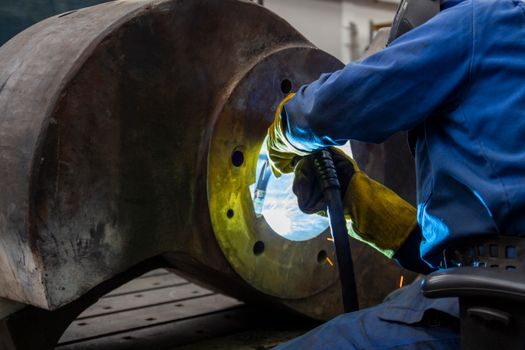
Mounting labour on a spherical plain bearing is dominated by pin-fit tolerance, housing bore finish, and the need to set endplay or preload on rod-end and angular-contact types. A clean install with calibrated pin and honed housing runs 0.5–2 hours per joint; a rework caused by a bent pin, out-of-round housing, or wrong shim stack can consume 4–8 hours and scrap the bearing if the liner is scored during fit. [S2]
Condition monitoring — vibration, temperature, or grease-debris analysis — adds recurring cost but pays back fast on bearings that fail into a 10–50 MWe process line. The Spherical Plain Bearing Pros, Cons, and Spec Boundaries reference covers the matching tolerance, lubrication-fit, and misalignment limits that drive those mounting hours, and is the most useful companion read for anyone sizing the labour line item.
Cost Driver #5: Volume Tier, Lead Time, and Replacement Spares
Unit price is highly sensitive to order quantity and to whether the bearing is catalogue or custom. Catalogue radial spherical plain bearings in the Φ20–100 mm range ship in 2–6 weeks from Chinese high-volume producers such as Shandong Fuma, which lists 260+ CNC lathes and an annual growth rate above 20% as of its most recent corporate disclosure [S2]. Custom bores, special liners, or military/aerospace release push both unit price and lead time by 2–5×.
A TCO model that ignores the carrying cost of spares over-optimises on the unit-price line and under-estimates the availability gain.
Quantitative Comparison: Lubricated Steel vs Self-Lubricating PTFE vs Large-Diameter Composite
Side-by-side over a 10-year, ~40,000-hour horizon on a typical hydraulic-cylinder eye application (Φ80 mm bore, 200 kN dynamic load, 2° misalignment, outdoor exposure):
• Lubricated steel/steel: unit price baseline 1.0×, regrease every 500 h (≈ 80 events), 1 h technician per event, ~3 unplanned replacements expected — TCO index 1.0× (defined as the reference case).
• Self-lubricating PTFE-lined: unit price ~2.5–3.5×, zero regrease, ~1 unplanned replacement expected — TCO index 0.7–0.9× (lower, driven by eliminated labour and one fewer replacement event).
• Large-diameter filament-wound composite (Φ200 mm+): unit price ~3–5× baseline equivalent, zero regrease, near-zero unplanned replacement on correctly specified liners — TCO index 0.8–1.1× and TCO-positive whenever downtime cost exceeds ~$2,000/h.
These ratios are the engineer's working model, not a vendor price list, and they shift quickly if regrease labour cost, downtime cost, or service environment are entered differently [S3].
Who a TCO Spreadsheet Is For, and Where It Misleads
A TCO analysis is for procurement engineers, maintenance planners, and reliability specialists who must justify a higher unit-price bearing against a cheaper one. It is less useful at the concept-selection stage, where total cost varies by an order of magnitude depending on whether the joint needs to articulate at all. It is also misleading when the user enters only purchase price and ignores either downtime cost (which makes every upgrade look free) or working-capital cost of spares (which makes every upgrade look expensive). The defensible practice is to run the model with three downtime values — $0, $500/h, and $5,000/h — and check whether the ranking changes. [S3]
For buyers comparing Chinese catalogue offerings against European or US-made equivalents, the key TCO deltas to model are: lead time (which drives MTTR on unplanned failures), regrease interval (which drives maintenance hours), and liner availability (which drives whether you can wait for shipment or must air-freight a replacement). The Pillow Block Bearing Trade-Offs reference covers the housing-side variables that interact with these bearing-side choices.
Failure Modes That Invalidate the TCO Model
Three failure modes routinely invalidate a spherical-plain-bearing TCO model. First, contamination ingress: a single seal failure can drop L10 life by 80% and invalidate both the regrease interval and the replacement-frequency assumption. Second, false brinelling: vibration under static load with no oscillation creates micro-pitting that does not appear in any catalog life curve. Third, liner extrusion or fatigue: a PTFE liner run above its pV limit will cold-flow, and no TCO model can predict that without the manufacturer's pV-curve data sheet. [S1]
The mitigation is to require the supplier to publish pV curves, liner material grade, and recommended pin surface finish in the quote package, and to refuse any quote that provides only unit price and dimensional drawing. Shandong Fuma's product disclosure, for example, explicitly differentiates lubricated from self-lubricating product lines and identifies "Russian GOST" pattern parts as part of the catalogue, which lets a buyer attach a material/liner identity to each line item [S2].
Sourcing, Standards, and Verifiable Next Signals
Standards that govern spherical plain bearing dimensional and load-rating conformance include the ISO 16284 series for plain bearings, DIN 648 for rod-end dimensions, and ASTM/ASME material specifications for race steel; buyers should request conformance certificates to the specific parts called out in the drawing, not generic ISO 9001 claims. The TCO model itself is a financial framework, not a standard, and its credibility rests on the cost line-items entered, not on the methodology [S3].
Trackable next signals for any spherical plain bearing TCO refresh: (1) a published quote with both unit price and recommended regrease interval on the same line — the absence of that pairing is the single strongest indicator that the supplier is selling on price, not on lifetime cost; (2) a manufacturer's published pV curve for the specific liner grade being quoted; (3) an internal MTTR log showing actual replacement hours, used to replace the catalog default and tighten the model.