
Spherical roller bearings use barrel-shaped rollers running on a spherical outer raceway, giving line contact and a self-aligning capacity of typically 0.5° to 2° depending on series, while ball bearings use point contact between balls and grooved races for low friction at high speed [S3][S4]. This single contact-mechanics difference drives nearly every other spec in the table: load rating, permissible speed, friction torque, misalignment tolerance, lubricant regime, and mounting sensitivity.
For a process engineer the decision is rarely "which is better" and almost always "which contact type fits the load/speed/misalignment envelope." Spherical roller bearings dominate heavy radial and shock-loaded service (rolling mills, gearboxes, conveyors, vibrating screens, crusher shafts, wind turbine main shafts). Deep groove and angular contact ball bearing designs dominate high-speed, low-friction service (electric motors, pumps, machine-tool spindles, fans). Treat them as complementary families, not substitutes, and size each against the duty it was designed for [S1][S2].
Contact Mechanics: Point Contact vs Line Contact
A ball bearing carries load through a small elliptical Hertzian contact patch at each ball/race junction; a roller bearing carries load through a long, narrow rectangular contact line, so for the same bore and the same material the contact area in a roller is several times larger [S4]. That larger area is the reason NSK's reference material states roller bearings have a higher load rating than ball bearings of the same size, and the same physics is why permissible speeds trend the other way: line contact generates more friction heat at the contact patch [S4].
For a like-for-like 100 mm bore, indicative values are: deep groove ball bearing dynamic load rating C roughly 50 to 70 kN at limiting speeds near 7000 to 9500 r/min grease-lubricated; spherical roller bearing of the same bore typically lands near 200 to 320 kN C but with grease limiting speeds in the 1500 to 3000 r/min range [S1][S2]. Treat those as envelope numbers to anchor expectations, then read the actual rating from the supplier catalogue (SKF, NSK, FAG/Schaeffler, NTN, Timken) for the exact series.
Spherical Roller Bearing Geometry and Self-Alignment
A spherical roller bearing has two rows of barrel-shaped rollers whose profile matches a common spherical outer raceway, so the rollers can pivot with the inner ring; this is what gives the bearing its self-aligning property and is what allows it to absorb shaft deflection and housing-machining error that would bind a cylindrical or tapered roller design [S3][S4]. The barrel shape is also why it tolerates bending, whereas a cylindrical roller bearing with line contact on a cylindrical raceway is the most misalignment-intolerant common roller type [S2][S6].
Self-alignment is the engineering reason spherical roller bearings are specified on long shafts between bearings (paper machine rolls, cement kiln trunnions, rolling-mill work rolls) and on equipment where mounting accuracy is hard to guarantee. Inner-ring rotation with the shaft, two rows of rollers, and a common sphered outer land are the three structural facts every specifier should know before going to the catalogue [S3]. For related deep-groove sourcing context, see Deep Groove Ball Bearing Selection: A Spec Engineer's Field Guide.
Load Capacity, Speed, and Friction Trade-off
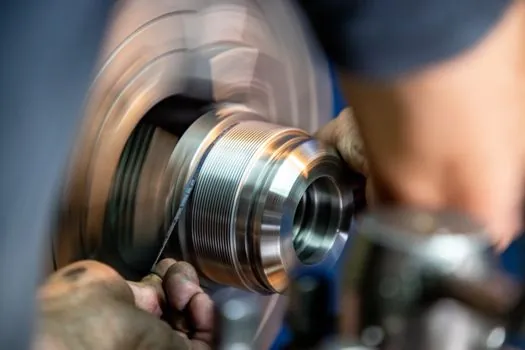
The selection question reduces to four numbers per candidate: dynamic load rating C, static load rating C0, limiting speed (grease and oil), and reference friction torque. Ball bearings win on the last two: a 6205 deep groove ball bearing runs at reference speeds in the 9000 to 13000 r/min region and produces low starting torque; a 22205 spherical roller bearing of the same bore runs nearer 6000 to 7500 r/min oil-lubricated and produces substantially higher friction because the line contact patch is larger [S1][S4][S5].
Spherical roller bearings win decisively on C and C0 per unit envelope. A practical rule of thumb that the catalogues support: for the same 100 mm bore, the spherical roller design delivers roughly 3× to 4× the dynamic radial load capacity of a deep groove ball bearing, with the trade being typically a 2× to 4× reduction in permissible speed [S1][S2]. If your motor is spinning at 12000 r/min, you are in deep-groove-ball territory. If your gearbox pinion is launching 250 kN of radial load and surviving crusher shock, you are in spherical-roller territory.
Misalignment, Shock, and Contamination: Where Each Family Fails
Spherical roller bearings tolerate static and dynamic misalignment of roughly 0.5° to 1.5° (small series) up to about 2° for some CC/W33 series, which is why a bent shaft in a rolling mill or a deflected trunnion in a kiln is a textbook application [S3][S4]. Deep groove ball bearings tolerate only a few minutes of arc in practice, typically cited around 2 to 10 arc-minutes before internal clearance is consumed and brinelling accelerates; misalignment beyond that causes edge loading and premature fatigue spalling [S2][S5].
On shock load, line contact distributes the impact across a longer patch and the barrel profile allows momentary elastic deflection, so spherical roller designs are routinely chosen for jaw crushers, vibrating screens, hammer mills, and conveyor pulleys. Ball bearings subjected to the same shock tend to brinell the raceway, and once brinelling starts the fatigue life is effectively decided. On contamination, both families depend on seals and shields; spherical roller bearings are more often specified with sealed or expanded-cartridge housings (SNR SNC, SKF SNL, Timken SAF) precisely because they live in dirtier plants where misalignment and shock coexist [S1][S3].
Decision Matrix: Spherical Roller vs Deep Groove Ball vs Angular Contact Ball
Use the table as a quick gate before opening a catalogue. Ratings are envelope values for a 100 mm bore class, intended to anchor expectation; always confirm against the supplier's published C, C0, and limiting speed for the actual part number. [S1]
Criterion 1: primary load direction. Deep groove ball: radial with light axial either side. Angular contact ball: combined radial + one-direction axial. Spherical roller bearing: heavy radial, with limited axial on some series (CC, CA, E type). Cylindrical roller bearing is the radial-only specialist [S1][S2][S6].
Criterion 2: dynamic load rating per unit bore (envelope, 100 mm). Deep groove ball ~50 to 70 kN C; angular contact ball ~55 to 80 kN C; spherical roller ~200 to 320 kN C. Cylindrical roller ~150 to 240 kN C. The roller family clearly wins the load contest [S1][S2].
Criterion 3: limiting speed (grease, indicative). Deep groove ball 7000 to 9500 r/min; angular contact ball 7000 to 11000 r/min; spherical roller 1500 to 3000 r/min; cylindrical roller 4000 to 9000 r/min depending on cage and lubrication. Ball designs win the speed contest [S1][S4][S5].
Criterion 4: misalignment tolerance. Deep groove ball ~2 to 10 arc-min; angular contact ball near zero (sensitive); cylindrical roller near zero (sensitive); spherical roller 0.5° to 2°. Spherical roller is the only family that forgives mounting error [S3][S4].
Criterion 5: typical cost envelope. Spherical roller > cylindrical roller > angular contact ball > deep groove ball for the same bore, with spherical roller often 2× to 4× the deep-groove price. Treat cost as a function of series, sealing, and clearance group, not of brand [S1][S2].
When to Specify Spherical Roller and When to Stay With Ball
Specify spherical roller bearings when at least two of the following are true: radial load per bearing above ~80 kN at 100 mm bore, expected shock or impact loading (crushers, mills, vibrating screens), shaft deflection above ~0.1°, long-span shaft between bearings, and a target bearing life above ~40000 hours under L10 calculation [S3][S4]. Common series are 22200, 22300, 23000, 23100, 23200, 24000, 24100 in steel or brass cage variants; CC, CA, E, ECA, and W33 (annular groove + 3 lubrication holes) are suffixes you will see in supplier catalogues [S3].
Stay with ball bearings when the duty is high speed, low friction, light to moderate load, and mounting accuracy is achievable. Use deep groove ball as the default radial choice, angular contact ball when axial load in one direction is non-trivial, and self-aligning ball bearings (two rows) for light radial load with small misalignment on a low-cost shaft. A common buyer mistake is overspecifying a spherical roller where a deep groove ball would run cooler and last longer, just because the duty "feels heavy"; check C/P ratio (catalog dynamic load rating divided by equivalent applied load) before assuming roller is the safer pick [S1][S2][S5].
Standards, Lubrication, and Sourcing Anchors
Boundary dimensions of metric radial bearings are governed by ISO 15, rolling bearing dynamic load rating and life calculation by ISO 281, and dynamic load rating / fatigue limit by ISO 76; these are the standards suppliers publish against and the ones a spec sheet should reference [S1][S2]. For spherical roller bearings specifically, dimensional series follow ISO 15 as well (213, 222, 223, 230, 231, 232, 240, 241 series), and the W33 suffix (annular lubrication groove and three holes in the outer ring) is the standard answer when the bearing lives in a remote, hard-to-relubricate housing [S1][S3].
For the buy side, deep-groove ball and spherical roller are both commodity parts with multiple credible suppliers (SKF, NSK, FAG/Schaeffler, NTN, Timken, NMB, TPI); the practical risk is not brand but part-number substitution, so insist on a published C, C0, limiting speed, and clearance group (C2, CN, C3, C4, C5) in the offer. Sourcing context for the ball side is summarised in Deep Groove Ball Bearing Suppliers: Spec Map, Sourcing Tiers, and Selection Gates [S1].
Verifiable next signals: check whether the candidate bearing series carries an E or ECA efficiency-class marking (signalling a redesigned internal geometry for higher load capacity), whether the W33 lubrication feature is present for the spherical roller side, and whether the catalogue quote includes the dynamic viscosity of the recommended grease at the operating temperature. Track these three in the datasheet and the ball-vs-roller choice becomes a one-page audit rather than a brand conversation [S1][S3][S4].
Detailed specification references: spherical plain bearing.