
The global steel rebar market is projected to reach $316.31Bn by 2030, expanding at a 4.40% CAGR over the 2024-2030 forecast window [S1]. Rebar is the dominant tension reinforcement in reinforced concrete and remains a commodity where the spec, not the brand, sets the price.
The product is also known as concrete reinforcement steel bar or reinforcing steel, with grade designations (e.g. ASTM A615, BS 4449, EN 10080) dictating yield strength, ductility, and weldability. Three end-use verticals — infrastructure, general construction, and oil & gas — pull the bulk of volume, with infrastructure cited as the fastest growing at a 6.2% CAGR over the prior forecast horizon [S1].
2026 Demand by Region and Vertical
APAC commanded roughly 66% of the global steel rebar market share in 2018, anchored by China and India construction activity and supported by Indonesia, Malaysia, and Japan infrastructure programs [S1]. India's "Housing For All" initiative and demographic pressure in China keep residential rebar demand structurally elevated, while India's National Infrastructure Pipeline and ASEAN road projects keep the non-residential mix supplied.
Infrastructure is the largest and fastest-growing end-use segment, with the United Nations Sustainable Development Goals creating a structural pull on road, bridge, and utility-grade rebar. The World Bank has flagged an $8 trillion global infrastructure investment gap attributable to roads alone, which directly translates into rebar tonnage at roughly 80-120 kg of rebar per cubic metre of structural concrete [S1]. For a complementary view on jobsite placement equipment, see the concrete vibrator types and spec bands map.
Construction and Oil & Gas as Demand Anchors
The construction industry contributed 25.39% to global GDP in 2016, per the World Bank, and remains the single largest downstream consumer of rebar through cast-in-place foundations, columns, beams, and slabs [S1].
Oil & gas is a smaller but higher-spec segment. OPEC has projected combined oil and gas demand to rise from 145.7 mboe/d in 2015 to 177.8 mboe/d in 2030, which expands refinery and pipeline capex [S1]. Rebar in this service is typically epoxy-coated or stainless-clad (ASTM A775 / A955) to resist H2S, CO2, and chloride attack — material cost runs 1.8-2.5x plain-carbon rebar, but field life extends from 25-30 years to 50+ years in sour service. Rebar couplers are the standard mechanical splice in these process areas where lap splicing is impractical.
Spec Bands: Grade, Size, and Coating Decision Matrix
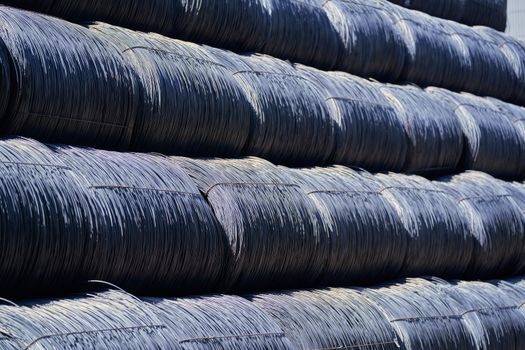
Specifying rebar is a four-axis decision: grade (yield strength), size (bar diameter), coating (corrosion protection), and length/form. The table below captures the dominant 2026 commercial bands: [S1]
Comparison — main rebar types on decision criteria:
• Plain carbon hot-rolled (ASTM A615 Gr 40/60, BS 4449 B500B): yield 40-60 ksi (275-420 MPa), cheapest, default for building frames, cast-in-place foundations. Rebar of this grade is cut and bent on-site using a rebar cutter and rebar bender.
• Epoxy-coated (ASTM A775): same core as A615 with fusion-bonded epoxy (FBEC) at 7-12 mils. Used in marine, bridge deck, and parking structure exposure. Adds ~$200-400/ton vs black bar.
• Stainless-clad / stainless (ASTM A955, BS 6744): 304/316 stainless outer layer, used in severe chloride/sour service. 3-4x cost of black bar.
• Glass-fiber reinforced polymer (GFRP, ACI 440): non-metallic, no corrosion, but lower modulus (40-60 GPa vs 200 GPa steel) and no ductile yield. Specified only where stray current or de-iced bridge decks rule out steel.
• Deformed vs plain: deformed bars (ribbed pattern) provide mechanical bond; plain bars are limited to spirals, stirrups, and dowel applications.
Size Range, Tolerances, and On-Site Processing
Standard rebar diameters range from #3 (10 mm) to #18 (57 mm) in imperial, or 6-50 mm metric; lengths are 12 m (40 ft) standard, with 6 m and 18 m available for containerized export. #8 = 25.4 mm, 2.00 kg/m). [S1]
For diameter ≥32 mm and heavily congested column/beam joints, lap splicing is replaced by mechanical splicing. Threaded rebar is produced on-site or in yard via a rebar threading machine to match coupler spec. Where bars arrive bent, a rebar straightener restores straightness before threading or cutting.
Standards, Sourcing, and Price Bands
Specifying engineers should anchor on these documents: ASTM A615 (carbon), A706 (low-alloy seismic), A775 (epoxy-coated), A955 (stainless), A996 (rail-steel), and BS 4449 / EN 10080 / ISO 6935-2 for international projects. ACI 318 and Eurocode 2 govern the structural design and splice/detailing rules; ACI 117 sets dimensional tolerances for cast-in-place work. For a parallel view on long-product coated-steel spec bands, the galvanized steel sheet spec map outlines adjacent EN 10346 grade logic. [S1]
2026 indicative price bands (FOB mill, benchmark #4 / 12 mm grade 60): China ex-works $480-540/ton, Turkey FOB $560-620/ton, US Midwest domestic $880-960/ton. Differential is driven by scrap (the dominant input at 70-80% of EAF-route billet), energy, and trade measures — Section 232 at 25% on imported steel into the US and EU CBAM reporting obligations from 2026 onward both shape landed cost.
Limitations, Failure Modes, and Sourcing Risks
Three failure modes dominate field returns: chloride-induced pitting on uncoated rebar in marine exposure, hydrogen embrittlement in epoxy-coated bars with damaged coating at bends, and stress-corrosion cracking under sustained tensile load in humid environments. The mitigation is the spec — coating type, cover depth (≥50 mm in cast-in-place per ACI 318 exposure class), and crack-width control (0.3-0.4 mm) — not the brand.
Nickel-bearing stainless rebar is exposed to upstream supply risk; for a deeper view of how Class-1 nickel feedstock volatility cascades into rebar price, see the nickel sulfate 2026 supply risk and spec bands brief. For complementary long-product context, the metal stamping part spec map covers the downstream fabrication side.
Track three signals through Q4 2026: Chinese mill export offers out of Tianjin (leading indicator for APAC FOB), US Midwest scrap #1 busheling (HMS 80/20), and EU CBAM verification deadlines for Q3 2026.