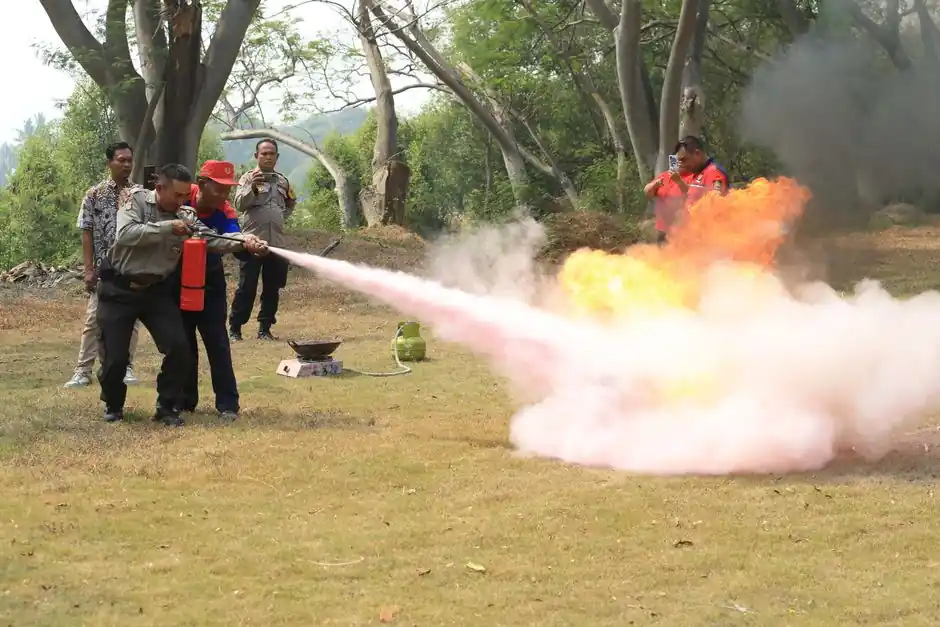
UL 299 (dry chemical) and UL 154 (carbon dioxide) are the two type-specific construction and performance standards that cover the bulk of portable extinguishers specified in commercial and industrial facilities; both pair with ANSI/UL 711 for the actual fire-test and rating method [S1][S5].
UL 299 was issued as Edition 12 in 2024 and governs stored-pressure dry chemical units, intended for use under ANSI/NFPA 10 [S2]. UL 154 was approved as Edition 10 on October 21, 2025, replacing the 2005 Edition 9, and governs hand-held and wheeled CO2 portables that discharge stored liquefied CO2 as the agent [S3]. California Title 19 §561.2 lists both standards side-by-side as the mandatory performance references for CO2 and dry chemical types respectively [S4][S5].
Listing structure: type standard plus fire-test standard
UL 154 and UL 299 share the same two-document listing architecture: a type standard that governs cylinder, valve, hose, horn, durability, and labeling, plus ANSI/UL 711 (and CAN/ULC-S508) for the rating and fire test method [S1][S3]. The cylinder is marked "UL Listed" only when both halves of the pair are satisfied; spec sheets therefore reference both documents.
Canadian listings run in parallel: CAN/ULC-S503 covers CO2 portables and CAN/ULC-S504 covers dry chemical portables, paired with CAN/ULC-S508 for fire test [S1][S7]. California Title 19 §561.2 explicitly accepts both UL 154 and UL 299 as the performance standards that satisfy state fire-test and performance requirements, alongside UL 711 for the fire test [S5].
UL 154 CO2: scope, pressure, and discharge physics
UL 154 covers high-pressure cylinder construction to DOT service-pressure specs, stored-pressure valve assemblies, discharge horn or hose-and-horn assemblies, mechanical durability (impact, vibration, salt spray, temperature cycling), and material compatibility with high-pressure CO2 service [S3]. Hydrostatic test pressure for a listed CO2 cylinder is typically 3000 psi, while the steady-state vapor pressure of the stored liquid CO2 agent is around 850 psi at 70°F [S3].
Discharge is governed by CO2 stored as a liquid under its own vapor pressure: when the valve opens the liquid flashes to gas at the horn, the rapid expansion drops horn surface temperature to roughly minus 110°F, and the agent extinguishes by oxygen displacement with modest localized cooling [S3]. Because CO2 leaves no residual coating and does not soak into Class A combustibles, listed commercial CO2 portables are normally rated B:C only, not A:B:C; re-ignition risk on deep-seated wood, paper, or fabric fires is high after visible knockdown [S3].
UL 299 dry chemical: scope, agent, and ratings

UL 299 covers stored-pressure dry chemical extinguishers, which pair with NFPA 10 for selection, placement, and maintenance [S2]. The standard governs the construction and performance of the cylinder, valve, pressure gauge, hose, nozzle, and the agent charge itself; the agent is most commonly monoammonium phosphate (ABC) or sodium bicarbonate (BC), and the listing requires the unit to discharge reliably across its full service-life pressure range.
Dry chemical units are the default choice for Class A, B, and C hazards in industrial facilities, including energized electrical equipment, because the powder does not conduct current and provides rapid flame knockdown across broad fuel types. The trade-off is residue: phosphate and bicarbonate powders are corrosive to electronics and precision machinery, and post-discharge cleanup in a server room or control cabinet is significant. CO2 avoids that problem but cannot match dry chemical on Class A fuel depth.
Decision matrix: UL 299 vs UL 154 on four criteria
Selection hinges on hazard class, residue tolerance, and electrical exposure, not on agent cost. The comparison below lines the two standards up against the four criteria that most often drive specifier choice: [S5]
1) Hazard class coverage. UL 299 dry chemical ABC units are rated A:B:C; UL 154 CO2 portables are typically B:C only, because CO2 does not soak into Class A fuels and re-ignition risk is high [S3]. For mixed office or warehouse occupancies, UL 299 wins on hazard breadth. For pure electrical or flammable-liquid hazards, UL 154 is sufficient.
2) Residue and equipment damage. UL 154 CO2 leaves no residue and is electrically non-conductive; UL 299 dry chemical powder is corrosive to electronics and requires full equipment teardown and cleaning after discharge [S3]. Data centers, control rooms, and telecom rooms almost always specify UL 154 for that reason, accepting the B:C rating limitation.
3) Cylinder and pressure. UL 154 units are high-pressure vessels tested to roughly 3000 psi hydrostatic, with stored liquid CO2 at about 850 psi vapor pressure at 70°F; UL 299 units are low-pressure stored-pressure vessels (typically 195 to 235 psi nitrogen propellant) [S3]. The UL 154 cylinder is heavier per pound of agent and requires DOT-spec transport handling.
4) Typical unit sizes and ratings. UL 154 hand-portable CO2 units run 5 to 20 lb of agent rated 5-B:C to 10-B:C, with 50 to 100 lb wheeled units rated around 20-B:C; UL 299 dry chemical portables run 2.5 to 30 lb hand-held (1-A:10-B:C up to 4-A:80-B:C depending on size) and larger wheeled units for industrial hazards. Range, discharge time, and dimensions vary by model and must be confirmed against current manufacturer spec sheets.
Use cases, limits, and the standards to pair with
Specify UL 154 when the protected asset is energized electrical equipment, a server room, a switchgear lineup, a printing press with solvent inks, or a flammable-liquid dip tank where residue would ruin the product. Specify UL 299 when the hazard mix includes ordinary combustibles (Class A) such as wood, paper, or palletized stock, or when a single unit must cover A, B, and C hazards at a low cost per square foot. For residential cooking, UL Subject 299D or UL Subject 711A may apply instead of the base UL 299/UL 154 pair, per California Title 19 §561.2 [S5].
Both standards must be paired with ANSI/UL 711 (and CAN/ULC-S508 for Canadian sites) to produce a complete listing; the type standard covers the hardware, UL 711 covers the rating letter and number on the nameplate [S1][S3][S5]. Halocarbon clean-agent portables fall under ANSI/UL 2129 (Edition 2 referenced in Title 19 §561.2), a separate type standard that sits in the same listing family as UL 154 and UL 299 [S3][S5]. For process-side gas detection that often sits alongside extinguisher selection, see tunable diode laser oxygen analyzers for process stream use, and for the halocarbon cousin of these two standards see UL 2129 listing scope, agents, and 2025 revision facts.
To read the underlying hardware standard, start with the fire extinguisher encyclopedia entry, then cross-check the CO2 type standard against UL 154 listings and the dry chemical type standard against UL 299 Edition 12 (2024). Confirm the rating and fire-test pair under UL 711, and verify state adoption (for example, California Title 19 §561.2) before procurement.
The underlying component specifications are covered under chemical anchor, and chemical material.