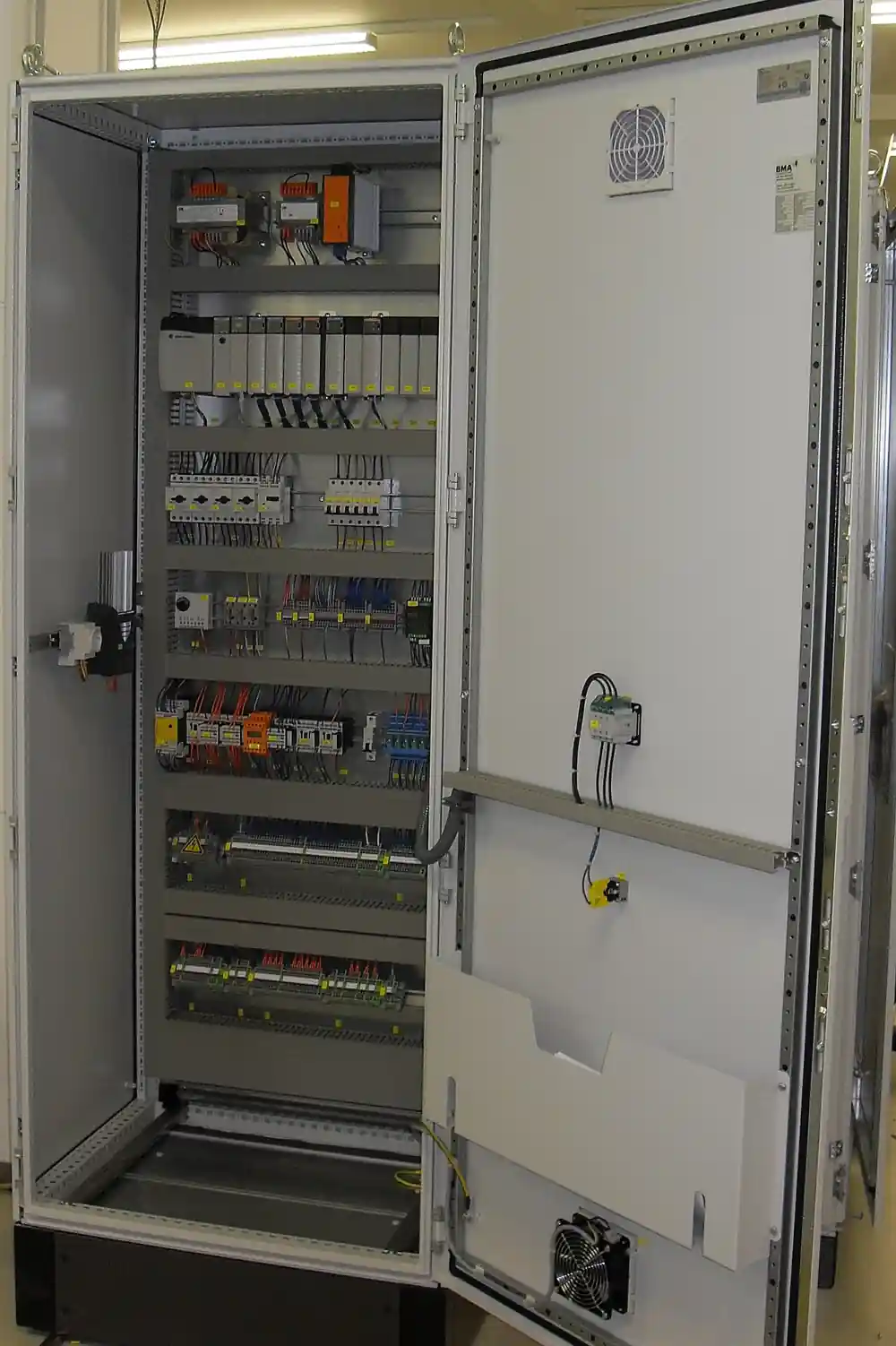
Industrial control cabinets function as the physical and electrical framework for automation systems. They consolidate power distribution, control logic, signal wiring, and operator interfaces within a defined enclosure, ensuring that equipment operates within rated conditions while remaining accessible for maintenance. The enclosure itself provides mechanical protection, ingress protection, and in many cases thermal management, while internal layouts follow modular conventions such as 35 mm DIN rail mounting.
Because cabinet design touches electrical safety, electromagnetic compatibility, and operator ergonomics, manufacturers and integrators must align with standards such as IEC 61439 and UL 508A. The breadth of applications ranging from chemical plants to data centers to robotic cells means that a single generic cabinet is rarely sufficient, and selection typically balances environmental rating, current capacity, control complexity, and physical footprint.
A control cabinet is a structured enclosure that houses electrical and electronic control devices used to command, protect, and monitor industrial equipment. It integrates components such as PLCs, contactors, relays, variable frequency drives, and human-machine interfaces into a single, organized, and safety-rated housing. Control cabinets form the operational backbone of factory automation, process control, building systems, and energy infrastructure.
Chapter 1 / 06
Fundamentals and Working Principle
A control cabinet operates as a centralized node between field devices and the controlled process. Sensors, motors, valves, and instrumentation in the field deliver signals into the cabinet, where terminal blocks, interposing relays, and PLC inputs receive them. The controller evaluates logic and issues commands through outputs, which in turn drive contactors, variable frequency drives, and actuators. Power distribution components such as circuit breakers, busbars, and power supplies ensure that each subsystem receives conditioned and protected energy.
The working principle depends on three coordinated functions: power distribution, control logic, and operator interfacing. Power distribution begins at the main isolator or breaker and fans out through branch protection devices to feed motor starters, drives, and 24 V DC power supplies that power electronics. Control logic resides in the PLC, distributed control system, or relay-based logic network, executing deterministic sequences based on field feedback. Operator interfacing occurs through HMI panels, selector switches, pilot lights, and emergency stop circuits that allow human operators to observe state and intervene when needed.
Physically, the cabinet is divided into functional zones. The upper section often contains the main breaker and incoming power terminals, the middle section houses DIN rail mounted control devices and terminal blocks, and the lower section may hold drives, transformers, or cable entry glands. Wiring channels route conductors between zones, separating power and signal paths to reduce electromagnetic interference. Doors provide access to operator controls while internal panels or swing frames allow maintenance access to terminations without exposing live busbars.
Thermal management is integral to operation. Heat generated by contactors, drives, and power supplies is removed through natural convection, filtered fans, or air conditioning units depending on the internal dissipation. Enclosure ingress protection ratings, expressed as IP codes per IEC 60529, define resistance to dust and water, while material choice (cold-rolled steel, stainless steel, or polycarbonate) balances cost, corrosion resistance, and structural strength. These fundamentals combine so that the cabinet functions as a self-contained automation subsystem that can be designed, built, tested, and shipped as a unit.
Chapter 2 / 06
Specifications and Key Parameters
Published cabinet specifications cover electrical ratings, mechanical dimensions, environmental limits, and interface counts. The Bkele industrial control panel lists rated voltage options of 24 VDC, 110 VAC, 220 VAC, and 380 VAC, with rated currents from 10 A to 400 A and a control voltage of 24 VDC or 110 VAC at 50/60 Hz. Its protection class options are IP54 as standard and IP65 as a high-protection variant, with NEMA 4/4X offered as an alternative enclosure rating. The cabinet body uses 1.5 to 2.5 mm 304 stainless steel or quality cold-rolled steel with epoxy resin powder coating, finished in RAL 7035 by default. Standard sizes span 400 by 300 by 200 mm to 1000 by 800 by 400 mm, operating temperatures range from -20 to +55 degrees Celsius, storage temperatures from -40 to +70 degrees Celsius, and relative humidity from 5 to 95 percent without condensation.
The Hengmeidda GGD-type heat exchange control cabinet specifies AC 380 V / 220 V at 50/60 Hz with a rated current up to 3150 A. Protection level is IP30 or IP40, customizable on request, and the enclosure uses cold-rolled steel with powder coating. Overall dimensions are 2200 mm in height, 800 mm in width, and 600 mm in depth, finished in RAL 7035 with custom color options. The control method integrates a PLC and an HMI touch screen. Certification listings include ISO9001 with CE available.
The Ducorobots DC15S and 30D-J9 R2 control cabinet, intended as a robot controller housing, presents a different parameter set. Color is grey Pantone 445C, and the unit measures 410 by 306 by 292 mm. The DC30D accepts 200 to 240 VAC at 47 to 63 Hz at 10 A or 100 to 200 VAC at 47 to 63 Hz at 16 A, delivering 48 V at 1200 W rated output at 14.8 kg. The DC15S accepts 100 to 240 VAC at 47 to 63 Hz at 10 A, delivering 48 V at 600 W at 13.6 kg. Environmental specifications for the R2 series include operating temperature from -10 to 50 degrees Celsius, storage temperature from -30 to 55 degrees Celsius, operating humidity 20 to 70 percent RH, storage humidity 10 to 95 percent without condensation, air pressure 70 to 106 kPa, altitude 0 to 1000 m, IP rating IP54, and noise at or below 55 dB.
Digital and analog interfaces for the Ducorobots unit include 16 user digital inputs with 8 configurable, PNP type at 11 to 30 VDC high level, and 16 user digital outputs at a maximum of 0.5 A per channel, PNP type, 22 to 28 V, with total current below 2 A unless an external supply is added. Two current analog inputs at 4 to 20 mA with plus or minus 1 percent accuracy and 160 ohm input impedance are paired with two voltage analog outputs at 0 to 10 V with plus or minus 1 percent accuracy and 15 kilohm input impedance. Communication options comprise CAN with configurable baud rates from 10k to 1000k bps, RS485 with rates from 4800 to 115200 bps, LAN supporting MODBUS TCP, PROFINET, and TCP/IP, plus an EtherCAT channel and an incremental encoder interface at 24 VDC operating voltage and below 200 kHz. Safety inputs cover one emergency stop, one protective stop, and two configurable safety dry-contact inputs, with safety outputs rated 0.5 A maximum at 23.52 to 25.2 VDC. Standard cable length is 5 m for both the power cable and the robot connection cable.
Parameter
Bkele Control Panel
Hengmeidda GGD Heat Exchange Cabinet
Ducorobots DC15S & 30D-J9 R2
Rated voltage
24 VDC / 110 VAC / 220 VAC / 380 VAC
AC 380 V / 220 V (50/60 Hz)
DC30D: 200-240 VAC or 100-200 VAC; DC15S: 100-240 VAC
Rated current / power
10 A - 400 A
Up to 3150 A
DC30D: 48 V @ 1200 W; DC15S: 48 V @ 600 W
Frequency
50/60 Hz
50/60 Hz
47-63 Hz
Protection level
IP54 standard, IP65 optional; NEMA 4/4X
IP30 / IP40 (customizable)
IP54
Enclosure material
1.5-2.5 mm 304 stainless steel or cold-rolled steel; epoxy powder coating
Cold-rolled steel; powder coating
Industrial enclosure, Pantone 445C grey
Color
RAL 7035 standard, custom available
RAL 7035 standard, custom available
Pantone 445C
Dimensions (mm)
400x300x200 to 1000x800x400
2200 H x 800 W x 600 D
410 x 306 x 292
Operating temperature
-20 to +55 degrees C
varies by model
-10 to 50 degrees C
Storage temperature
-40 to +70 degrees C
varies by model
-30 to 55 degrees C
Humidity
5%-95% RH (no condensation)
varies by model
20%-70% RH operating; 10%-95% RH storage (no condensation)
Certifications
IEC 61439, UL 508A, CE, RoHS
ISO9001, CE available
varies by model
Control method
PLC and HMI integration per configuration
PLC + HMI touch screen
Integrated robot controller with PLC, safety I/O, fieldbus
Chapter 3 / 06
Types and Configurations
Control cabinets are classified by mounting style, door arrangement, control complexity, and intended environment. Wall-mounted cabinets conserve floor space and are typical for small PLCs, lighting control, and pump stations. The Bkele catalog lists wall-mounted, floor-standing, and rack-mounted options, with indoor or outdoor installation. The Hengmeidda custom data center cabinet shown on metalelectricalcabinet.com is a wall-mounted single-door design with 4U to 42U capacity, ventilation slots, and powder-coated surface treatment, intended for data center and lab use. Floor-standing cabinets dominate heavy-industry and process applications where higher current ratings, more device real estate, and easier human access are required.
Door configuration distinguishes single-door cabinets, such as the Hengmeidda floor-standing chemical plant cabinet with model number 264515145415 and CE certification, from multi-door or partitioned cabinets. Single-door designs suit localized control where a single PLC or MCC section is enclosed, while partitioned cabinets separate power distribution from control electronics to limit exposure of operators to energized busbars. The small commercial building visual PLC cabinet from the same Hengmeidda family addresses HVAC, lighting, and pump control in a compact cold-rolled steel form factor. Each door arrangement affects layout, hinge selection, and lock type, all of which influence operator safety and maintenance ergonomics.
Functional classification includes basic relay-logic cabinets, standard PLC cabinets, advanced DCS cabinets, explosion-proof cabinets for hazardous areas, and outdoor cabinets for all-weather operation, as listed in the Bkele configuration options. GGD-type cabinets, exemplified by the Hengmeidda heat exchange model, are a Chinese low-voltage distribution family used in power distribution and motor control rooms. Robot-oriented control cabinets, such as the Ducorobots DC15S and 30D-J9 R2, integrate motion control, safety I/O, and fieldbus communications into a single chassis optimized for a robot arm rather than a process line.
Material and finish differentiate standard, hygienic, and corrosive-environment cabinets. Standard cold-rolled steel with epoxy powder coating suffices for most indoor industrial use, while 304 stainless steel addresses food, pharmaceutical, and chemical areas requiring corrosion resistance. NEMA 4X ratings extend protection to wash-down or marine environments. Cabinet construction also varies between bolted, welded, and folded-edge designs, with welded enclosures offering higher rigidity at higher cost and folded designs providing faster panel fabrication for high-volume orders. These configuration choices determine not only protection and aesthetics but also the manufacturer's tooling, lead time, and pricing structure.
Wall-mounted cabinets for small PLCs, lighting, pump stations, and small data center enclosures (Hengmeidda 4U to 42U).
Floor-standing single-door cabinets for chemical plants and factories (Hengmeidda model 264515145415, CE certified).
Floor-standing multi-section cabinets for power distribution and motor control, including GGD-type designs.
Compact PLC cabinets for HVAC, lighting, and pump control in commercial buildings.
Robot controller cabinets such as the Ducorobots DC15S and 30D-J9 R2 with integrated safety I/O and EtherCAT.
Relay-logic, PLC, DCS, explosion-proof, and outdoor configuration tiers as offered in the Bkele lineup.
Chapter 4 / 06
Selection Criteria for Procurement
Selection begins with the electrical envelope. Rated voltage, rated current, and short-circuit withstand determine whether the cabinet can be connected to the supply system without nuisance tripping or thermal overload. The Bkele panel covers 24 VDC, 110 VAC, 220 VAC, and 380 VAC at 10 A to 400 A; the Hengmeidda GGD cabinet handles up to 3150 A at 380 V. For sites above 400 A, a higher-tier distribution cabinet or motor control center is required. Procurement teams should match the cabinet rating to the sum of branch loads with an appropriate diversity factor, and confirm that the busbar bracing and breaker interrupting capacity exceed the available fault current at the point of installation.
Environmental conditions drive enclosure rating and material. For indoor industrial areas with airborne dust, IP54 is common; for wash-down or outdoor service, IP65 with stainless steel is typical. The Bkele standard is IP54 with IP65 as a high-protection option and NEMA 4/4X as an alternative. The Hengmeidda GGD is IP30 to IP40, which is acceptable for clean switchrooms but unsuitable for harsh field locations. Ambient temperature extremes must also be checked against the cabinet rating: Bkele specifies -20 to +55 degrees Celsius operating and -40 to +70 degrees Celsius storage, while the Ducorobots robot cabinet is rated -10 to 50 degrees Celsius operating. Humidity, altitude, and air pressure values from the Ducorobots data sheet (20 to 70 percent operating, 70 to 106 kPa, 0 to 1000 m) further constrain deployment in tropical or high-altitude sites.
Control complexity shapes the internal layout. A relay-logic basic cabinet uses discrete contactors and timers, while a PLC standard cabinet adds a controller, HMI, and communication modules. The Bkele configuration tiers range from basic relay logic through PLC to DCS distributed control. The Ducorobots robot cabinet extends this to safety-rated I/O, fieldbus connectivity including CAN, RS485, MODBUS TCP, PROFINET, TCP/IP, and EtherCAT, plus an incremental encoder interface. Procurement must verify the I/O count, the protocol compatibility with existing SCADA or MES systems, and the availability of expansion slots for future capacity.
Commercial and logistical factors include minimum order quantity, lead time, payment terms, and certification. Hengmeidda lists MOQ of 5 units with 20-day delivery and T/T payment for the chemical plant floor-standing cabinet, while the custom data center and lab cabinet lists MOQ of 1 unit with 7-day delivery and T/T or Western Union terms. CE marking is consistently available, and ISO9001 is cited for the GGD cabinet. Buyers should align MOQ and lead time with project schedule, and confirm that the certification package includes the test reports required by their jurisdiction.
Match rated voltage, current, and short-circuit withstand to the supply system and available fault level.
Select ingress protection and material based on dust, water, chemical, and temperature exposure (IP30 to IP65, NEMA 4/4X).
Verify operating and storage temperature, humidity, altitude, and air pressure against site conditions.
Confirm control complexity tier: relay logic, PLC, DCS, or robot-specific integration.
Check I/O count, safety I/O, encoder support, and communication protocols against SCADA, MES, or robot requirements.
Align minimum order quantity, lead time, payment terms, and certification scope with project schedule and jurisdiction.
Chapter 5 / 06
Standards, Compliance, and Testing
Control cabinets sit at the intersection of multiple standards. The Bkele product page states compliance with IEC 61439, the international series for low-voltage switchgear and controlgear assemblies, and UL 508A, the Underwriters Laboratories standard for industrial control panels in North America. CE marking indicates conformity with applicable European directives, and RoHS compliance addresses restriction of hazardous substances in electrical equipment. These references are listed in the Bkele detailed technical parameters as the standards to which the industrial control panel family is built. Hengmeidda lists ISO9001 for quality management and CE marking for the GGD heat exchange and chemical plant cabinets.
IEC 61439 defines construction, temperature-rise, dielectric, short-circuit, and verification requirements for low-voltage assemblies. Verification can be satisfied by testing, by calculation, or by design rules, with the assembly manufacturer responsible for the final declaration of conformity. UL 508A follows a similar logic for the North American market, with specific requirements for branch circuit protection, wiring methods, and component selection. Industrial control panels placed in hazardous areas additionally require protection concepts such as flameproof enclosures, increased safety, or intrinsic safety depending on the zone classification, though explosion-proofing details vary by model and are not specified in the cited sources.
Functional safety standards govern the safety-related portions of a control cabinet. Robot controller cabinets such as the Ducorobots DC15S and 30D-J9 R2 incorporate safety digital inputs (emergency stop, protective stop, configurable safety inputs) and safety digital outputs, each specified at passive dry contact or PNP active with 0.5 A maximum and short-circuit protection. These interfaces are designed to interface with safety relays or safety controllers, and the wiring practices that connect them must follow the applicable safety standard, typically ISO 13849-1 for machinery or IEC 61508 for process safety. The cited sources do not state the safety integrity level achieved, and this value must be obtained from the integrator or supplier.
Testing spans routine factory tests and type tests. Routine tests include visual inspection, wiring continuity, dielectric withstand, and functional checks of the as-built configuration. Type tests, performed on representative designs, cover short-circuit withstand, temperature rise, and ingress protection per IP code. The IP54 rating in the Bkele and Ducorobots specifications must be verified by test per IEC 60529. Buyers should request the routine test report, the bill of materials, the as-built schematic, and any third-party certification documents at delivery to demonstrate compliance to local inspectors and end customers.
IEC 61439 for low-voltage switchgear and controlgear assemblies (Bkele listing).
UL 508A for industrial control panels in the North American market (Bkele listing).
CE marking and RoHS compliance for the European market (Bkele listing).
ISO9001 quality management system certification (Hengmeidda GGD listing).
Ingress protection verification per IEC 60529 to support IP30, IP40, IP54, IP65 claims.
Functional safety interfaces per ISO 13849-1 or IEC 61508 for safety I/O wiring (vendor-specific implementation).
Chapter 6 / 06
Market Landscape and Buying Process
The market for industrial control cabinets spans global automation vendors, regional system integrators, and specialized original equipment manufacturers. Schneider Electric, owner of the Gutor brand that publishes the G.BMS user guide referenced in the source set, supplies battery monitoring cabinets alongside a broad low-voltage and medium-voltage product family. Chinese manufacturers including Bkele and Hengmeidda offer modular, customizable cabinets covering distribution, PLC, MCC, and application-specific niches. Robot OEMs such as Ducorobots package control cabinets as part of an integrated robot system rather than as a standalone product. The cited sources do not provide market share figures, and any percentage claims are outside the scope of this entry.
Product configuration options are wide. The Bkele catalog offers basic relay-logic, standard PLC, advanced DCS, explosion-proof, and outdoor configuration tiers. Hengmeidda offers wall-mounted data center cabinets at 4U to 42U capacity, floor-standing single-door PLC cabinets for chemical plants with CE certification, and HVAC and lighting control cabinets for commercial buildings. Ducorobots sells its DC15S and 30D-J9 R2 cabinets specifically for its robot platform, with safety I/O and fieldbus connectivity as standard. The breadth of options indicates a market in which cabinet design is typically tailored to the application rather than selected from a fixed catalog.
The buying process begins with a specification that captures electrical ratings, environmental conditions, control architecture, I/O list, communication protocols, and applicable standards. Suppliers then provide a quotation that includes the enclosure dimensions, component list, and lead time. Hengmeidda publishes MOQ of 5 units with 20-day delivery for the chemical plant cabinet, MOQ of 1 unit with 7-day delivery for the custom data center cabinet, and T/T or T/T plus Western Union payment terms. The Bkele site offers an inquiry form for quotation requests, reflecting a project-based sales motion rather than a fixed-price retail channel. After order placement, the supplier manufactures the cabinet, performs factory acceptance testing, ships the unit, and supports commissioning on site.
Procurement should require documentation including the as-built schematic, the bill of materials, the routine test report, the declaration of conformity or CE certificate, and the operating and maintenance manual. Warranty terms and post-sales support, including spare parts and on-site service, are typically negotiated alongside the order. Because the cited sources do not include warranty duration, service-level commitments, or pricing bands, these terms must be confirmed directly with the supplier. By aligning the specification, the standards requirements, and the supplier's commercial terms before purchase, the buyer reduces the risk of late-stage redesign or compliance gaps during commissioning.
Schneider Electric / Gutor offers battery monitoring cabinets within a broader low-voltage and medium-voltage portfolio (S1 reference).
Bkele offers modular industrial control panels with configuration tiers from relay logic to DCS and multiple standards (S2 reference).
Hengmeidda supplies GGD heat exchange, chemical plant, HVAC, and data center cabinets with CE and ISO9001 references (S3, S6 to S10 references).
Ducorobots integrates the control cabinet as part of a robot system, with EtherCAT, PROFINET, and safety I/O built in (S4, S5 references).
MOQ ranges from 1 unit for custom small orders to 5 units for floor-standing PLC cabinets, with lead times from 7 to 20 days (S6 to S10 references).
Required deliverables: as-built schematic, bill of materials, routine test report, declaration of conformity, operating and maintenance manual.
FAQ
What is a control cabinet?
A control cabinet is a structured enclosure that houses electrical and electronic control devices such as PLCs, contactors, relays, variable frequency drives, and HMIs. It centralizes power distribution, control logic, and operator interfaces for an industrial process or machine, providing mechanical protection, ingress protection, and a defined wiring framework.
What ingress protection rating should a control cabinet have?
Indoor industrial sites typically use IP54, as cited for the Bkele control panel and the Ducorobots robot cabinet. Cleaner switchrooms may use IP30 or IP40, as listed for the Hengmeidda GGD heat exchange cabinet. Outdoor or wash-down sites usually need IP65 or NEMA 4/4X, which the Bkele product offers as a high-protection option.
What voltage and current ratings are typical?
The Bkele industrial control panel covers 24 VDC, 110 VAC, 220 VAC, and 380 VAC with rated currents from 10 A to 400 A. The Hengmeidda GGD heat exchange cabinet is rated for AC 380 V or 220 V at 50/60 Hz with rated current up to 3150 A. Robot controller cabinets, such as the Ducorobots DC15S and 30D-J9 R2, accept 100 to 240 VAC at the input and deliver 48 VDC at 600 W or 1200 W to the robot system.
What standards apply to control cabinets?
Common standards include IEC 61439 for low-voltage switchgear and controlgear assemblies and UL 508A for industrial control panels, both cited in the Bkele product specification. CE marking applies in Europe and RoHS restricts hazardous substances. ISO9001 is cited for the Hengmeidda GGD cabinet as a quality management reference. Functional safety wiring of safety I/O follows ISO 13849-1 or IEC 61508, depending on the application.
What is the difference between a wall-mounted and a floor-standing control cabinet?
Wall-mounted cabinets are compact, save floor space, and suit small PLCs, lighting, pump stations, and small data center enclosures such as the Hengmeidda 4U to 42U design. Floor-standing cabinets provide more device real estate, support higher current ratings, and allow easier human access for maintenance, as in the Hengmeidda chemical plant floor-standing single-door PLC cabinet. Selection depends on load size, I/O count, and site space.
How many digital and analog I/O channels do typical control cabinets provide?
The Ducorobots DC15S and 30D-J9 R2 robot controller provides 16 user digital inputs (8 configurable), 16 user digital outputs (8 configurable) at up to 0.5 A per channel, 2 current analog inputs at 4 to 20 mA, and 2 voltage analog outputs at 0 to 10 V, plus safety I/O including emergency stop, protective stop, and configurable safety dry contacts. Cabinet I/O counts in distribution-oriented products vary by model and project specification.
What is the typical lead time and minimum order quantity when buying a custom control cabinet?
Hengmeidda lists a minimum order quantity of 5 units and a 20-day delivery for the chemical plant floor-standing single-door PLC cabinet, and a minimum order quantity of 1 unit with 7-day delivery for the custom data center and lab cabinet, with payment by T/T or T/T plus Western Union. The Bkele site supports project-based quotation requests via an inquiry form. Actual lead times depend on configuration complexity, component availability, and certification requirements.