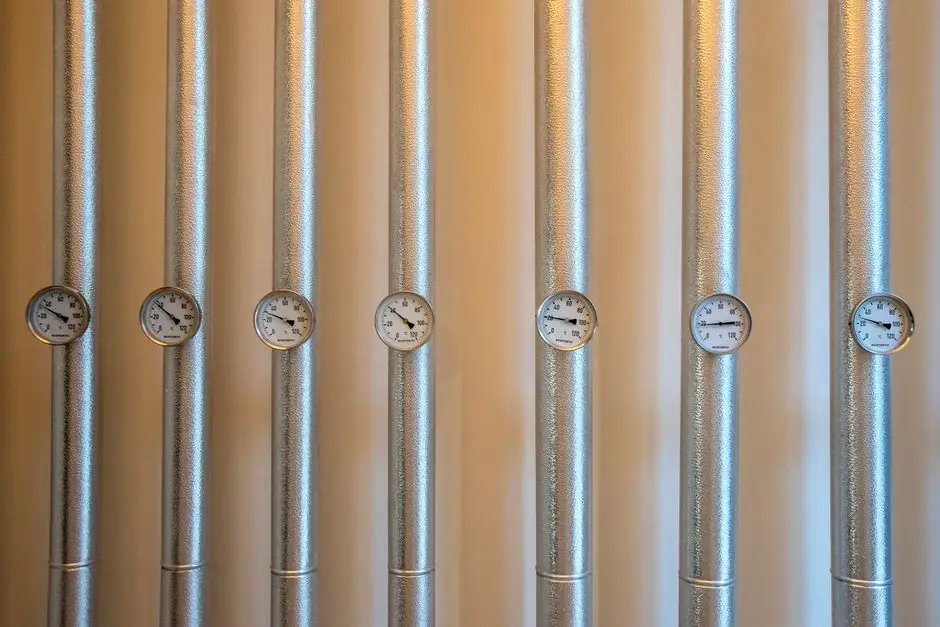
Fuji Electric specifies long-term stability of ±0.1% over 5 years for its pressure transmitters, a performance figure that must be checked against the complete accuracy statement [S9].
The figure applies to drift, not the total possible error, and it applies only within the manufacturer’s stated conditions; temperature effect, hysteresis, linearity, repeatability, static pressure, and installation effects must be assessed separately [S3][S5].
What the 0.1% Five-Year Figure Means
Long-term stability describes the maximum output change over a stated period while a constant input is applied, and is commonly expressed as a percentage of full-scale output or full-scale range per year [S4]. A transmitter specified at 0.1% over 5 years therefore has a five-year drift requirement of 0.1%, provided the test conditions, reference basis, and applicable limits match the datasheet wording [S9].
Accuracy is broader. It combines deviations such as non-linearity, hysteresis, and repeatability, and is usually valid only at reference conditions such as room temperature and nominal supply [S5]. As a concrete example, a 0–1000 Pa sensor with a stability limit of 0.1% of full scale per year can drift by as much as 1 Pa in one year [S4].
For 5 years, the same example produces a maximum 5 Pa drift under the stated condition. That calculation is illustrative rather than a universal five-year specification, because stability must remain constant at the applied pressure and under the specified environmental conditions [S4].
Drift Is Not Total Measurement Error
A 0.1% five-year stability claim does not mean the transmitter will always measure within 0.1% of true pressure. A datasheet can quote 0.1% reference accuracy, 0.1% total temperature drift across −10 to +70 °C, and 0.1% long-term stability as separate performance limits [S5].
One documented transmitter family specifies 0.1% reference accuracy, an optional 0.075% accuracy version, and total temperature drift within 0.1% of maximum range from −10 to +70 °C [S5]. Another model in the same family is specified at 0.075% accuracy with the same temperature-drift limit [S5]. These figures describe different error mechanisms, not interchangeable guarantees.
Long-term stability is also distinct from short-term stability, which concerns output variation over minutes or hours, and repeatability, which measures agreement when the same pressure is applied repeatedly under the same conditions [S4]. A pressure transmitter can have good repeatability while still accumulating a small permanent offset over years.
Calibration Interval Does Not Equal Warranty

Direct-mounted pressure transmitters installed inside in a controlled environment on a stable process should be calibrated every 4 to 6 years, while direct-mounted units installed outside on stable processes should be calibrated every 1 to 4 years depending on ambient conditions [S2]. These are general maintenance guidelines, not automatic validation of a 5-year stability claim.
For a remote diaphragm-seal installation, the recommended calibration interval is reduced by a factor of two, changing a 4 to 6 year interval to 2 to 3 years [S2]. The seal system uses more fill fluid and experiences greater mechanical stress from process or ambient temperature changes; physical damage to the diaphragm can also cause offset or linearity errors [S2].
Significant pressure swings or over-pressurization can justify reducing the interval by one-half [S2]. By contrast, one manufacturer states that Rosemount 3051 calibration is stable for 5 years and Rosemount 3051S for 10 years, with those stability periods guaranteed [S6]. Such statements are model-specific and cannot be transferred to an unspecified transmitter without matching the exact model, configuration, and service conditions.
Compare the Selection Criteria
Long-term stability should be compared using four decision criteria: the drift limit and period, the reference basis, the operating environment, and the installation architecture. A 0.1% five-year specification with 0.1% reference accuracy and quantified temperature performance is easier to engineer than a 0.1% claim without environmental limits [S5][S9].
A direct-mounted transmitter in a controlled indoor location normally has the broadest recommended calibration interval of 4 to 6 years, whereas an outdoor direct-mounted transmitter is typically assigned 1 to 4 years because weather and humidity can accelerate degradation [S2]. A remote diaphragm seal reduces the corresponding interval to 2 to 3 years, and a dynamic or over-pressurized process can require a further reduction [S2].
For differential-pressure measurements, static-pressure dependence and zero effects require separate review. The comparison between a direct-mounted differential pressure transmitter and a seal-equipped installation therefore depends not only on stated accuracy, but also on fluid volume, thermal stress, diaphragm condition, and pressure cycling [S2][S5].
Who Should Specify the Five-Year Claim
The specification fits applications that need a controlled error budget, such as stable tanks, pipelines, or process loops with limited maintenance access. It is less suitable for fluctuating pressure, severe thermal cycling, remote seals exposed to physical damage, or installations where the required maximum permissible error is much tighter than the transmitter’s reference accuracy [S2].
The 0.1% figure is not suitable for every class of instrument. A general-purpose transmitter specified at 0.35% accuracy, with an optional 0.15% version, is a different selection from a 0.1% or 0.075% high-accuracy device [S5]. Tightening the calibration tolerance to match a manufacturer’s best reference accuracy can increase calibration non-conformances rather than improve process performance [S2].
For custody-transfer decisions, the pressure transmitter accuracy class for custody transfer must be evaluated separately from long-term stability. Drift over 5 years is one budget item, while reference accuracy, span error, temperature performance, repeatability, and calibration uncertainty remain distinct contributions [S5].
Installation and Service Risks That Erode the Budget
Process media can attack the wetted materials, while deposits, corrosion, and abrasion can change the sensing surface and introduce offset or linearity errors [S2]. Heavy vibration is another factor that must be considered when setting calibration intervals, along with contaminants, humidity, and temperature variation [S2].
Equipment condition still matters even when a long-term stability figure is specified. Guidance published on 26 January 2026 states that aging or damaged parts should be replaced promptly and that, under normal operating conditions, most high-quality components can be used for 5 to 8 years [S8]. That component-service range is distinct from a guaranteed 5-year calibration stability specification.
Calibration practices should follow the manufacturer’s instructions and use a pressure calibrator with uncertainty appropriate to the required tolerance [S2]. The chosen maximum permissible error should reflect process quality, safety, and regulatory requirements rather than simply copying the manufacturer’s reference-accuracy figure [S2].
How to Confirm the Claim Before Purchase
Require the supplier to state the exact model and sensor range, then verify whether the 0.1% value applies to calibrated span, full-scale range, or upper range limit [S5]. A 0.1% error on a 0–5 bar configured span of a 0–10 bar sensor equals ±0.005 bar, while the same absolute error is larger relative to a narrow configured range [S5].
Request the measurement conditions, duration, reference basis, and temperature limits supporting the 5-year claim. The accuracy statement must also disclose linearity, hysteresis, repeatability, static-pressure effects where applicable, and the effect of turndown [S5]. A credible review should not accept ±0.1% over 5 years if the datasheet provides no drift definition or operating envelope.
Then compare that guarantee with the installation. Indoor controlled, outdoor, remote-seal, and pressure-cycling installations have materially different maintenance schedules, ranging from 4 to 6 years down to 1 to 4 years or 2 to 3 years before process-specific reductions [S2]. The next verification points are the approved datasheet, the installation drawing, and the calibration plan, all using the same model, range, ambient conditions, and service assumptions.