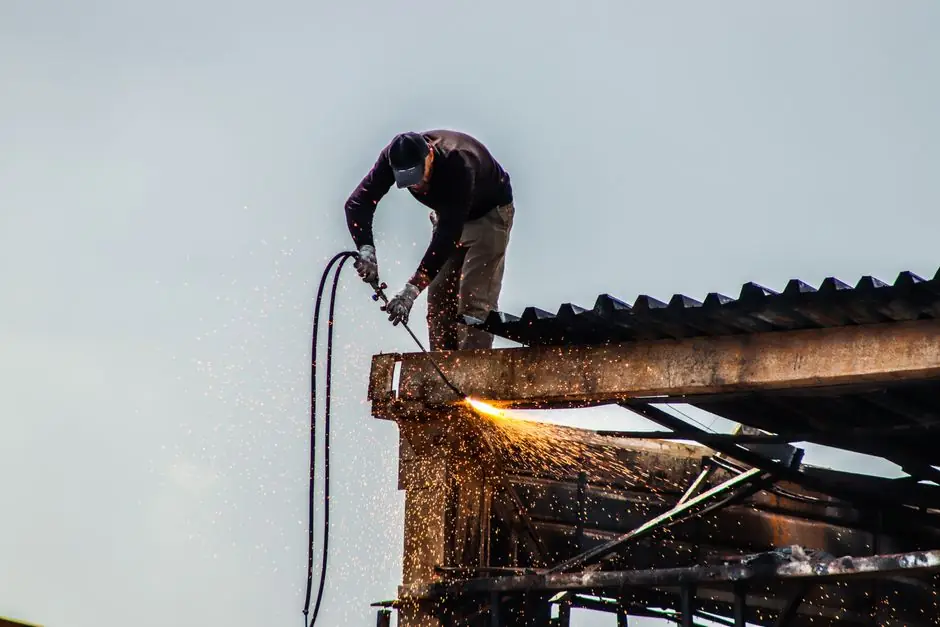
A welding mat is a process-graded floor protection device placed under stick, MIG, TIG, plasma, and grinding stations to catch sparks, hot spatter, and molten debris before they reach the substrate, with typical service life of 3-5 years for heavy spark-resistant rubber compounds [S2].
Selection hinges on the welding process, the size of the spatter and spark zone, the operator's working footprint, and the mat's documented fire classification, not on a generic "welding-safe" label [S5]. Worn or charred mats lose their protective function even when they still look intact from a distance [S4].
What a welding mat actually protects against
A welding mat protects floors and adjacent surfaces from sparks, hot spatter, and molten metal generated during welding, grinding, and thermal cutting, catching debris before it reaches the surface below and reducing both fire risk and floor damage [S5]. It is classified as protective equipment that supports hot-work precautions such as permits, fire watch, and PPE, and is not a substitute for them [S5].
No welding mat on the market is fireproof: products are designed to resist sparks, spatter, and heat for a stated use envelope, and wording such as "fire-resistant" describes a graded performance, not immunity [S5]. For broader floor coverage around a fixed station, the welding mat is normally paired with general fire-resistant matting, because sparks and spatter can travel well past the workpiece footprint [S5]. The safety mat family also covers pressure-sensitive and perimeter-monitored mats used for machine guarding, which is a different function from hot-work floor protection.
Matching the mat grade to the welding process
The correct grade is driven by spatter volume, slag type, and heat intensity, and a higher fire classification is specified as those inputs rise [S5]. A practical process map used in current buyer guidance lines up: TIG (minimal spatter, prioritise comfort and basic spark resistance), MIG/MAG (moderate to heavy spatter plus slag, prioritise fire classification and spatter durability), stick/arc MMA (heavy spatter, slag, hot stub ends, prioritise higher fire classification and a robust surface), and grinding/cutting (wide spark spray, hot fragments, prioritise wider coverage and a spark-resistant surface) [S5].
Heavy spark-resistant rubber mats are typically rated for 3-5 years of service life under normal hot-work exposure, and they double as anti-fatigue surfaces at fixed standing stations [S2]. For static-sensitive operations, electrically conductive nitrile rubber mats such as the Hog Heaven Anti-Fatigue Indoor Mat are welding-safe and ESD-conductive in a single part, allowing one mat to cover both spark and static-dissipation duties [S7]. Higher temperature and heavier slag generally push the buyer toward thicker nitrile or mineral-filled rubber rather than foam-backed vinyl, which can char quickly under continuous spatter.
Sizing to the operator's working zone, not the table
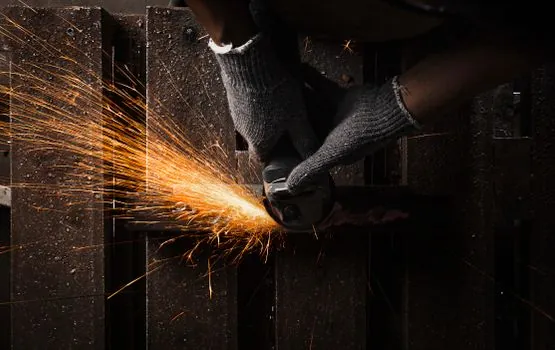
The mat should cover the position where the welder stands most often, including the natural movement area along the bench, fixture, or welding table; a mat that is too small forces the user to step on and off its edge throughout the shift, while an oversized mat interferes with access, material handling, and cleaning [S4]. For a fixed workstation, the standing area is measured rather than estimated, and the layout of foot pedals, welding leads, gas lines, and tool carts is checked so the mat does not trap or sharply bend cables [S4].
Thickness is a function of the task: thick, soft cushioning can increase ankle movement and tire the operator during precise work, so detailed fabrication and inspection typically use a firm industrial mat with responsive cushioning, while long, mostly stationary shifts can take a slightly more cushioned construction provided footing remains secure [S4]. Edge design is part of the spec: low, tapered bevels improve access and reduce perimeter damage where pallet jacks, carts, and welders move through the area, and a mat specified for standing traffic should not be loaded with repeated vehicle or heavy rolling loads unless the manufacturer documents that use [S4].
Material, contaminants, and cleanability
Welding bays share space with solvents, cutting fluids, oils, degreasers, and cleaning products, and a material that performs well in a dry fabrication area may not be appropriate beside a service bench with frequent oil contact; procurement should document the likely contaminants and match them against the mat's material specifications before standardising across a facility [S4]. Pigmented nitrile rubber with high tear resistance and lighter handling weight than many dense rubber alternatives is common where flexibility matters, while dense rubber remains the default where its specific resistance properties match the environment [S4].
For grinding stations beside welding tables, the mat is inspected regularly for embedded metal fragments, and a damaged or contaminated surface is taken out of service even when it still looks usable from a distance; the same removal rule applies to curled edges, tears, hard spots, and loss of grip, because in industrial safety equipment condition matters as much as the original specification [S4]. Where the concern is shielding equipment or a wall next to the work, a welding blanket is the correct product rather than a floor mat, and the two are not interchanged [S5].
Electrical safety: when a switchboard mat matters
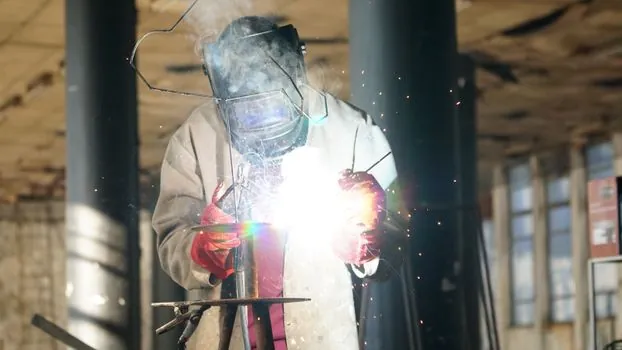
Welding environments combine hot work with exposed energised circuits, and a mat specified only for spark resistance does not automatically deliver the dielectric isolation required for live electrical work; products specifically labelled as electrical insulating or switchboard mats are required where that hazard is present [S8]. For shock protection, look for products labelled as welding or electrical insulating mats and check for certifications such as ASTM F1506 on the documentation pack [S8].
In a typical bay, the dielectric switchboard mat is laid in front of the electrical panel or transformer area, while a separate spark-resistant mat is placed at the welding table, and the two mats are not expected to perform each other's job. Anti-fatigue and spark protection can be combined in a single nitrile rubber mat, but the dielectric function is a separate spec line that must be documented for the exact product, not assumed from the family name. Compliance documentation around safety certification is what turns a vendor claim into a verifiable protection level.
Inspection, replacement, and the "still in one piece" trap
Replacement is triggered the moment protection is reduced, since a damaged mat with gaps no longer catches spatter reliably, even when it still looks structurally intact; check regularly for burn-through, charring, holes, and hardening, and retire the mat when any of these appear [S5]. Embedded metal fragments from adjacent grinding, curled edges, hard spots, and loss of grip are all removal triggers, and the inspection cycle is short enough to catch them between shifts [S4].
For bay-wide coverage, current fire-safety guidance recommends pairing the welding mat with general fire-resistant matting to extend the protected zone, and requesting the product's classification report (commonly issued under EN 13501-1) for the exact part number rather than relying on a generic material claim [S5]. A documented fire classification, a dated inspection log, and a written replacement trigger are the three records an auditor will ask for first, and they are the same three a safety manager should track. Broader fire safety controls, including extinguishers, fire watch, and hot-work permits, are layered on top of the mat and are not replaced by it [S5].
Trackable signals for the next planning cycle: (1) whether the supplier provides a per-part EN 13501-1 fire classification report rather than a family-level claim, and (2) whether the bay's dielectric hazard zones have a separate switchboard-mat specification with documented ASTM F1506 certification, since a single spark-resistant mat does not cover both duties [S5][S8].
For related coverage, see AAC Block Selection for Data Center Shells: 2026 Spec Map.