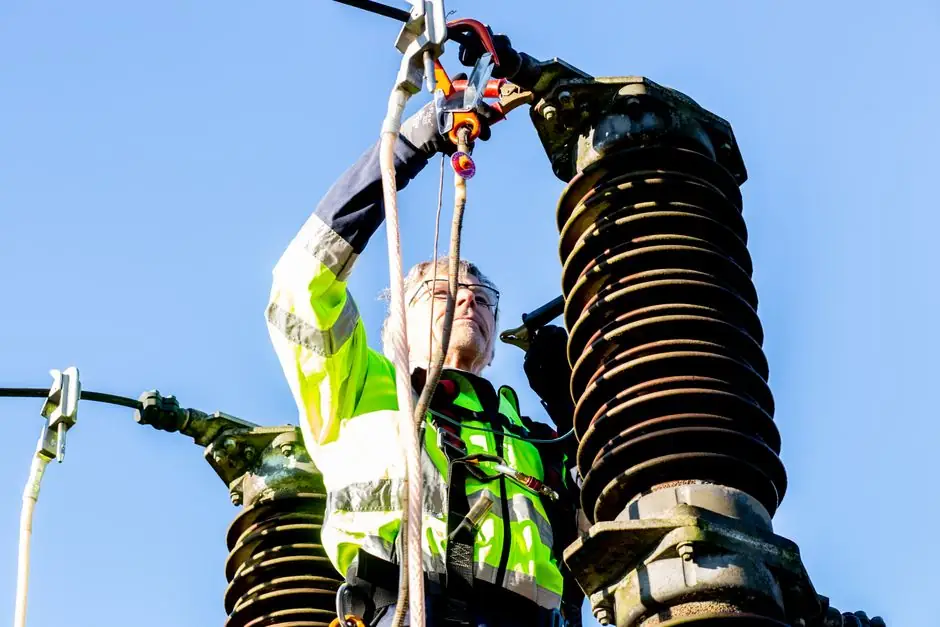
Selection of a "two-hand control" arrangement for elevated work is a misnomer in most jurisdictions: regulators and standards bodies do not certify a two-hand device for height work, they require a hands-free posture, meaning the worker cannot be holding anything other than the structure, ladder rail, or fall-protection hardware. The practical decision is therefore which fall-restraint or fall-arrest subsystem keeps both gloved hands free while still meeting OSHA 29 CFR 1926 Subpart M or the UK Work at Height Regulations 2005 [S2][S4].
Falls from height remain one of OSHA's Focus Four hazards and account for roughly one third of all US construction fatalities, with 35 worker fatalities recorded in the UK alone in 2024/25 following a fall from height [S3][S4]. A positioning device system, anchored above the worker with a short lanyard that prevents reach to the edge, is the configuration that physically enforces the hands-free rule on towers, mezzanines, and rig structures [S4].
What "two-hand control" means in a height-work context
In machinery safety, a two-hand control is a discrete category-III safety device defined by ISO 13851, requiring simultaneous actuation of two push-buttons within a 500 ms window to start and maintain a hazardous motion. That device is built into a press, a baler, or a robotic cell, not worn by a roofer or a rigger, so the term collides with a different engineering requirement when it is imported into height-safety vocabulary [S2].
For work at height the equivalent functional requirement is that the worker's two hands are occupied with the task or with the structure itself, and never with a clipboard, a phone, a radio, or a tool tether. WorkSafe NZ and the UK HSE both frame this as part of competent planning under the Work at Height Regulations 2005 and the Health and Safety at Work Act 2015, and treat any hand-held documentation or barcode scanner as a control gap that must be designed out, for example by using enterprise smart glasses with a head-up display [S1][S3].
Trigger heights and the legal floor before any hands-free device is specified
OSHA trigger heights in the United States are 4 ft (1.2 m) for general industry under 29 CFR 1910, 6 ft (1.8 m) for construction under 29 CFR 1926 Subpart M, 5 ft (1.5 m) for shipyards under 29 CFR 1915, and 8 ft (2.4 m) for longshoring; construction also imposes 10 ft for scaffolding, 15 ft for steel erection, and 24 ft for fixed ladders [S2][S4]. Australia uses a flat 2 m trigger through Safe Work Australia, and the UK WAH Regulations 2005 set no numerical trigger, requiring protection "wherever a fall could cause personal injury" [S2].
Falls from as little as 2-3 m (6-10 ft) cause death and permanent disability regularly, and OSHA estimates 100% of fall fatalities are preventable with proper planning, equipment, and training, which is why the hands-free posture is enforced below the trigger height whenever a worker is within reach of an unprotected edge [S2]. Falls, slips, and trips account for 18% of all nonfatal work injuries resulting in days away from work, according to BLS 2020 data [S2].
Selection criteria: restraint vs. arrest vs. positioning, not "two-hand device" brands

Fall restraint (or travel restraint) physically prevents the worker from reaching the unprotected edge and is the preferred OSHA hierarchy choice because no fall ever occurs; fall arrest accepts a fall in progress and limits arresting force to 1,800 lbf (8 kN) peak on the body, while a positioning device system supports the worker at an elevated work location and keeps both hands free for the task [S1][S4]. A total restraint system therefore replaces a "two-hand control" requirement because the lanyard length, typically 0.6-1.8 m fixed or adjustable, is sized so the anchor point keeps the worker inside the safe zone.
For drill-rig and oilfield use in the UAE and wider MENA region, the same hierarchy applies but with environmental derating: ambient temperatures above 50 deg C degrade polyester webbing and shock-pack lanyards, fine desert sand fouls self-retracting lifeline (SRL) housings, and salt spray on Gulf offshore platforms accelerates corrosion of alloy connectors, all of which push the spec toward stainless or galvanised hardware, sealed SRLs, and 6-month rather than annual inspection cycles [S5]. The Dropped Objects Prevention Scheme reports that struck-by incidents from falling tools and materials cause more than 30% of all serious injuries on offshore installations, which is why tethering and tool-lanyard practice is treated as part of the same hands-free envelope [S5].
Equipment map: what actually enforces the hands-free rule at elevation
The practical equipment stack for hands-free work at height is a full-body harness rated to EN 361 / ANSI Z359.11, a positioning lanyard rated to EN 358 / ANSI Z359.11 with a 0.6-1.2 m fixed arm, a shock-absorbing lanyard or SRL to EN 360 / ANSI Z359.14 for any fall-arrest backup, and an anchor point rated to 22.2 kN (5,000 lbf) per attached worker for steel structures or 12 kN for concrete [S4][S5]. On ladders specifically, a fixed ladder above 24 ft in US construction requires either a ladder safety system (cable grab plus carrier) or a personal fall arrest system, because a ladder does not allow a hands-free work posture by itself [S4].
For documentation tasks that traditionally force a worker to let go with one hand, hands-free wearables such as the Vuzix M400-style enterprise smart glasses, head-mounted cameras, voice-activated RFID scanners, and foot- or hip-located barcode readers are the modern substitute for a hand-held tablet; Net4Connect reports that the Vuzix M400 leaves both hands on the structure at all times and supports remote-expert video, photo capture, and document reference through voice commands [S3]. A two-hand control safety relay from a press-safety catalog does not satisfy any of these height-safety requirements and should be kept separate in the bill of materials.
Comparison of the three hands-free options against 4 decision criteria
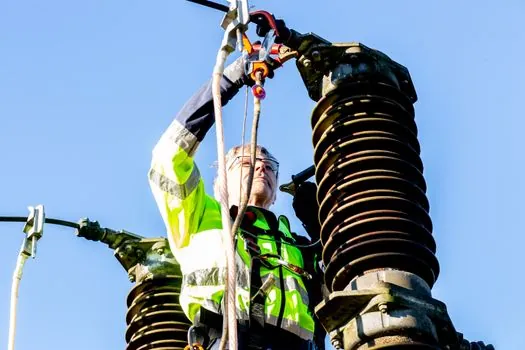
Travel restraint, fall arrest with SRL, and positioning device each map differently against four decision criteria relevant to elevated work. On fall clearance, travel restraint needs near-zero (worker never falls), fall arrest needs 5.5-7.5 m of clear space below the anchor including 1.8 m deceleration distance and 1 m safety margin, and positioning needs clearance for the supported work posture only [S4][S5]. On user mobility, restraint is the most restricted (worker can only move within the lanyard radius), positioning allows two-handed work at a fixed station, and SRL-backed arrest allows near-full mobility but at the cost of accepting a possible fall event.
On inspection burden, restraint lanyards need a pre-use visual check, arrest systems need formal inspection every 6-12 months by a competent person with recorded results, and SRLs additionally need annual service and a withdrawal-from-service test after any arrest event; positioning lanyards sit between the two [S5]. On hands-free compliance, all three score 100% by design, whereas a work positioning lanyard to EN 358 with a 1.2 m arm and a Y-leg lanyard is the most common combination on drilling rigs and tower steel because it keeps two hands on the tool and one anchor above the D-ring [S4][S5]. Where the aerial work platform is the chosen host machine, the platform's guardrail plus a short restraint lanyard is normally sufficient, and a full arrest system is only specified when the platform can swing or when outriggers are on uneven ground.
Limitations, failure modes, and the "not for" list
Two-hand control logic imported from press safety fails at height in three predictable ways. First, the 500 ms simultaneity window of ISO 13851 assumes a stationary operator with two free hands; at height the operator may only have one free hand and may be wearing thick cold-weather or cut-resistant gloves, so the timing budget is unrealistic [S2]. Second, a two-hand control relay stops a machine motion when released, but a fall is a kinematic event, not a controlled stop, so the same relay architecture cannot arrest free-fall and must never be the primary height-safety device. Third, an aerial work truck such as a bucket truck is not a substitute for restraint when the boom can slew into a structure; the operator can still be ejected and needs a secondary harness and short lanyard clipped to the bucket's anchor point.
Specifying hands-free technology is also not appropriate when the worker's hands must be gloved and gripping a tool under load, as in rock-drilling or torque-bolting on derrick structures, because the hands are occupied with force application rather than with a control device, and the hands-free rule is satisfied by the task itself rather than by added equipment [S5]. Finally, ladders are explicitly excluded as a work platform when both hands are needed for the task; the UK HSE and WorkSafe NZ both treat a ladder as access equipment, not a sustained work station, and require a mobile elevating work platform or scaffold for any hands-busy task above the trigger height [S1][S2].
Applicable standards, sourcing, and where to verify before purchase
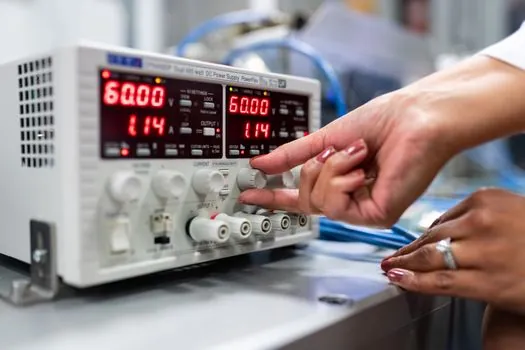
For US projects, anchor strength and harness/lanyard ratings are governed by 29 CFR 1926 Subpart M and the ANSI Z359 family, with 22.2 kN (5,000 lbf) anchor capacity as the field rule of thumb and 1,800 lbf peak arrest force on the body as the design ceiling [S4]. For UK and EU work, EN 361 (full-body harness), EN 360 (SRL), EN 358 (work positioning lanyard), EN 362 (connectors), and EN 795 (anchor devices) are the load-bearing references, and the Work at Height Regulations 2005 sit above them as the legal duty [S2]. In the UAE and MENA, OSHAD and the ADNOC HSE Management System add the regional layer, with IADC and DROPS providing the oilfield-specific incident data that drives the hands-free and dropped-object rules [S5].
Where hands-free information access is the only remaining gap, the procurement decision is a hardware-plus-managed-service package such as the Net4Connect smart-glasses bundle with remote-expert software, rather than a two-hand control relay; this is a category shift from machine safety to PPE and remote-collaboration tooling, and the specifier should treat it as a separate line item from the harness-and-lanyard assembly [S3]. For related reading on two-hand control selection in firefighting applications and the parallel spec map for two-hand control selection in electrical work, the same ISO 13851 timing logic applies but the host machines and PPE stack are different.
Trackable signals for the next planning cycle: any revision to OSHA 29 CFR 1926 Subpart M trigger heights, updates to ANSI Z359.14 SRL classification tables, and the published IADC incident statistics for the MENA region, since the dropped-object share of serious injuries and the fall fatality trend in UK 2025/26 data will both shift the hands-free baseline again.