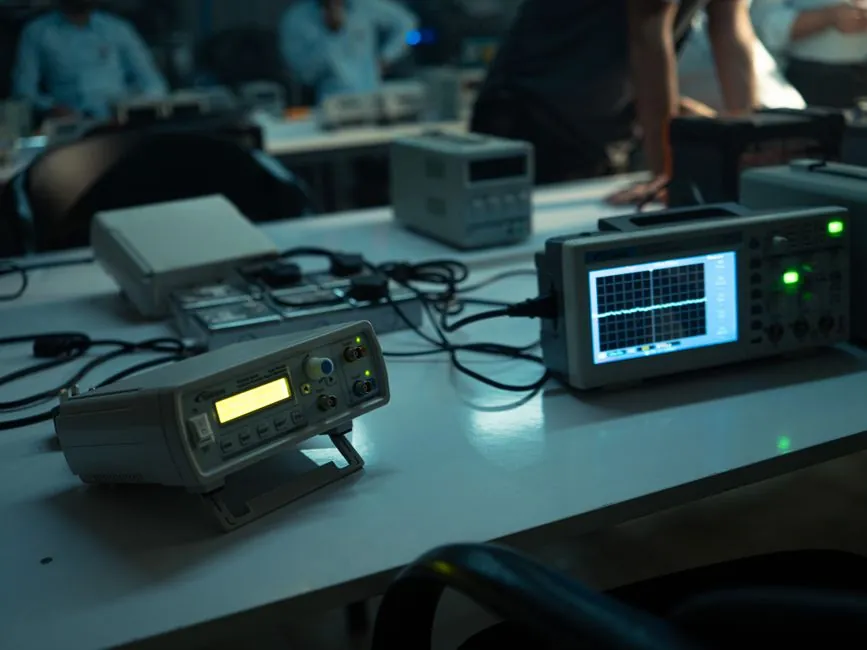
In a decade resistance box, the comparator or null detector is used to find the point at which an unknown resistance or voltage matches the known resistance selected by the decade dials.
The arrangement supports resistance calibration, bridge measurement, and tolerance checks, including use with resistance thermometers, insulation resistance testers, and other resistance-measuring instruments [S1][S5][S8].
Core Function of the Comparator
A decade resistance box presents a selectable, traceable resistance value through its dials. The comparator determines whether the voltage associated with that selected value equals the voltage associated with the unknown resistance. When the two values balance, the null detector produces its most useful output: an indication that the comparison is at balance rather than a direct numerical measurement of the unknown quantity [S7].
The same principle is used in a null measurement instrument, which determines an unknown voltage or electromotive force by comparing it with a precisely known reference voltage [S7]. In a resistance-measurement bridge, the decade box supplies the known resistance ratio, while the detector identifies the condition in which the bridge is balanced. A practical description of resistance decade-box use also identifies the Wheatstone bridge as a traditional configuration for measuring an unknown resistance [S8].
This is different from using the decade box only as a passive resistance substitution source. A resistance decade box can substitute standard values into a circuit, while the comparator adds a comparison function for checking whether the quantity under test agrees with the selected reference [S2][S5].
How a Null Detector Detects Balance
A null detector does not need to measure a large voltage difference to locate the comparison point. It responds to the difference between two input signals, and the balance condition is reached when that difference approaches zero. A null detector may show zero current with no input signals and zero current again when the applied signals are arranged in a null condition [S4].
In a bridge, the decade-box setting changes the ratio of known resistances in one branch of the bridge. The detector monitors the imbalance between the bridge branches and is adjusted, through the unknown resistor or the decade setting, until the imbalance is null. The decade setting at balance then represents the unknown resistance through the bridge equation, provided the other bridge arms and their values are known.
The detector is therefore an instrument for finding a condition, not for replacing the resistance box as the source of the known value. The box supplies the controlled reference, the bridge provides the comparison network, and the null detector provides the balance indication. This division of functions is consistent with resistance-ratio measurement methods that compare voltage drops across resistors [S3].
Where the Comparator Is Used in Practice
One practical use is checking whether a resistor falls within an expected tolerance. The known values in the decade box provide the comparison points, allowing the operator to determine whether the component is close to its nominal value. This is the function described for comparator-equipped resistance decade boxes: compare resistors against the known values in the box to check tolerances [S2].
The 279301 is a decade resistance box [S1]. For a resistance thermometer, the decade box can provide the simulated resistance associated with a selected temperature, while the comparator or measuring instrument checks the agreement between the simulated value and the measured value.
The 279303 is listed as a decade resistance box [S1]. This range makes the comparator useful where the detector and bridge arrangement must resolve a comparatively small imbalance around a high reference resistance. The choice of box, detector sensitivity, test current, and connection method matters more as resistance increases.
Comparator Versus Direct Resistance Measurement
The main selection criterion is the required result. A decade box alone substitutes a known resistance into a circuit, while a decade box with a comparator or null detector supports a balance test against an unknown resistance or voltage [S5][S7]. For rapid substitution and circuit adjustment, the passive decade-box function is sufficient. For determining an unknown value or checking agreement with a reference, the comparator arrangement provides the required decision point.
Three practical criteria separate the options. First, a direct ohmmeter gives a resistance reading without requiring manual balance, whereas a null method identifies the equality point and can use the selected decade value as the reference. Second, a direct comparator is useful for tolerance screening, but the decade resolution, accuracy, and stability determine how finely the comparison can be made. Third, a null detector requires a suitable input signal, adequate sensitivity, and an appropriate bridge or test circuit; it is not a substitute for a calibrated resistance measurement [S3][S6].
For a laboratory choosing equipment, the decisive questions are: What is the resistance range? Is the detector sensitive enough at the lowest imbalance? Are four-wire or guarded connections available? Is the objective substitution, calibration, or tolerance verification? A single decade box can serve the first two purposes, but a separate optical comparator is unrelated to this measurement task and should not be confused with a null detector.
Connection, Balance, and Measurement Limits
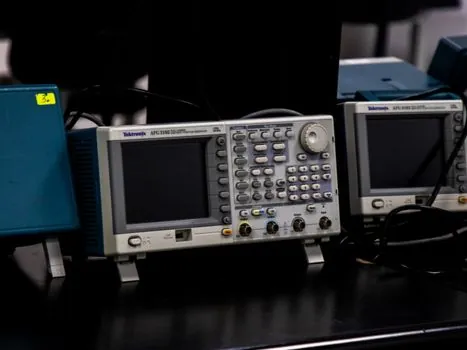
Connection resistance is a primary limitation in resistance comparison. The 2793 family uses dial switches with low contact resistance to provide good reproducibility, but the complete measurement still includes the box, leads, fixture, and detector input [S1]. In bridge measurements, four-terminal connections reduce the effect of lead resistance because voltage is sensed separately from current injection.
Technical work on resistance-ratio systems describes the direct current comparator bridge and binary voltage divider methods over resistance ratios from 1 µΩ to 1 GΩ [S3]. At balance, no current flows in the measuring leads for the BVD and DCC arrangements described, which makes lead resistance unimportant with four-terminal connections [S3]. The same work identifies practical range constraints: the BVD approach has a sub-ppm dynamic-range limitation associated with power dissipation in the larger resistor, while the DCC approach is limited above 10,000 Ω by two-terminal measurement effects and uses four-terminal measurement over 1,000 Ω to 1 GΩ [S3].
For a decade box, the detector must also have enough sensitivity and input resistance for the selected range. Low-resistance comparison is vulnerable to contact and lead effects. High-resistance comparison is vulnerable to leakage, insulation paths, surface contamination, and detector input loading. A null reading should therefore be checked for repeatability before the decade value is accepted as a calibration result.
Calibration Logic and Traceable Use
The comparator supports calibration because it compares the instrument response with a controlled resistance rather than relying only on an uncalibrated display. Decade boxes are used to verify the accuracy of measuring devices and test equipment, including multimeters, and resistance boxes are commonly used for Pt100 simulation when calibrating RTD transmitters and resistance temperature devices [S5].
The selected resistance is only a valid calibration reference if the box accuracy, stability, temperature coefficient, and switching repeatability are known for the operating conditions. The 2793 range includes medium resistance from 0.1 to 1,111.210 Ω in 1 mΩ steps and high resistance from 0 to 111.1110 MΩ in 100 Ω steps [S1]. The chosen model must therefore match the resistance scale of the device under test.
A null measurement is most useful when the balance point is reproducible and the detector response is stable. Record the decade setting, bridge configuration, detector condition, terminal arrangement, and environmental state with the result. If the balance drifts after the decade switch is changed, investigate contact resistance, insulation leakage, source stability, and detector noise before assigning the reading to the unknown resistance.
Choosing the Right Decade Box for Comparison Work

Choose a decade box whose range and resolution cover the expected unknown value, then verify that the comparator circuit can drive it through the intended balance point. A 1 mΩ-step box in the 0.1 to 1,111.210 Ω range supports precision bridge and thermometer work, while a 100 Ω-step box reaching 111.1110 MΩ supports high-resistance instruments [S1].
The selected detector must also suit the test method. Direct voltage comparison, bridge comparison, and DMM-assisted measurements do not have identical sensitivity requirements. The BVD and DCC systems described in the technical paper show that balance detection can reach sub-ppm uncertainty, but their usable resistance ranges differ because of current noise, power dissipation, and terminal configuration [S3].
For an instructional or troubleshooting bench, a comparator-equipped decade box gives a practical answer to the question: it is the device that tells the operator whether the selected known resistance is equal to the unknown resistance, so the resistance can be determined or its tolerance confirmed [S2][S7]. For further selection context, What “Decade” Means on a Resistance Box Dial explains the dial construction that determines the available comparison values.
Before closing the test, verify that the detector returns to a stable null, repeat the balance from at least one other decade setting, and confirm that the result is consistent with the box specifications and connection method. Those checks distinguish a genuine resistance match from a temporary zero produced by leakage, an unstable source, or switch contact variation.