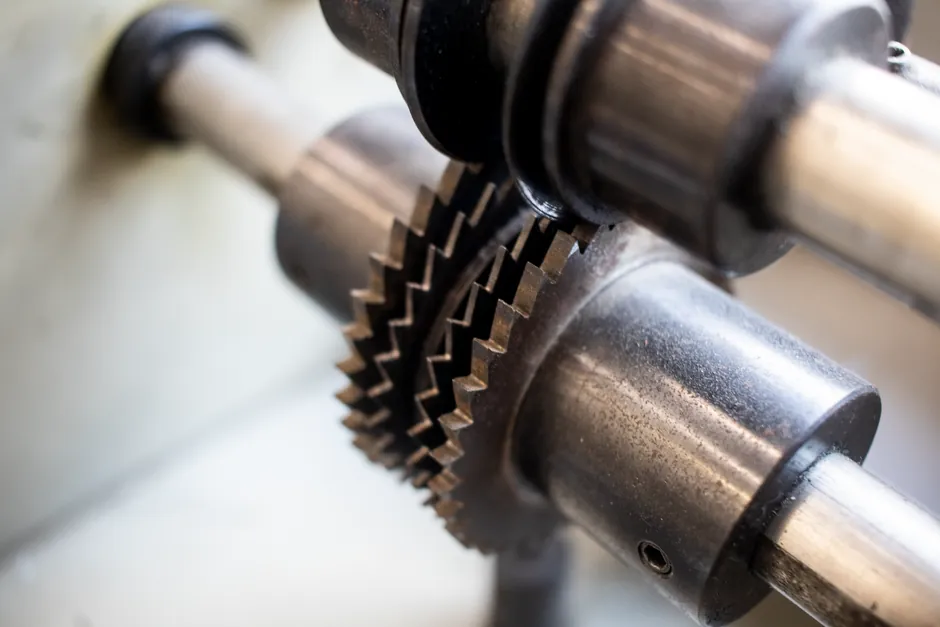
A balancing machine rotates the rotor so unbalance generates measurable centrifugal force, with the response recorded as bearing-force or vibration data during rotation.
The scope is dynamic balancing of rigid and flexible rotors, using 1-plane, 2-plane, static, and coupled correction methods to quantify residual unbalance and calculate correction weights [S1][S3].
Static Geometry Cannot Reveal Rotor Unbalance
At rest, a rotor can appear concentric even when its center of mass is displaced from its geometric or journal axis. The defect becomes physically meaningful only when rotation converts that eccentricity into a rotating centrifugal force, and the machine measures the resulting response relative to shaft angle [S2][S3].
This is why a dynamic balancing machine does more than inspect diameter or runout. It captures the phase relationship between the once-per-revolution force and rotor rotation, then converts that information into an unbalance magnitude and angular location.
Centrifugal Force Makes Hidden Eccentricity Measurable
Rotating an eccentric mass converts its imbalance force with angular speed according to F = m·e·ω², where m is the eccentric mass, e is its offset from the rotation axis, and ω is angular velocity. The measurement is therefore speed-dependent, which is why balancing machines prescribe a controlled test speed and a defined rotor-support configuration [S3][S7].
The machine does not measure force by guessing where the heavy spot lies. It records a response for each revolution, using phase information to relate the force pulse to a known angular position. After one or more trials, the instrument calculates the residual unbalance and the correction required at the designated correction radius [S1][S6].
Spinning also reproduces the operating condition that matters in service. Rotor balancing aims to leave an acceptable vibration magnitude when installed and, for flexible rotors, acceptable deflection at every speed up to maximum service speed [S2]. A stationary inspection cannot reproduce the speed-dependent behavior of the shaft, bearings, supports, and rotor mass distribution.
Soft-Bearing and Hard-Bearing Machines Measure Different Effects
Soft-bearing machines support the rotor so it can move, then measure support or frame vibration with vibration sensors. Hard-bearing machines constrain the rotor and measure the unbalance force transmitted into the bearings with force sensors [S3][S5].
On a hard-bearing machine, the support spring system responds to centrifugal force generated by the spinning rotor [S7]. A calibrated machine can then determine unbalance across different rotor geometries within its rated mass and speed envelope, subject to periodic calibration checks [S3]. A balancing machine measures static or dynamic unbalance.
Soft-bearing support stiffness and damping affect the measured amplitude and phase, so correction data are tied to the test setup. Hard-bearing support stiffness also matters, but its force-based measurement offers a different calibration path. Machines are therefore selected for rotor mass, diameter, journal spacing, speed range, support type, and required correction planes rather than for balancing principle alone [S3][S5].
One Plane or Two Planes Changes the Correction
Single-plane balancing uses one measuring plane and one correction plane, while total balancing uses two measuring planes simultaneously; specialized multi-plane methods address flexibly prone rotors [S1]. A single-plane result is not interchangeable with a 2-plane result because the same physical rotor can produce a different calculated correction when only one plane is observed [S1].
The main decision variables are rotor stiffness, bearing spacing, correction radius, and whether the machine must report coupled unbalance. The terms "soft-bearing" and "hard-bearing" balancing machines indicate how the rotor is supported on the pedestals.
For a long rotor, the distinction is operational rather than cosmetic. The broader comparison of single-plane and 2-plane correction is covered in Single-Plane vs Two-Plane Balancing for Long Rotors.
Correcting Mass Requires Mass and Angle
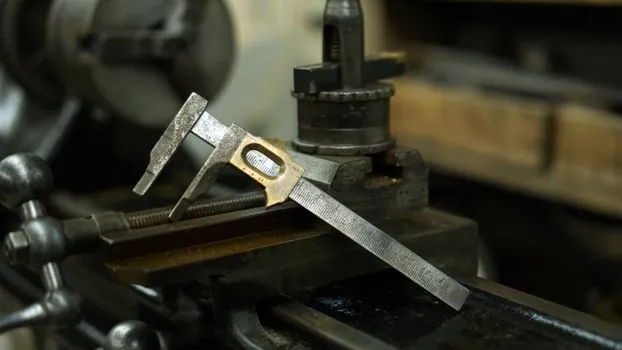
Unbalance is corrected by adding or removing mass at a specified radius and angle, not by changing the rotor while it is stationary. A trial weight must produce a measurable response so the machine can establish the relationship between correction mass, radius, phase, and measured unbalance [S1][S6].
Weights placed close to the rotor center require a larger mass for the same correction effect than weights placed near the outer radius [S6]. The calculation also depends on whether the rotor is subcritical or supercritical. Subcritical machines do not require the same separate calibration procedure used for supercritical machines, while supercritical machines use a test-weight calibration sequence [S1].
After correction, the rotor is spun again to confirm lower vibration, and the cycle can be repeated if residual response remains above the required limit [S4]. This verification matters because a calculation can be mathematically correct while the achieved correction still contains effects from assembly, fixture repeatability, support conditions, or weight seating.
Limits, Failures, and Acceptance Criteria
Dynamic balancing cannot repair misshapen castings, porous material, or eccentric machining; compensation weights only counteract a residual force, so poor manufacturing remains an underlying defect [S2]. Rotors that are distorted, corroded, worn, or coated with uneven deposits may require correction and investigation rather than balancing alone [S2].
Acceptance criteria must match the rotor and machine context. ISO 1940-1 provides a route for permissible residual balance, ISO 10876 and ISO 7919 provide routes based on vibration limits, and ISO 11342 covers balancing methods for flexible rotors [S2]. For flexible rotors, residual unbalance must also satisfy deflection limits across the operating speed range, not merely a single balance reading [S2].
Single-plane correction can leave residual effects that two-plane correction would identify differently [S1]. Hard-bearing calibration must be checked periodically and repeated if necessary, while machine relocation can affect calibration because the work supports must remain stable [S3][S5]. A final acceptance run therefore needs the same rotor mounting, speed, sensor arrangement, and correction-radius basis used during correction.
Choosing the Test Method by Rotor Behavior

Use a soft-bearing machine when measuring free-support motion or response is appropriate, and use a hard-bearing machine when bearing-force measurement, direct correction calculation, and repeatable calibration across a defined rotor envelope are required [S3][S5]. Both methods require the rotor to spin because dynamic unbalance is an angular, speed-dependent phenomenon rather than a stationary dimensional condition.
The decision is not simply soft bearing versus hard bearing. The engineer must also define the rotor’s corrected mass, operating speed, correction radius, allowable residual unbalance, number of correction planes, and whether the component is rigid or flexibly prone [S1][S2]. Portable systems can support maintenance balancing, while production balancing commonly uses dedicated horizontal or vertical machines with application-specific fixtures [S3][S5].
Track the correction result through the machine record: residual unbalance in mass units, correction mass, angular position, trial speed, calibration status, and the post-correction vibration response. Those fields close the loop between a hidden mass distribution defect, the calculation of a physical counterweight, and verified reduction of dynamic force after the rotor spins again [S1][S4].