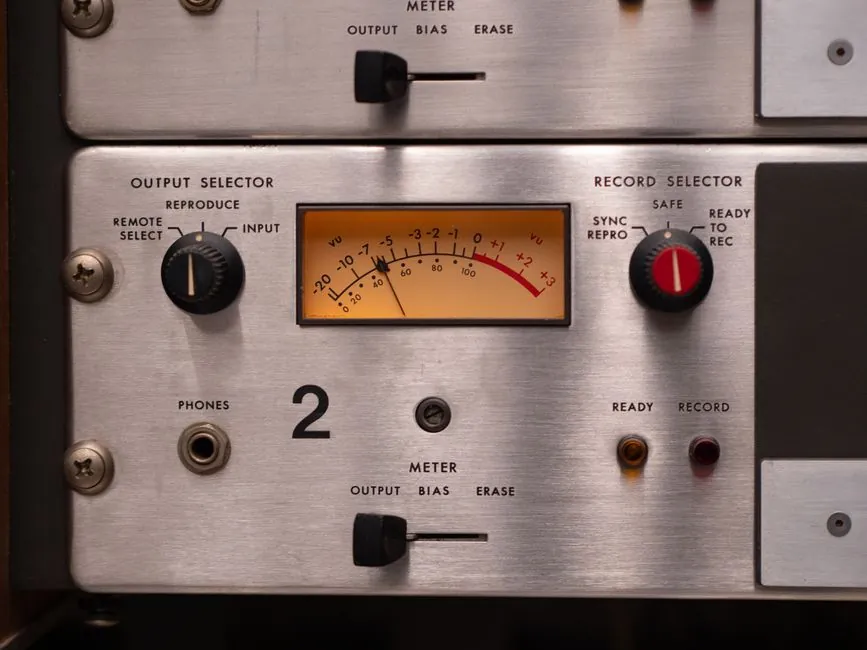
A decade box can lose accuracy at its lowest and highest values because fixed lead, switch and contact resistance dominate the low end, while insulation resistance, leakage and thermal effects become significant at the high end.
The 1051 8-decade low-ohm resistance box has a range of 0 to 1 MΩ in 0.01 Ω steps, residual resistance below 90 mΩ, a power rating of 1 watt per resistor, a maximum voltage rating of 250 V DC/AC RMS, and a temperature coefficient of 50 ppm/°C [S3].
Where the accuracy curve changes across decades
The weakest accuracy is not spread evenly across a decade box. It concentrates around the first usable decade and the upper electrical limit of the instrument.
That pattern reflects two different physical constraints. At the bottom, the selected resistance is small compared with the box's residual resistance. At the top, leakage through insulation and imperfect high-value resistors become measurable fractions of the nominal value. The practical accuracy band is therefore usually a middle decade range, not the full printed range.
IET Labs offers resistance decade boxes covering 1 mΩ to 10 TΩ, and its PRS-370 programmable resistance box has a range of 0.1 Ω to 20 MΩ with accuracy better than 10 ppm [S1]. Product-range and accuracy specifications should be read as separate constraints, not as a promise of equal precision from minimum to maximum resistance.
Why the lowest decades lose percentage accuracy
Residual resistance is the central error source at the low end. The 1051 8-decade low-ohm resistance box has residual resistance below 90 mΩ [S3]. Against a nominal 0.1 Ω value, 60 mΩ of residual resistance is already 60% of the target before resistor tolerance, switch resistance and lead effects are counted.
A residual-resistance error is expressed as ΔR divided by the selected R. When the selected resistance is 0.01 Ω, a fixed 0.02 Ω error corresponds to a 200% fractional error [S3].
Reliable low-ohm measurement therefore requires attention to terminals, cable resistance and switching configuration. The residual resistance of two units differs from the residual resistance of one unit, so four-wire measurement and resistance subtraction can be necessary when working below 1 Ω. For the box used in a calibration workflow, its residual resistance should be treated as part of the measurement uncertainty rather than ignored.
Low-ohm accuracy also conflicts with usable power. The 1051 8-decade low-ohm resistance box has a power rating of 1 watt per resistor [S3]. Applying the full 1 A at 0.1 Ω would demand 0.1 W in that decade alone, before switch, wiring and tolerance effects are considered.
Why the highest decades lose percentage accuracy

At high resistance, insulation leakage becomes a current path that is no longer negligible.
The maximum voltage rating also narrows the usable high-resistance performance. The 1051 8-decade low-ohm resistance box is rated for a maximum of 250 V DC/AC RMS [S3]. Rated voltage is not the same as accuracy at rated voltage: increasing voltage can expose dielectric leakage, insulation absorption and heating effects that were negligible at lower voltages.
Temperature also becomes more visible at the top of the range. The 1051 8-decade low-ohm resistance box has a temperature coefficient of 50 ppm/°C [S3]. A 50 ppm/°C coefficient produces a 0.005% change per degree Celsius, but that value must be combined with the box's stated accuracy class, residual resistance and environmental exposure.
High-value decade boxes also need guarded, clean and stable test environments. A deadweight tester is unrelated to this failure mechanism, but the same discipline applies in principle: measure the residual or parasitic effect with a controlled procedure, then quantify it rather than assuming the nominal decade value is exact.
Selecting a box for the required resistance band
The correct comparison is not maximum resistance versus headline accuracy. Compare the required operating band against decade accuracy, residual resistance, allowable current, voltage and temperature coefficient. IET Labs offers resistance decade boxes from 1 mΩ to 10 TΩ, and its PRS-370 programmable resistance box has accuracy better than 10 ppm [S1].
A precision box is not automatically the right choice for every range.
Laboratory or automated users should also account for traceability and repair support. IET Labs identifies its calibration facility as A2LA-accredited to ISO/IEC 17025, accreditation number 2073.01, and lists decade-box brands including IET, GenRad, esi, Tinsley, Biddle, Cropico, Clarostat and Yokogawa [S2]. A documented calibration interval, as-found and as-left data, and an uncertainty statement are more useful than the printed accuracy class alone.
Measurement methods that reduce end-of-range error
At the low end, subtract the box's residual resistance and use a stable four-wire connection. Measure the resistance of the complete path from the selected output to the input, then evaluate whether that path resistance is small relative to the intended value. A path of 20 mΩ is manageable near 10 Ω but not near 0.1 Ω. [S4]
At the high end, verify insulation resistance and use guarded or guarded-guard connections where the instrument supports them. Clean terminals, avoid humidity and contamination, and keep test voltage within the manufacturer's rating. The 250 V rating for the 1051 is specified as a maximum [S3].
For resistance standards used to verify decade-box settings, note that the reference standard, loop calibrator, or multifunction process calibrator must have uncertainty materially below the tolerance being tested. Calibration at a single point cannot validate every decade, because the low-end residual, central decade tolerance and high-end leakage are separate failure mechanisms [S2][S3].
A useful acceptance test records error at the lowest, highest and several intermediate decades, with separate measurements of residual resistance, allowable current and temperature sensitivity. For resistance standards and decade-step selection, see Resistance Standards and Decade Steps for Calibration Labs.